
UAE Jordan Railway Launches $2.3 Billion Aqaba Rail Project
The UAE–Jordan Railway Company launched the $2.3 billion Aqaba Port Railway Project, constructing a 360 km line to transport 16 million tons of raw materials annually.
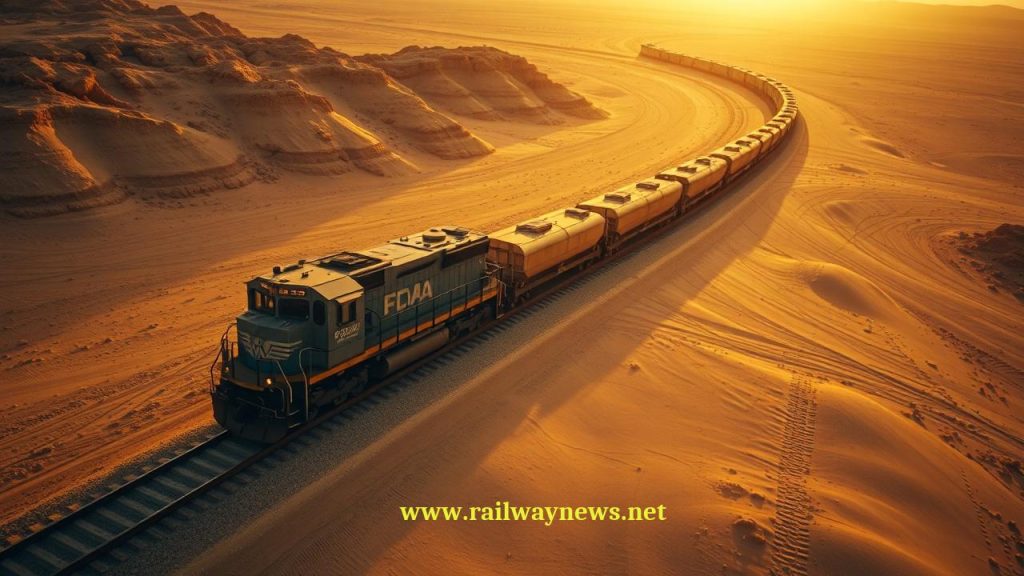
⚡ In Brief: The United Arab Emirates and Jordan have launched a joint venture to construct a $2.3 billion, 360 km railway connecting Jordanian phosphate and potash mines to the Port of Aqaba, designed to transport 16 million tons of raw materials annually.
[AMMAN, JORDAN] – The United Arab Emirates and Jordan have signed a definitive agreement to develop Jordan’s national railway network, commencing with the $2.3 billion Aqaba Port railway project. The deal establishes the UAE–Jordan Railway Company (UJRC), a joint venture tasked with constructing and operating the 360 km line. The project is the first phase of a plan to establish a detailed national rail network in Jordan.
What Is the Full Scope of This Project?
The project entails the construction of a 360 km freight railway connecting Jordan’s primary phosphate and potash mining areas with the industrial port facilities at Aqaba. The network is structured along two main corridors serving production centres in Al-Shidia and Ghor Safi, with a planned capacity to transport approximately 16 million tons of raw materials per year. The infrastructure development includes all necessary railway lines, bridges, and overpasses, managed by the newly formed UJRC, a partnership between an Abu Dhabi sovereign investment platform and several Jordanian institutional partners.
Key Project Data
| Parameter | Value |
|---|---|
| Project / Contract Name | Aqaba Port Railway Project |
| Total Value | ~$2.3 billion USD (within a ~$5.5B joint investment framework) |
| Parties Involved | UAE–Jordan Railway Company (UJRC), Jordanian Phosphate and Potash Companies, Abu Dhabi sovereign investment platform |
| Timeline / Completion | Financing finalisation by early 2027; ~5-year construction period |
| Country / Corridor | Jordan / Aqaba Port to Al-Shidia and Ghor Safi mining regions |
How Does This Compare to Similar Projects?
Direct cost-per-kilometre comparisons with other regional mineral freight lines were not publicly available at the time of publication. However, the project’s strategic scope extends beyond a national mineral line and positions it as a foundational segment of a much larger ambition: a Gulf-Europe rail corridor. This initiative seeks to modernise the historic Hejaz Railway route, creating a land-based trade alternative that connects the Gulf states through Jordan and Syria to Turkish and European markets (Source: The Jerusalem Post, 2024). This strategic vision elevates the project from a purely domestic logistics solution to a key node in a potential intercontinental transport network, a scale far greater than most national resource-hauling rail lines.
Editor’s Analysis
This UAE-funded project is a clear example of economic statecraft, using infrastructure investment to secure supply chains and build regional influence. For Jordan, it provides a critical upgrade to its export logistics, potentially doubling the output of its key mining sector while laying the groundwork for a modern national network. The project’s ultimate success as a regional connector, however, is heavily dependent on long-term political stability and alignment, particularly concerning the planned future transit route through Syria. This move aligns with a broader trend of Gulf nations investing heavily in rail to diversify their economies and create resilient trade corridors independent of traditional maritime chokepoints (Source: Business Insider, 2024).
FAQ
Q: Is this project part of a larger railway network?
A: Yes, this is the first phase of Jordan’s national railway network. The long-term vision is to connect the line north through Syria to Turkey and Europe, as well as south to Saudi Arabia and other Gulf states, creating a major regional corridor.
Q: What is the project’s timeline and total investment?
A: The investment for this initial phase is approximately $2.3 billion. Project financing is scheduled to be finalised in early 2027, with the construction work expected to take about five years to complete.
Q: What is the main economic impact of this railway for Jordan?
A: The primary goal is to double Jordan’s phosphate and potash export volumes by efficiently transporting 16 million tons annually. This will significantly reduce logistics costs for the mining industry and enhance the Port of Aqaba’s role as a regional trade hub.

Railway infrastructure, rolling stock and transport technologies specialist focused on global rail industry developments, high-speed rail systems, signaling technologies and freight transportation. Covering railway investments, public transport modernization, rail operations and international mobility projects across Europe, Asia and North America.
RELATED POSTS

October 8, 2026 1:15 pm
Alstom secured a €1bn contract to build 13 automated trains,...

October 1, 2026 7:09 am
United States regulators confirmed a September 30 deadline for the...

October 8, 2026 12:18 pm
Siemens Mobility signed an agreement with VinSpeed to supply 350...

October 4, 2026 5:14 pm
Alstom secured a CA$4.7 billion order from VIA Rail Canada...

October 5, 2026 6:12 pm
AECOM and Jacobs secured a contract in September 2026 to...

October 1, 2026 12:13 am
Illinois approved $1.5 billion annually for the Northern Illinois Transit...