
Spain Train Crash: 68 Dead After Two High-Speed Trains Collide Near Urda
Two high-speed trains collided in Spain’s Toledo province, killing at least 68. What we know about the cause, the red signal, and the investigation.
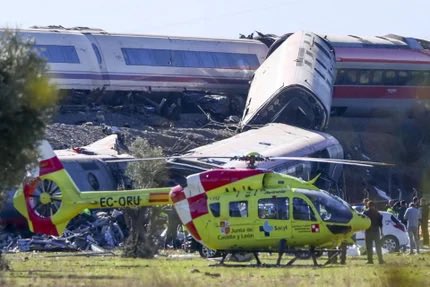
A Renfe high-speed train struck the rear of a stopped Iryo train on the Madrid–Seville line. Officials say a control-centre decision to let it proceed despite a red signal is at the centre of the investigation. It is Europe’s deadliest rail disaster since 2013.
What Happened?
Two high-speed trains collided on the morning of Wednesday, October 28, 2026, in Spain’s Toledo province, in the Castilla-La Mancha region. The crash happened on the Madrid–Andalusia (Madrid–Seville) high-speed line between Urda and Los Yébenes, around kilometre point 118. A Renfe AVE struck the rear of an Iryo train that was standing on the same track. Authorities say at least 68 people died.
Key Facts at a Glance
| Detail | Information |
|---|---|
| Date and time | October 28, 2026, around 08:50–08:54 local time |
| Location | Between Urda and Los Yébenes, Toledo, Castilla-La Mancha (PK 118) |
| Line | Madrid–Andalusia high-speed line (Madrid–Seville) |
| Trains involved | Renfe AVE 2080 and Iryo 6076, both on Madrid–Seville services |
| Passengers on board | 397 on the Renfe train, 147 on the Iryo train |
| Fatalities | At least 68 (some Spanish outlets reported 64; officials expect the toll to rise) |
| Injured | About 80, 15 of them seriously (Health Minister Mónica García) |
| Investigation | CIAF (Spain’s rail accident investigation commission) and the Guardia Civil |
How Did the Collision Unfold?
Based on statements by the transport minister and reports from several outlets, the sequence appears to be:
- The Iryo 6076 service stopped on the line on instructions from infrastructure manager Adif because of a signal fault.
- At around 08:30 local time, the LZB safety system on the line dropped out. LZB is a continuous cab-signalling system that monitors train speed and spacing.
- According to Transport Minister Óscar Puente, at about 08:36 Adif’s control centre at Atocha authorised the Renfe AVE to resume its journey, even though there was a red signal at the entrance to Urda station and a train ahead on the track. No speed restriction was imposed.
- The AVE covered roughly 25 kilometres and, 15 to 17 minutes later, hit the stationary Iryo train from behind. Several carriages of both trains derailed, and two Iryo carriages reportedly went down an embankment.
Puente called the control-centre decision “inexplicable” and described it as the origin of the accident. Government sources say a restart order was issued in breach of protocol.
What Does the Investigation Show So Far?
- The control-centre operator has been questioned. The Guardia Civil, assisting CIAF technicians, questioned the operator who was managing traffic on the Madrid–Seville line from Adif’s Atocha control centre.
- Weather has been ruled out. Meteored said weather played no role in the crash.
- The Prime Minister’s position. Speaking near the crash site, Pedro Sánchez said authorities were working to establish the cause and promised the “utmost firmness” if negligence is found. He said two such accidents in under a year are not acceptable for Spain.
- No official findings yet. CIAF’s final report could take months. What is known today comes from ministerial statements and sources close to the investigation, not from a final determination.
Analysis: Why This Crash Matters
1. The focus is on procedure, not infrastructure. The picture so far points less to the physical condition of the high-speed line than to the operating decision taken when the automatic protection system went down. When continuous train control fails, the rules for authorising a restart become critical: how a red signal, a speed restriction and the known position of the train ahead are handled together.
2. A second fatal crash on the same line. On January 18, 2026, near Adamuz in Córdoba province, the rear part of an Iryo train derailed and struck an oncoming Renfe train, killing 45 to 46 people (early reports said 41). That crash happened on a straight, recently renovated section, and early official statements said speeds were within limits. Two major accidents in nine months on the same corridor raise questions about the safety reputation of Europe’s largest high-speed network.
3. Public and private operators share one infrastructure. Both crashes involved an Iryo (private consortium) train and a Renfe (public) train. With the line open to competition, the decision quality of infrastructure manager Adif is a shared risk for every operator.
4. Historical context. The crash is reported as Europe’s deadliest rail accident since the 2013 Santiago de Compostela derailment, in which about 80 people died. That accident was linked to excessive speed. This time, attention is on operating procedure and the decision chain.
5. Lessons for the industry. Degraded-mode operations, when continuous speed supervision is unavailable, are among the most vulnerable moments in railway safety. Safeguards typically include multiple confirmations before a restart, imposed speed limits, and verification that the section ahead is clear. Which rule or practice failed here will be answered by the CIAF report.
Impact on Services and Passengers
- High-speed services on the Madrid–Andalusia line were suspended. Delays and cancellations were reported at stations such as Seville Santa Justa.
- Renfe set up an alternative shuttle service from Madrid to Ciudad Real and Puertollano. Iryo gave no timeline for restoring service.
- The US State Department confirmed that “several” American citizens were injured.
- Three days of national mourning were announced. Andalusia declared official mourning from 14:00 on October 28 until 14:00 on Saturday, October 31, and the Community of Madrid also declared three days of mourning.
- King Felipe VI expressed condolences, and messages of sympathy arrived from European and world leaders.
What Is Still Unclear
- The final death toll. Rescue work continues and officials expect the number to rise. Figures of 30, 39, 46, 64 and 68 reflect balances that changed through the day.
- The exact time of impact. Iryo put the collision at 08:48, while other reports said 08:54.
- Why the control centre allowed the restart, and how responsibility is shared. The investigation is ongoing.
- When the line will reopen. No date has been announced.
This story will be updated as new information emerges.
Frequently Asked Questions
Where and when did the Spain train crash happen?
On the morning of Wednesday, October 28, 2026, in Toledo province between Urda and Los Yébenes, on the Madrid–Seville high-speed line.
How many people died in the Spain train crash?
At least 68 people were reported dead in the first official tally. Some Spanish outlets reported 64, and officials say the toll may rise.
Which trains were involved?
Renfe’s AVE 2080 and a train operated by private company Iryo, service 6076. The Renfe train hit the stationary Iryo train from behind.
What caused the crash?
The official cause has not been announced. Transport Minister Óscar Puente says the origin was Adif’s control centre allowing the Renfe AVE to restart despite a red signal. The CIAF investigation is ongoing.
Did weather play a role?
No. Meteored said weather was not a factor.
Is this the first deadly crash on this line this year?
No. It is the second fatal crash on the Madrid–Andalusia corridor, after the Adamuz accident on January 18, 2026, which killed 45 to 46 people.
Are Madrid–Andalusia high-speed trains running?
Services on the line were suspended after the crash. Renfe has set up alternative transport on some routes.
What is Adif?
Adif is Spain’s railway infrastructure manager, responsible for track maintenance, signalling and traffic control.
Sources

Railway industry analyst and transport media specialist focused on railway infrastructure, rolling stock, signaling systems and global mobility developments. Covering high-speed rail projects, railway modernization, freight transportation and smart rail technologies across international markets.With a strong interest in transport innovation and sustainable mobility, he follows major railway investments, urban transit expansion projects and next-generation rail technologies shaping the future of transportation.His editorial approach combines industry-focused reporting with accessible technical analysis, delivering clear and reliable insights for railway professionals, transport stakeholders and rail enthusiasts worldwide.
RELATED POSTS
October 8, 2026 12:18 pm
Siemens Mobility signed an agreement with VinSpeed to supply 350...
October 7, 2026 5:15 pm
Canada confirmed a $113 billion rail cost for the Quebec...
October 9, 2026 2:16 am
Operation Lifesaver launched the 2026 rail safety week across 47...
October 9, 2026 7:13 pm
CTDOT launched a $24.8 million upgrade of New Haven Union...
October 5, 2026 12:10 pm
CPKC launched an agri-food customs facility at Puerta Mexico in...
October 7, 2026 4:13 pm
TransLink confirmed the rebuild of 21 SkyTrain elevators at 15...