
Siemens & Rheinmetall: Remote-Control High-Speed Trains with 5G & AI
Siemens and Rheinmetall launch the RemODtrAIn project, using €17M to pilot remote-controlled high-speed trains with 5G and AI, boosting rail automation.
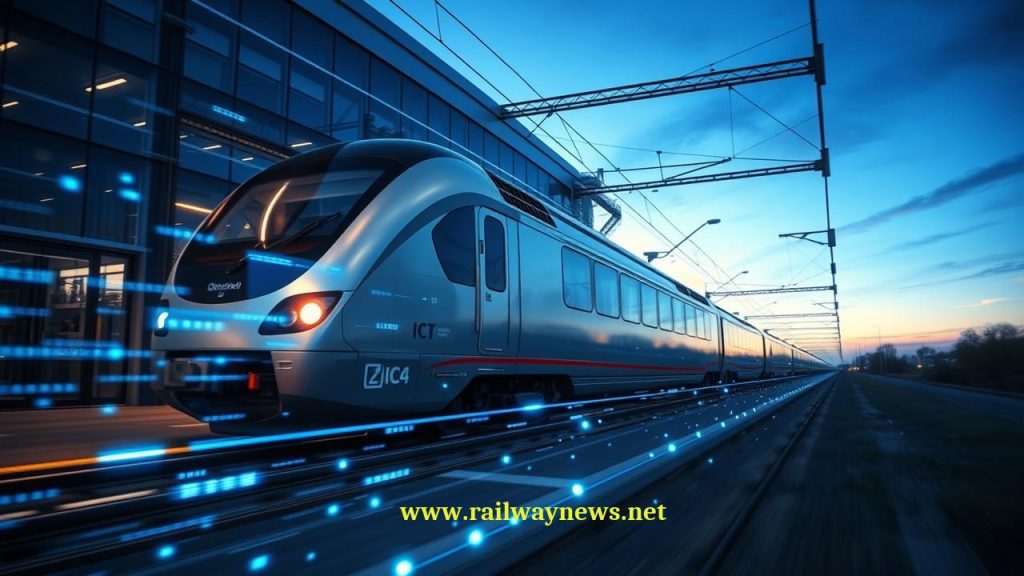
BERLIN, Germany – A consortium led by Siemens Mobility, and featuring a key contribution from defence and automotive specialist Rheinmetall, has launched a landmark €17 million project to develop remote-controlled high-speed trains. The project, named RemODtrAIn, will leverage 5G and Artificial Intelligence to pilot the remote operation of an ICE 4 train, marking a critical step towards highly automated rail networks across Europe.
| Category | Details |
|---|---|
| Project Name | RemODtrAIn (Remote operated train with AI based Obstacle Detection) |
| Total Funding | Approximately €17 million |
| Lead Consortium | Siemens Mobility |
| Key Partners | Rheinmetall (via MIRA GmbH), Deutsche Bahn, Cattron |
| Core Technologies | Secure 5G Communications, AI-based Obstacle Detection, Remote Teleoperation |
| Test Platforms | ICE 4 Train (Remote Control), Berlin S-Bahn (AI Detection) |
Main Body:
The RemODtrAIn initiative, co-funded by the European Union and the German Federal Ministry for Economic Affairs and Energy, aims to fundamentally enhance railway efficiency, resilience, and automation. The project’s central goal is to equip a Deutsche Bahn ICE 4 high-speed train with a sophisticated remote control system, enabling it to be operated from a distant control station at a maintenance depot near Cologne. This will demonstrate the viability of teleoperation for complex tasks such as depot shunting, stabling, and vehicle dispatch, which currently create significant operational bottlenecks and require on-board drivers.
At the heart of the project are two critical technologies. First, a highly secure and robust 5G communication architecture will ensure reliable, low-latency data transmission between the train and the control centre. This system is expected to leverage advanced 5G capabilities like network slicing to guarantee bandwidth for safety-critical functions, a technique already being explored for mission-critical services in other sectors. Second, an advanced AI-based obstacle detection system is being tested in real-world conditions on the Berlin S-Bahn network. Rheinmetall subsidiary MIRA is developing the core teleoperation solution, which includes a safety-designed vision system meeting the stringent ASIL-D (Automotive Safety Integrity Level D) requirements and certified vehicle interfaces developed with partner Cattron.
The RemODtrAIn project does not exist in a vacuum but represents a significant milestone in the global rail industry’s broader push towards digitalisation. This trend sees operators worldwide adopting AI and advanced connectivity to optimise everything from passenger service to infrastructure management. For instance, Israel Railways recently partnered with tech firm Exodigo to deploy an AI-powered system for mapping underground infrastructure, demonstrating a parallel use of AI to enhance asset management and operational decision-making. These initiatives collectively underscore a strategic shift towards data-driven, intelligent railway systems designed for greater efficiency and safety.
Key Takeaways
- Depot Automation: The project directly targets depot and workshop inefficiencies by enabling remote-controlled shunting and stabling, reducing the need for on-board drivers and speeding up turnaround times.
- Advanced Technology Integration: It combines secure 5G connectivity with ASIL-D compliant AI vision systems, establishing a technical and safety blueprint for remote operation in live railway environments.
- Scalable and Retrofittable Solution: MIRA’s system is designed to be modular, allowing for cost-effective retrofitting onto existing fleets as well as integration into new rolling stock, facilitating widespread adoption.
Editor’s Analysis
The RemODtrAIn project is more than a technological showcase; it is a vital stepping stone towards the future of mainline rail automation. While fully autonomous (GoA4) passenger trains on complex networks remain a long-term vision, this initiative tackles the immediate, tangible challenge of depot automation and operational resilience. By proving the safety case for remote operation in controlled environments, the consortium is building the regulatory and operational confidence needed for wider deployment. This successfully addresses pressing issues like skilled driver shortages and network capacity constraints, laying the practical groundwork for a more flexible, efficient, and ultimately automated European rail system.
Frequently Asked Questions
- What is the primary goal of the RemODtrAIn project?
- The primary goal is to develop and test a system for the secure remote operation of trains, using an ICE 4 as a demonstrator. This aims to improve efficiency in depots and lay the foundation for higher levels of railway automation.
- Which companies and organisations are involved?
- The project is led by Siemens Mobility and includes Rheinmetall (through its subsidiary MIRA), Deutsche Bahn, and Cattron, among other industry and research partners. It is funded by the EU and the German government.
- How are 5G and AI being used in the project?
- 5G is being used to create a secure, high-availability communication link between the train and the remote control centre. AI powers the obstacle detection system, which is being tested to identify and react to hazards in the train’s environment, enhancing operational safety.

Railway infrastructure, rolling stock and transport technologies specialist focused on global rail industry developments, high-speed rail systems, signaling technologies and freight transportation. Covering railway investments, public transport modernization, rail operations and international mobility projects across Europe, Asia and North America.
RELATED POSTS

October 1, 2026 7:09 am
United States regulators confirmed a September 30 deadline for the...

October 1, 2026 12:13 am
Illinois approved $1.5 billion annually for the Northern Illinois Transit...

October 4, 2026 5:14 pm
Alstom secured a CA$4.7 billion order from VIA Rail Canada...

October 1, 2026 6:10 am
Amtrak approved a System Expansion Committee on July 30 to...
October 1, 2026 3:12 am
Greenbrier confirmed Brian Comstock as new president and CEO effective...

October 6, 2026 2:14 am
Union Pacific launched export rail shipments with Ferromex to deliver...