
Reading & Northern Secures 124 CPKC Covered Hoppers for $4M
Reading & Northern Railroad signed a $4 million deal in late July to buy 124 covered hoppers from CPKC, its largest railcar purchase, serving EAF steel mills.
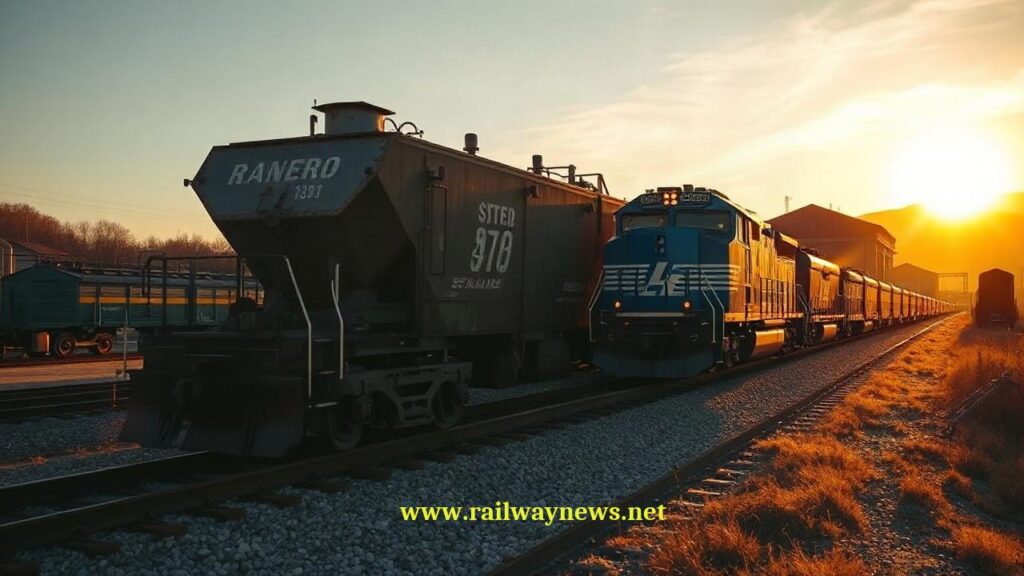
⚡ In Brief: Reading & Northern Railroad agreed in late July to buy 124 covered hopper cars from CPKC for $4 million — its largest single railcar purchase — and added 30 more hoppers as anthracite demand from EAF steel mills grows.
PENNSYLVANIA, USA – Reading & Northern Railroad (R&N) finalized the largest single railcar purchase in its history in late July, agreeing to acquire 124 covered hopper cars from CPKC for $4 million. R&N separately agreed to buy 30 additional covered hoppers from another car owner, which lifts its total railcar fleet to 2,000 units. The equipment will support R&N’s anthracite business serving electric-arc-furnace (EAF) steel mills across the United States and Canada.
What Does This Contract Cover?
The combined transaction adds 154 railcars, but the publicly disclosed $4 million price applies only to the 124-car CPKC portion.
Based on that total, the CPKC cars cost an average of $32,258 per unit ($4,000,000 ÷ 124 cars). The purchase price for the 30 additional covered hoppers was not disclosed, nor was the seller’s identity. R&N’s fleet stood at approximately 1,846 cars before the two agreements, based on the 154-car increase to the announced 2,000-car total. The railroad said the cars will enter service quickly because it expects its EAF-related anthracite business to grow by 10% this year.
Key Contract Data
The table below covers only the transaction data confirmed by R&N and CPKC at the time of the late-July announcement.
| Parameter | Value |
|---|---|
| Contract Name | Covered hopper car purchase agreement (Reading & Northern Railroad / CPKC) |
| Total Value | $4 million for 124 cars; value of 30-car transaction not disclosed |
| Parties Involved | R&N (buyer), CPKC (seller); one unidentified car owner (second seller) |
| Timeline / Completion | Agreement signed late July; “quick” service entry planned; exact schedule not disclosed |
| Country / Corridor | Pennsylvania anthracite region to EAF steel mills in the United States and Canada |
How Does This Compare to Similar Contracts?
In late July 2024, Swiss freight operator SBB Cargo International ordered 20 Siemens Vectron locomotives under an agreement with leasing company Südleasing, a fleet expansion that also included a 15-year Siemens maintenance contract (Source: Railway Technology, 2024).
R&N’s earlier record for a single railcar purchase was not disclosed, so no like-for-like comparison with the same operator is publicly available. The structure of the R&N deal also differs from the European benchmark: no leasing partner and no maintenance agreement were named, and the equipment is being transferred from CPKC’s railcar fleet rather than ordered from a manufacturer.
Regional reporting confirms that R&N recorded its highest traffic volume ever in the first half of 2026 while expanding its fleet (Source: Republican Herald, 2026). The broader investment context remains dominated by passenger rail: the high-speed rail market was projected at $57.04 billion for 2025, with conventional high-speed rail valued at $30–60 billion and maglev at $15–30 billion (Source: Market Research Future, 2025).
Editor’s Analysis
R&N is paying roughly $32,300 per car to secure dedicated equipment for a commodity whose customer base is shifting from heating use to large-scale electric-arc steelmaking; EAF processes now account for the majority of U.S. steel output, a structural shift that favors Pennsylvania anthracite as a furnace carbon additive (Source: American Iron and Steel Institute, 2025). The railcars give R&N a capacity buffer for its forecast 10% growth in EAF traffic, allowing it to capture more anthracite loads without depending on interchange-car availability. The risk is cyclical steel demand; if furnace orders slow, the hoppers can be stored or redeployed, but R&N has not disclosed any contingency plan for that scenario.
FAQ
Q: Are the 124 railcars from CPKC new or used?
A: Neither company has specified whether the cars are new or drawn from CPKC’s existing fleet, and the original build year was not disclosed. The $32,258 average unit price points to a secondary-market equipment transfer rather than a new-build order.
Q: What cargo will these covered hoppers carry?
A: The cars will haul dried Pennsylvania anthracite to electric-arc-furnace steel mills in the United States and Canada. Covered hoppers protect the moisture-sensitive product from rain and contamination between the mine and the furnace.
Q: What happens to the extra cars if the expected 10% growth in EAF business does not materialize?
A: Covered hoppers are interchangeable across many dry bulk commodities, such as cement, aggregates, or grain, so R&N could redeploy them elsewhere. No alternative-use plan for the 154 cars has been announced.

Railway infrastructure, rolling stock and transport technologies specialist focused on global rail industry developments, high-speed rail systems, signaling technologies and freight transportation. Covering railway investments, public transport modernization, rail operations and international mobility projects across Europe, Asia and North America.
RELATED POSTS

October 8, 2026 1:15 pm
Alstom secured a €1bn contract to build 13 automated trains,...

October 1, 2026 7:09 am
United States regulators confirmed a September 30 deadline for the...

October 4, 2026 5:14 pm
Alstom secured a CA$4.7 billion order from VIA Rail Canada...

October 1, 2026 12:13 am
Illinois approved $1.5 billion annually for the Northern Illinois Transit...
October 5, 2026 1:13 pm
New York MTA confirmed a late 2026 DEIS release for...
October 6, 2026 9:17 am
Illinois approved $1.1M in state funds to upgrade two McHenry...