
Port of Antwerp-Bruges Approves 7M TEU Rail Yard Expansion
The Government of Flanders approved a new 7 million TEU container terminal expansion project with a dedicated rail freight yard at the Port of Antwerp-Bruges.
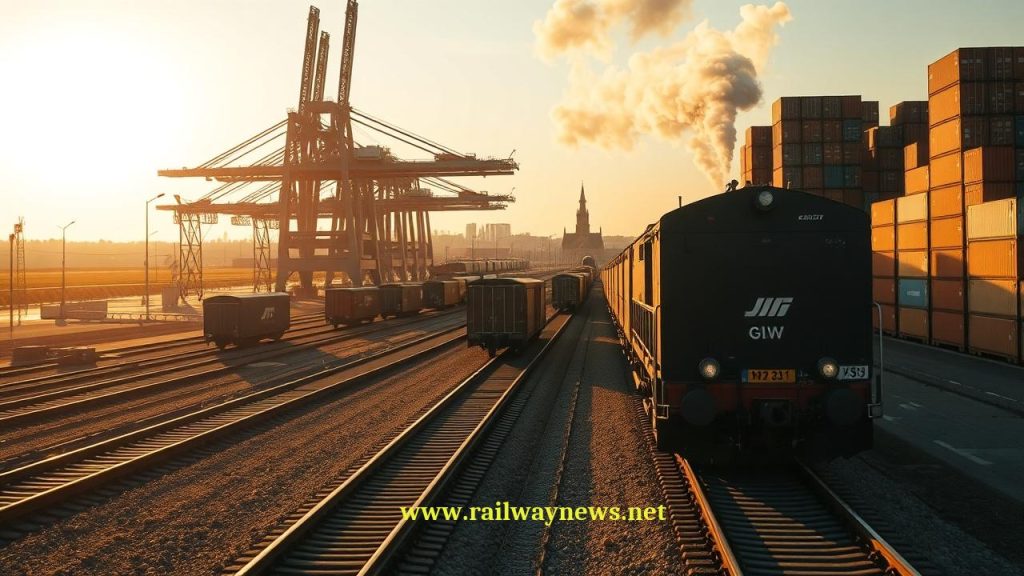
⚡ In Brief: The Government of Flanders approved a draft decision to develop the Container Cluster Linkerscheldeoever at the Port of Antwerp-Bruges, adding 7 million TEU of container handling capacity with a dedicated rail freight yard for hinterland distribution.
ANTWERP, BELGIUM – The Government of Flanders approved the draft decision for the Container Cluster Linkerscheldeoever (CCL) at the Port of Antwerp-Bruges, a capacity expansion targeting an additional 7 million TEU to meet rising international trade demand. The project, part of the Extra Container Handling Capacity Antwerp (ECA) program, will centre on a second tidal-access dock adjacent to the existing Deurganck Dock. Public consultation runs from June 12 to August 10, 2026, after which a final investment decision will follow.
What Is the Full Scope of This Project?
The CCL project encompasses a second tidal-access dock for container ships beside the Deurganck Dock, a new container terminal created by filling in the Northern Cut dock, and the Three Docks logistics area for warehousing and distribution. A new rail freight yard will handle train formation and dispatch to economic centres across Belgium and Europe, while supplementary works include relocating high-voltage power lines, developing the De Bieshoek industrial zone, and establishing two nature areas in South Doelpolder and South Prosperpolder. A buffer zone with earthen embankments and vegetation will separate port infrastructure from nearby communities to reduce noise and light pollution, and new terminals will use zero-local-emission technologies.
Key Project Data
| Parameter | Value |
|---|---|
| Project / Contract Name | Container Cluster Linkerscheldeoever (CCL) |
| Total Value | Not disclosed |
| Parties Involved | Flemish Department of Mobility and Public Works; Port of Antwerp-Bruges; Linkerscheldeoever Development Company |
| Timeline / Completion | Not disclosed (public consultation June 12–August 10, 2026; final decision pending Council of State opinion) |
| Country / Corridor | Belgium / Antwerp–Bruges hinterland connecting to major European economic centres |
How Does This Compare to Similar Projects?
The 7 million TEU addition represents approximately 50% of the Port of Antwerp-Bruges’ current annual throughput of roughly 13.5 million TEU (Source: Port of Antwerp-Bruges, 2023). By comparison, Rotterdam’s Maasvlakte 2 terminal expansion, completed in 2015, added approximately 4 million TEU of capacity across a reclaimed land area of 2,000 hectares. The CCL expansion would nearly double that capacity injection, making it one of the largest single container-infrastructure commitments in Northern Europe this decade. Belgium’s rail freight market is projected to grow steadily through 2025, driven by demand for efficient logistics and the country’s position within European transport corridors (Source: IndexBox, 2024). The explicit prioritisation of rail infrastructure within the CCL design aligns with this trajectory, aiming to shift container flows away from road haulage.
Editor’s Analysis
The CCL approval signals that Antwerp-Bruges is preparing for a structural modal shift rather than a linear capacity top-up. Embedding a dedicated rail freight yard at the terminal design stage—rather than retrofitting one later—positions the port to capture a larger share of Europe’s long-haul container flows as EU carbon-pricing mechanisms raise road-transport costs. The absence of a disclosed total investment figure and completion date, however, leaves open questions about how the port will sequence this expansion against competing projects in Rotterdam and Hamburg, both of which are also investing in rail-linked terminal capacity. A binding final decision after the mid-2026 consultation will determine whether Antwerp-Bruges can close the capacity gap before competitor ports absorb the next wave of container growth.
FAQ
Q: When will the new Container Cluster Linkerscheldeoever terminal become operational?
A: No operational start date has been announced. The draft decision triggers a public consultation from June 12 to August 10, 2026, after which the Council of State must issue an opinion before the Government of Flanders can adopt a final implementation decision.
Q: How much will the CCL project cost?
A: The total investment value was not disclosed in the draft decision or accompanying government statements. Detailed cost estimates are expected to emerge during or after the public consultation phase in mid-2026.
Q: How will the project affect road congestion and emissions around Antwerp?
A: The development strategy prioritises shifting container transport to rail and river modes. The new freight yard is designed to increase the rail modal share while routing residual road traffic away from nearby communities, and terminal equipment will use zero-local-emission technologies.

Railway infrastructure, rolling stock and transport technologies specialist focused on global rail industry developments, high-speed rail systems, signaling technologies and freight transportation. Covering railway investments, public transport modernization, rail operations and international mobility projects across Europe, Asia and North America.
RELATED POSTS

October 8, 2026 1:15 pm
Alstom secured a €1bn contract to build 13 automated trains,...

October 1, 2026 7:09 am
United States regulators confirmed a September 30 deadline for the...

October 8, 2026 12:18 pm
Siemens Mobility signed an agreement with VinSpeed to supply 350...

October 4, 2026 5:14 pm
Alstom secured a CA$4.7 billion order from VIA Rail Canada...

October 5, 2026 6:12 pm
AECOM and Jacobs secured a contract in September 2026 to...

October 1, 2026 12:13 am
Illinois approved $1.5 billion annually for the Northern Illinois Transit...