
PKP PLK Signs €706M Warsaw Station Modernisation Contract
PKP PLK signed a €706.4 million contract with Torpol to modernise Warsaw East and Warszawa Stadion stations, with works running from December 2026 to end-2029.
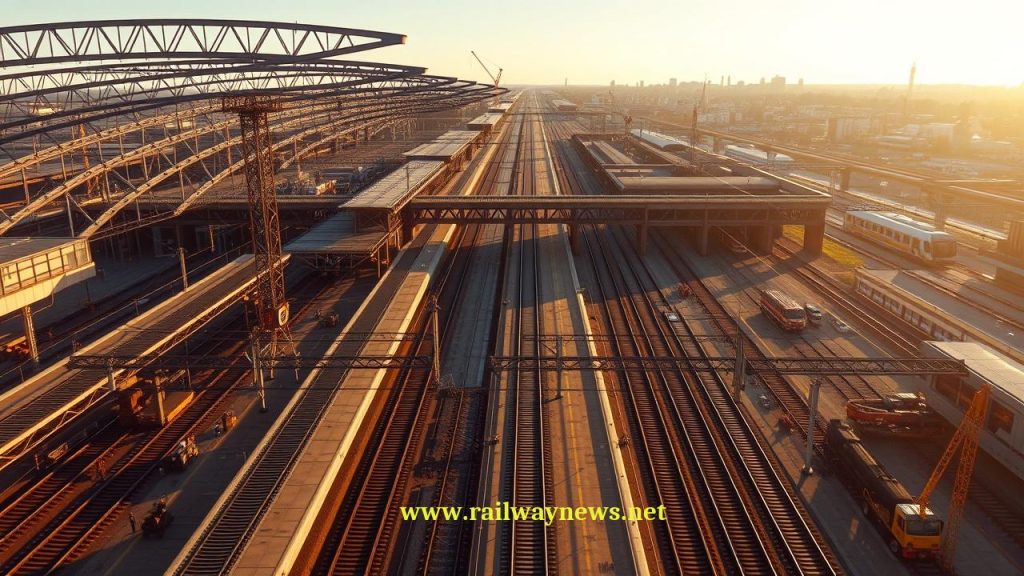
⚡ In Brief: PKP PLK signed a €706.4 million contract with Torpol to modernise Warsaw East Station and Warszawa Stadion station, with construction running December 2026 to end-2029, funded through the EU FEnIKS programme.
WARSAW, POLAND – PKP Polskie Linie Kolejowe (PKP PLK) has awarded Torpol a €706.4 million (PLN 3 billion) contract for the comprehensive modernisation of Warszawa Wschodnia (Warsaw East Station) and the adjacent Warszawa Stadion station. Works begin in December 2026 and will run through end-2029, with the tender originally carrying a €942 million (PLN 4 billion) budget ceiling when launched in August 2025.
What Is the Full Scope of This Project?
All seven platforms at Warsaw East Station will be demolished and rebuilt to standard height with full canopy coverage, while a new Local Traffic Control Centre equipped with digital train traffic management systems will be constructed on site. The project encompasses 46 km of railway track modernisation, 57 km of new overhead contact line installation, 170 new turnouts, and the reconstruction of seven railway viaducts—plus a new 1.6 km twin-track viaduct connecting to railway line no. 9 for improved flows toward Gdańsk, Olsztyn, and Legionowo.
Passenger circulation will be transformed through three rebuilt underpasses, a new pedestrian passage beneath platform 6, and a dedicated cycle path in the western tunnel. The station will receive 14 lifts and seven pairs of escalators. At Warszawa Stadion station, an additional platform will be added alongside a direct connection to the Stadion Narodowy M2 metro station, enabling sealed transfers between rail and metro. A tunnel beneath the tracks linking Kijowska and Żupnicza streets will reconnect the Praga Północ and Praga Południe districts—an element Warsaw Mayor Rafał Trzaskowski described as “long-awaited.”
Key Project Data
| Parameter | Value |
|---|---|
| Project / Contract Name | Warsaw East Station (Warszawa Wschodnia) & Warszawa Stadion Modernisation |
| Total Contract Value | €706.4 million (PLN 3 billion) — awarded below the €942 million tender budget |
| Parties Involved | PKP PLK (infrastructure manager); Torpol (contractor); coordinated with Metro Warszawskie, Tramwaje Warszawskie, PKP SA, and municipal authorities |
| Timeline / Completion | Construction: December 2026 – end-2029; two-phase execution (Phase 1: platforms 1-4 and long-distance infrastructure; Phase 2: platforms 5-7 and suburban infrastructure) |
| Country / Corridor | Poland; Warsaw railway hub — serves line no. 9 (Gdańsk/Olsztyn/Legionowo corridor) and cross-city routes |
How Does This Compare to Similar Projects?
The Warsaw East project follows the recently completed modernisation of Warszawa Zachodnia (Warsaw West Station) — Poland’s largest station rebuild to date — forming a sequential upgrade of the capital’s two principal rail gateways. Where Warszawa Zachodnia focused on decongesting east-west cross-city throughput, the Wschodnia investment addresses the northern corridor bottleneck via the new 1.6 km viaduct to line no. 9, a structural intervention absent from the Zachodnia scope. The combined effect positions Warsaw’s railway node for the planned reconstruction of the cross-city line through central Warsaw, which PKP PLK has been preparing through parallel upgrades at Warszawa Gdańska and Warszawa Centralna.
At €706 million for a multi-platform station with 46 km of track and a new traffic control centre, the Warsaw East contract sits in the upper tier of Central European station modernisation programmes but remains markedly below comparable Western European projects. Stuttgart 21, for example, carries an estimated cost exceeding €11 billion for a single through-station reconfiguration, while Vienna Hauptbahnhof was delivered at approximately €1 billion — albeit for a full new-build rather than a rebuild. The below-budget award (€706 million against a €942 million ceiling) suggests competitive bidding dynamics in Poland’s contracting market. Note: The specific signalling and traffic management system integrator for the Local Traffic Control Centre was not disclosed in the contract announcement. (Source: PKP PLK, 2026; Deutsche Bahn AG Stuttgart 21 project data; ÖBB Infrastruktur AG Vienna Hauptbahnhof data)
Editor’s Analysis
PKP PLK’s decision to award the contract 25% below the tender ceiling — €706 million versus €942 million — signals both competitive pressure among Polish rail contractors and possible scope refinements during negotiation. The two-phase delivery strategy, isolating long-distance platforms first before switching to suburban infrastructure, has become PKP PLK’s standard playbook after applying a similar staged approach at Warszawa Zachodnia; it preserves revenue service on roughly half the station’s capacity throughout construction. The broader strategic takeaway is that this contract, combined with PKP PLK’s €1.2 billion in recent six-month project signings, confirms Poland is currently the most active rail infrastructure market in Central Europe by contract volume, a position reinforced by the Poland railway signalling market’s projected growth trajectory driven by industrial Ethernet adoption, PoE-enabled traffic management, and cloud platform integration from suppliers including Siemens AG, Hirschmann, Moxa, Rockwell Automation, Cisco Systems, and Advantech. (Source: IndexBox, 2025; PKP PLK, 2026)
FAQ
Q: Will Warsaw East Station remain open during the modernisation works?
A: PKP PLK plans a two-phase construction sequence — platforms 1–4 and long-distance infrastructure will be rebuilt first while platforms 5–7 remain operational for suburban services, then the roles will reverse. Exact service reductions during each phase have not been confirmed by the operator as of publication.
Q: How does the new 1.6 km viaduct change operations at Warsaw East?
A: The twin-track viaduct creates a grade-separated connection to railway line no. 9, eliminating at-grade conflicts between trains heading toward Gdańsk, Olsztyn, and Legionowo and other traffic flows through the station throat. This removes a long-standing capacity constraint at the northern approach to the Warsaw railway hub.
Q: What happens at Warszawa Stadion station as part of this project?
A: Warszawa Stadion will receive an additional platform and a direct pedestrian link to the Stadion Narodowy metro station on line M2, enabling passengers to transfer between regional rail and the metro without exiting the paid area. This interconnection is the first of its kind on the Warsaw cross-city corridor.

Railway infrastructure, rolling stock and transport technologies specialist focused on global rail industry developments, high-speed rail systems, signaling technologies and freight transportation. Covering railway investments, public transport modernization, rail operations and international mobility projects across Europe, Asia and North America.
RELATED POSTS

October 8, 2026 1:15 pm
Alstom secured a €1bn contract to build 13 automated trains,...

October 1, 2026 7:09 am
United States regulators confirmed a September 30 deadline for the...

October 8, 2026 12:18 pm
Siemens Mobility signed an agreement with VinSpeed to supply 350...

October 4, 2026 5:14 pm
Alstom secured a CA$4.7 billion order from VIA Rail Canada...

October 5, 2026 6:12 pm
AECOM and Jacobs secured a contract in September 2026 to...

October 4, 2026 11:08 pm
Sound Transit confirmed the September 30 opening of Seattle Pinehurst...