
ÖBB Completes 27.3-Kilometre Semmering Base Tunnel Excavation
Austrian Federal Railways (ÖBB) completed 27.3-kilometre Semmering Base Tunnel excavation in Austria by late 2024, initiating the three-year technical outfitting for 2029 commissioning.
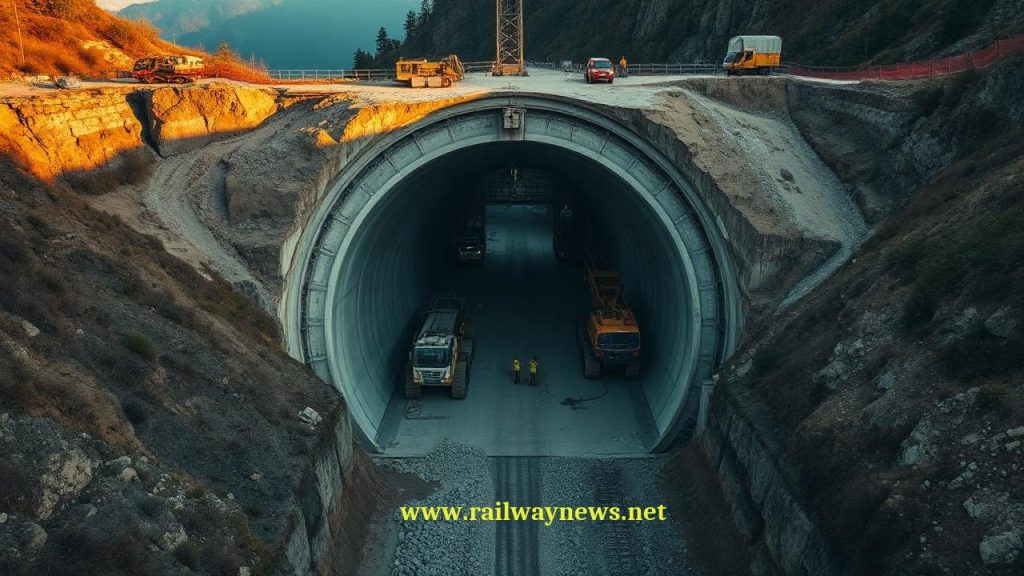
⚡ In Brief: Austrian Federal Railways (ÖBB) has completed excavation on the 27.3-kilometre Semmering Base Tunnel, transitioning to a three-year technical outfitting phase ahead of its scheduled commissioning at the end of 2029.
GLOGGNITZ, AUSTRIA – Austrian Federal Railways (ÖBB) marked a critical milestone at the end of 2024 with the final breakthrough of the 27.3-kilometre Semmering Base Tunnel, signaling the end of excavation work. Following a historic crossing of the entire Gloggnitz Tunnel by an official delegation in a private minibus, works have shifted entirely to the technical outfitting phase as of mid-2025. This major infrastructure asset, which has been under construction for nearly 15 years, is scheduled to open for commercial passenger and freight operations at the end of 2029.
What Is the Full Scope of This Project?
The Semmering Base Tunnel (SBT) project comprises a 27.3-kilometre twin-tube rail link designed to bypass the historic, mountainous Semmering Pass. The total length of all tunnel tubes, shafts, and connecting galleries is 62 kilometres, connecting Gloggnitz in Lower Austria with Mürzzuschlag in Styria. Technical outfitting, which commenced in the summer of 2025, requires more than three years to complete and involves installing track infrastructure, cabling, and safety systems. The final concrete lining works are currently being completed in the Gloggnitz area and the emergency stop shafts at Fröschnitzgraben.
Key Project Data
| Parameter | Value |
|---|---|
| Project / Contract Name | Semmering Base Tunnel (Südstrecke) |
| Total Value | Not disclosed in primary source (Estimated at €3.9 billion by external industry tracking) |
| Parties Involved | Austrian Federal Railways (ÖBB), Austrian Ministry of Mobility |
| Timeline / Completion | End of 2029 (Excavation completed end of 2024; outfitting began summer 2025) |
| Country / Corridor | Austria / Baltic-Adriatic Corridor (Southern Route) |
How Does This Compare to Similar Projects?
The Semmering Base Tunnel is one of three massive tunnel projects currently reshaping Austria’s Southern Route, alongside the Koralm Tunnel and the Brenner Base Tunnel. At 27.3 kilometres, the Semmering Base Tunnel is slightly shorter than the 32.9-kilometre Koralm Tunnel, which is scheduled to enter service in December 2025 to connect Graz and Klagenfurt (Source: ÖBB, 2024). While the Koralm Tunnel took roughly 15 years from initial main construction to commissioning, the Semmering Base Tunnel is tracking a similar 15-year timeline from its 2012 construction start to its late 2029 opening. In comparison, Europe’s premier Brenner Base Tunnel project spans 64 kilometres and is projected to cost €10.5 billion, representing more than double the scale of the Semmering project (Source: BBT SE, 2024).
Editor’s Analysis
The commissioning of the Semmering Base Tunnel in 2029 will fundamentally shift Austrian freight dynamics, unlocking modern rail paths for 1,600-tonne freight trains that currently require costly double-locomotive operations over the mountain pass. This capacity expansion aligns directly with projections indicating that the Austrian rail freight market value will grow at a compound annual rate of 2.0-3.0% over the 2026-2035 horizon (Source: IndexBox, 2025). By cutting Vienna-to-Graz transit times to 1 hour and 50 minutes, ÖBB is positioning rail as the dominant passenger corridor, effectively neutralizing regional air travel and long-distance road transit.
FAQ
Q: What is the travel time between Vienna and Graz once the Semmering Base Tunnel opens?
A: Once the tunnel opens at the end of 2029, travel times between Vienna and Graz will be reduced to approximately 1 hour and 50 minutes. This cuts the current journey time by more than 30 minutes, offering a competitive alternative to road transport.
Q: Can the public access the Gloggnitz Tunnel portals using public transit?
A: No direct public transit options connect to the Gloggnitz Tunnel construction site or its portals. Visitors or delegations must arrange private or chartered minibus transport with local operators to access the area.
Q: What specific technical work remains before the tunnel is commissioned?
A: Following the excavation breakthrough, teams are completing concrete lining in Gloggnitz and the Fröschnitzgraben emergency shafts. The primary focus through 2029 is a three-year technical outfitting phase, which includes installing tracks, power supplies, signaling, and telecommunications.

Railway infrastructure, rolling stock and transport technologies specialist focused on global rail industry developments, high-speed rail systems, signaling technologies and freight transportation. Covering railway investments, public transport modernization, rail operations and international mobility projects across Europe, Asia and North America.
RELATED POSTS

October 8, 2026 1:15 pm
Alstom secured a €1bn contract to build 13 automated trains,...

October 1, 2026 7:09 am
United States regulators confirmed a September 30 deadline for the...

October 8, 2026 12:18 pm
Siemens Mobility signed an agreement with VinSpeed to supply 350...

October 4, 2026 5:14 pm
Alstom secured a CA$4.7 billion order from VIA Rail Canada...

October 5, 2026 6:12 pm
AECOM and Jacobs secured a contract in September 2026 to...

October 1, 2026 12:13 am
Illinois approved $1.5 billion annually for the Northern Illinois Transit...