
Network Rail Completes First UK ETCS Level 2 Grinder Integration
Network Rail confirmed its RGC01 rail grinder received the UK’s first ETCS Level 2 certification for digital signalling in 2025.
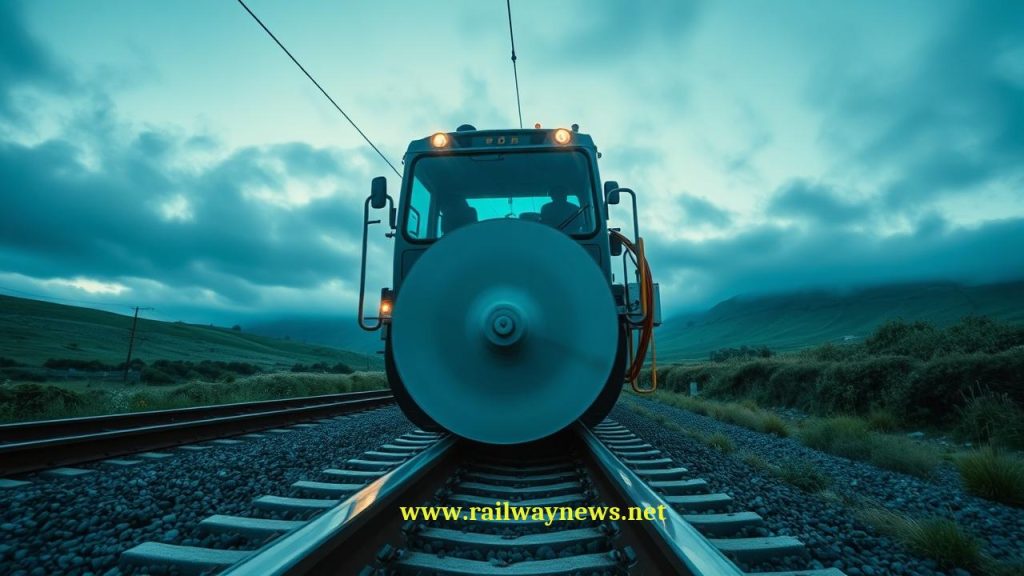
⚡ In Brief: A new US-built rail grinder, RGC01, has become the first maintenance machine in the United Kingdom to achieve ETCS Level 2 certification, a critical milestone for Network Rail’s East Coast Digital Programme to replace trackside signals.
UNITED KINGDOM – Network Rail has confirmed that its new RGC01 rail grinding machine, delivered to the UK in May 2025, has successfully completed European Train Control System (ETCS) Level 2 testing. The vehicle, equipped with 40 digitally programmable grinding stones, is the first of its kind in the UK certified for digital cab signalling. The two-year integration project was validated on test lines at Tuxford and Melton Mowbray.
What Are the Technical Specifications?
The RGC01 is a specialised maintenance vehicle designed to re-profile rail heads, equipped with an onboard ETCS Level 2 system for digital signalling. Its 40 grinding stones can be programmed to address specific infrastructure conditions, traffic speeds, or engineering requirements. The successful ETCS integration, a two-year process involving multiple companies, makes the machine fully compatible with the European Rail Traffic Management System (ERTMS) that underpins the East Coast Digital Programme.
Key Technical Data
| Parameter | Value |
|---|---|
| Technology / System Name | ETCS Level 2 Integration on RGC01 Rail Grinder |
| Total Value | Not disclosed |
| Parties Involved | Network Rail, various system design and testing collaborators |
| Timeline / Completion | Vehicle delivered May 2025; ETCS integration completed 2025 |
| Country / Corridor | United Kingdom / East Coast Main Line |
Where Does This Technology Stand in the Market?
ETCS Level 2 represents a significant advancement over legacy and lower-level digital signalling systems. Unlike ETCS Level 1, which uses intermittent trackside balises to transmit movement authority, Level 2 provides continuous communication between the train and a Radio Block Centre via the GSM-R network (with future migration to FRMCS). This enables in-cab signalling and eliminates the need for most lineside signals, allowing for higher capacity and operational flexibility. In contrast, Communications-Based Train Control (CBTC) systems, common in high-density metro environments, often use a more continuous train-to-track communication loop to create “moving block” operations for even shorter headways than ETCS L2 typically provides.
Editor’s Analysis
The certification of a maintenance vehicle is a critical, non-negotiable step toward the full commissioning of a digital railway. While passenger and freight fleet fitment receives more attention, the entire operational ecosystem, including engineering trains like the RGC01, must be ETCS-compliant before legacy signals can be decommissioned. This milestone indicates the East Coast Digital Programme is advancing beyond primary vehicle testing into full logistical integration. This focused investment in digital rail upgrades is a notable growth area, proceeding even as the wider UK construction sector reports a downturn in new project starts (Source: Glenigan, 2026).
FAQ
Q: What is the East Coast Digital Programme?
A: It is a major Network Rail project to replace conventional lineside signals with an ETCS Level 2 digital cab signalling system on the southern section of the East Coast Main Line. The programme aims to improve safety, increase capacity, and reduce delays on the route.
Q: What is the practical difference between ETCS Level 2 and traditional signals?
A: ETCS Level 2 transmits movement authority and speed information directly to a screen in the driver’s cab via a dedicated radio network. This removes the reliance on drivers visually observing and reacting to a series of fixed, coloured-light signals along the trackside.
Q: How does certifying a rail grinder impact passenger services?
A: The certification itself has no immediate impact on passenger services. However, it is an essential prerequisite for the overall programme, as all vehicles using the line, including for maintenance, must be compatible with the new system before the old one can be switched off.

Railway infrastructure, rolling stock and transport technologies specialist focused on global rail industry developments, high-speed rail systems, signaling technologies and freight transportation. Covering railway investments, public transport modernization, rail operations and international mobility projects across Europe, Asia and North America.
RELATED POSTS

October 1, 2026 7:09 am
United States regulators confirmed a September 30 deadline for the...

October 8, 2026 1:15 pm
Alstom secured a €1bn contract to build 13 automated trains,...

October 4, 2026 5:14 pm
Alstom secured a CA$4.7 billion order from VIA Rail Canada...

October 1, 2026 12:13 am
Illinois approved $1.5 billion annually for the Northern Illinois Transit...

October 6, 2026 2:14 am
Union Pacific launched export rail shipments with Ferromex to deliver...

October 1, 2026 6:10 am
Amtrak approved a System Expansion Committee on July 30 to...