
Mexico: New Passenger Rail Lines Announced, Construction in 2025
Mexico’s railway future is here! Construction starts in 2025 on the Querétaro-Irapuato and Saltillo-Nuevo Laredo passenger rail lines, revolutionizing transportation.
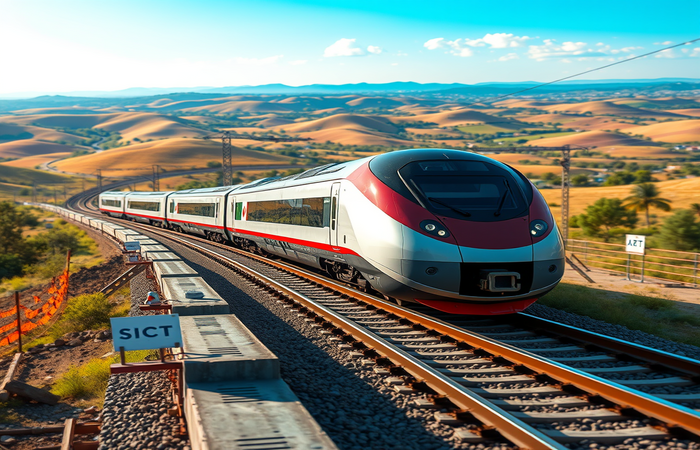
Mexico Announces Ambitious Passenger Rail Expansion with Construction Set to Commence in 2025
Mexico’s railway landscape is on the cusp of a significant transformation. The Regulatory Agency for Railway Transport (ARTF) (Agencia Reguladora del Transporte Ferroviario), under the guidance of the Secretariat of Infrastructure, Communications and Transport (SICT), has unveiled plans to initiate construction on two pivotal passenger rail lines: Querétaro–Irapuato and Saltillo–Nuevo Laredo. These projects, slated to begin in July 2025, represent a key component of Mexico’s national passenger rail development program. This article will delve into the specifics of these two rail corridors, including the construction phases, estimated passenger capacity, and the broader implications for Mexico’s transportation infrastructure, with details about the project, the phases, and the construction companies that are currently candidates to participate in the project.
## Strategic Construction Blocks for Enhanced Efficiency
The construction of these passenger rail lines will be executed through a strategic approach, dividing the projects into multiple construction blocks to facilitate efficient project management and resource allocation. The Querétaro–Irapuato route, spanning 107.8 kilometers, will be constructed in four segments:
- Apaseo El Grande–Querétaro (30.7 km) – Construction will commence here.
- Irapuato station segment (1.8 km)
- Irapuato–Cortázar (46.9 km)
- Cortázar–Apaseo El Grande (28.4 km)
This corridor is projected to serve approximately 4 million annual trips, with feasibility studies ongoing to refine this estimate.
The Saltillo–Nuevo Laredo corridor, a more extensive 393.9-kilometer route, will be built across six construction fronts:
- Unión San Javier–Arroyo El Sauz (99.9 km) – Construction will also commence here.
- Derramadero–Ramos Arizpe (54.1 km)
- Ramos Arizpe–Santa Catarina (63.25 km)
- Monterrey–Joyas Anáhuac (19.4 km)
- Joyas Anáhuac–Unión San Javier (23.8 km)
- Arroyo El Sauz–Nuevo Laredo (133.5 km)
Initial estimates indicate a potential passenger capacity of 5.5 million annually for this line. These numbers are also subject to refinement based on further assessments.
## The Tender Process and Project Execution
The SICT, under the leadership of Jesús Antonio Esteva Medina, has initiated public tenders for both rail projects. Construction companies are now invited to submit proposals for various segments of the lines. The selected contractors will receive a detailed definitive executive project. This project encompasses critical elements such as topographical surveys, geotechnical studies, and detailed technical specifications for materials, construction methodologies, and railway systems.
The construction phase will encompass a range of activities, including environmental mitigation measures, drainage systems, earthworks, and the construction of essential infrastructure components such as bridges and viaducts. Upon completion of these primary construction stages, the projects will transition into the crucial testing and commissioning phase. This phase includes rigorous static and dynamic testing, system integration, and the final delivery of all required documentation.
## Integration within the National Rail Development Program
These two rail lines are integral to a more expansive national passenger rail development program. This initiative includes the Mexico City–AIFA–Pachuca and Mexico City–Querétaro corridors, which were launched in March and April, respectively. The combined total length of the rail network developed in this first stage will reach 774 kilometers, showcasing the Mexican government’s commitment to revitalizing its rail infrastructure.
## Conclusion: Paving the Way for a Modernized Railway Network
The upcoming commencement of construction on the Querétaro–Irapuato and Saltillo–Nuevo Laredo passenger rail lines marks a pivotal moment in Mexico’s transportation history. The strategic segmentation of the projects into manageable construction blocks, the issuance of public tenders, and the emphasis on thorough executive planning demonstrate a commitment to efficiency and quality. The projected passenger capacities for these lines, coupled with their integration into a broader national rail development program, underscore the transformative potential of this initiative.
As these projects progress, they are expected to stimulate economic growth, enhance connectivity, and offer a sustainable alternative to traditional modes of transportation. The meticulous approach to construction, involving detailed testing and commissioning phases, ensures that these new rail lines will meet the highest standards of safety and operational excellence. Ultimately, these initiatives will contribute to a more modern, efficient, and interconnected railway network, offering significant benefits to the population and fostering a more sustainable future for Mexico’s transportation infrastructure. The Mexican government is betting on the growth of the railroad and its role in the Mexican population.
## Company Summary
* **Regulatory Agency for Railway Transport (ARTF):** The agency responsible for overseeing and regulating railway transport in Mexico.
* **Secretariat of Infrastructure, Communications and Transport (SICT):** The government ministry in Mexico responsible for infrastructure, communications, and transport.

Railway infrastructure, rolling stock and transport technologies specialist focused on global rail industry developments, high-speed rail systems, signaling technologies and freight transportation. Covering railway investments, public transport modernization, rail operations and international mobility projects across Europe, Asia and North America.