
HS2 2026: £102.7bn Cost, 2039 Opening & Speed Cut to 320km/h
HS2, the UK’s high-speed rail project, faces cost overruns but promises faster inter-city travel and economic benefits. Construction continues across multiple phases.

🚨 May 2026 Critical Update: The HS2 ‘Reset’
In May 2026, the UK government announced a major ‘reset’ of the HS2 project, fundamentally changing its scope:
In May 2026, the UK government announced a major ‘reset’ of the HS2 project, fundamentally changing its scope:
- Costs: The expected completion cost has risen to between £87.7 billion and £102.7 billion (in 2025 prices).
- Opening Date: The first HS2 services (Old Oak Common to Birmingham) are now expected to begin between May 2036 and October 2039, a delay of up to 13 years.
- Speed: The maximum operational speed has been reduced to 320 km/h (200 mph) from the original 360 km/h (225 mph).
- Automation: Plans for Automatic Train Operation (ATO) have been dropped entirely.
- Euston Link: Services to central London’s Euston station are not expected until 2040-2043, with the station’s scope being significantly scaled back.
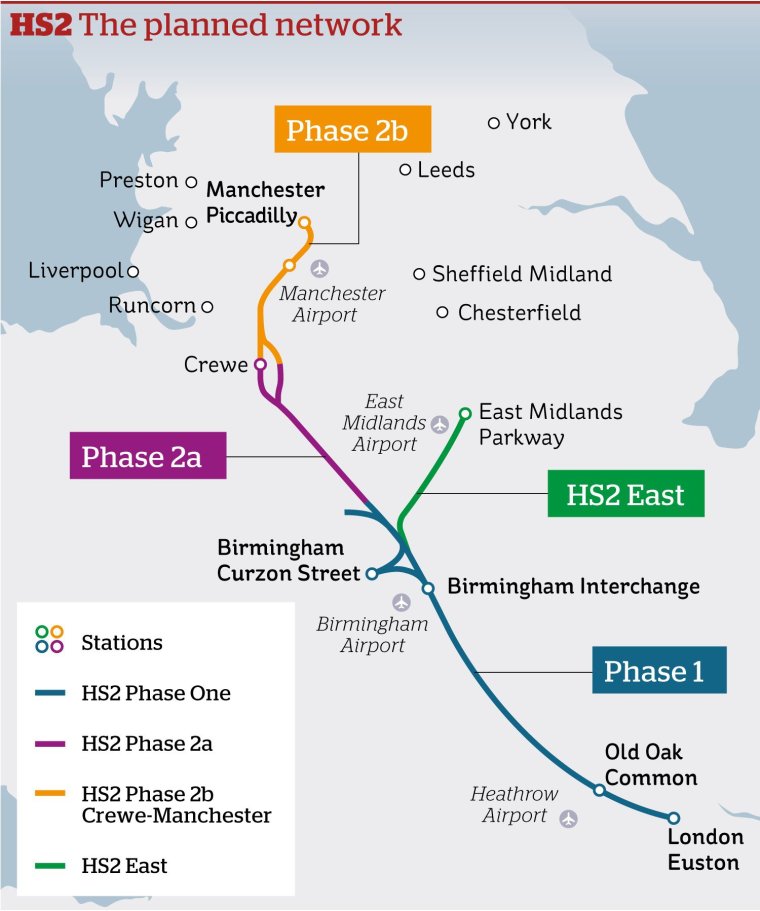
- Manchester Link: The government has not reversed the cancellation of the Phase 2 leg to Manchester.
- Eastern Leg (Leeds): The cancellation of the eastern leg to Leeds remains in place, with land on the route being sold off.
Project Profile: High Speed 2 (HS2) Railway, UK
High Speed 2 (HS2) is a multi-phase, high-speed rail infrastructure project in the United Kingdom designed to enhance national connectivity between London, the Midlands, and the North. The project involves the construction of a new dedicated high-speed line, advanced rolling stock, and integrated station hubs, representing a significant upgrade to the UK’s conventional rail network and a major undertaking in civil engineering.
| Attribute | Details (as of May 2026) |
|---|---|
| Project name | High Speed 2 (HS2) |
| Location | United Kingdom (London, Midlands, North of England) |
| Length (planned network) | Approximately 330 miles (531 km) |
| Max Operational Speed | 320 km/h (200 mph) (reduced from 360 km/h in May 2026) |
| Estimated Completion Cost | £87.7 billion – £102.7 billion (in 2025 prices) |
| Spent to date (as of March 2026) | £44.2 billion |
| Status (as of May 2026) | Phase 1 (London-West Midlands) & Phase 2a (West Midlands-Crewe): Under Construction. Northern legs (to Manchester & Leeds) are cancelled and will not be reinstated. |
| Expected Opening (First Services) | Old Oak Common (London) to Birmingham Curzon Street: Between May 2036 and October 2039 |
| Euston Extension Opening | Not expected until 2040-2043 |
| Key Contractors | Managed by HS2 Ltd. Major joint ventures: Costain/Skanska/STRABAG (SCS), Balfour Beatty/VINCI (BBV), Eiffage/Kier/Ferrovial/BAM Nuttall (EKFB). |
Technical Specifications
The HS2 project is defined by its advanced engineering and technological systems. The route is a ‘Y’ shaped network, with Phase 1 forming the trunk from London Euston to Birmingham Curzon Street. The infrastructure is designed to accommodate high-speed trains with a capacity of over 1,100 passengers per unit, operating at speeds up to 225 mph (362 km/h). A significant portion of the route involves complex civil engineering, including over 30 miles of tunnels on Phase 1 alone, such as the Chiltern and London Tunnels, to mitigate environmental and noise impact. The project will utilize state-of-the-art digital signalling systems (ETCS Level 2) for safe and efficient high-frequency operation, integrating seamlessly with the existing network at key interchanges.
Key Takeaways
- Capacity and Economic Rebalancing: HS2 is engineered to solve critical capacity constraints on the UK’s Victorian-era rail network, freeing up pathways for more local, regional, and freight services. By improving connectivity, it aims to stimulate economic growth and investment in the Midlands and Northern England.
- Technological Advancement: The project represents a significant technological upgrade for UK rail, introducing 225 mph (362 km/h) capable rolling stock and advanced digital signalling systems, setting a new standard for national infrastructure.
- Enhanced National Connectivity: HS2 aims to fundamentally reduce inter-city journey times between London, Birmingham, and Manchester, strengthening economic and social ties between the UK’s largest economic centres.
You can interested with our Why HS2 Failed — And What Europe Should Learn article.
❓ Frequently Asked Questions (FAQ) About HS2
What is the latest cost of HS2?
In May 2026, the government announced that the expected completion cost for HS2 is now between £87.7 billion and £102.7 billion (in 2025 prices), a significant increase from previous estimates.
When will HS2 open?
The first services, running between Old Oak Common in west London and Birmingham Curzon Street, are now expected to begin between May 2036 and October 2039. The extension into central London’s Euston station is not expected until 2040-2043.
Will HS2 go to Manchester?
No. The previous government’s decision to cancel the Phase 2 leg to Manchester has not been reversed. While a new rail line between Birmingham and Manchester is proposed, it will not be a reinstatement of HS2.
Will HS2 go to Leeds?
No. The eastern leg to Leeds was cancelled in 2021. This decision remains in place, and land on the former route is being sold off.
How fast will HS2 trains go?
Following the May 2026 reset, the maximum operational speed has been reduced to 320 km/h (200 mph) to save costs and align with European high-speed standards.

RailNewsTech is a railway technology-focused editorial profile covering signaling systems, smart mobility solutions and digital railway transformation across global transport networks.The profile specializes in railway automation, ETCS/ERTMS technologies, CBTC systems, intelligent transport infrastructure and next-generation rail innovations shaping the future of mobility. Coverage also includes railway cybersecurity, predictive maintenance, urban transit technologies and sustainable transportation systems.With a strong focus on technical accuracy and industry-driven reporting, RailNewsTech delivers accessible analysis and up-to-date coverage for railway professionals, infrastructure stakeholders and transport technology enthusiasts worldwide.
RELATED POSTS
October 1, 2026 10:14 am
HS2 installed a 55-metre steel span in Birmingham, completing phase...

October 1, 2026 8:12 am
Knorr-Bremse expanded its UK rail adhesion trial on Chiltern Railways...

October 9, 2026 10:15 am
Costain secured a £700 million contract from Transport for London...

October 7, 2026 8:12 pm
$65.33 billion marks the global digital rail market size by...
October 5, 2026 2:13 am
Britain confirmed a £1.75 billion rail link in Birmingham to...

October 1, 2026 9:10 am
Transpennine Route Upgrade launched a £270,000 fund on 28 September,...