
HS2 Confirms Birmingham Bridge Demolitions June Weekends
HS2 confirms two Birmingham bridge demolitions over two June weekends, disrupting three UK rail routes for its high-speed line.
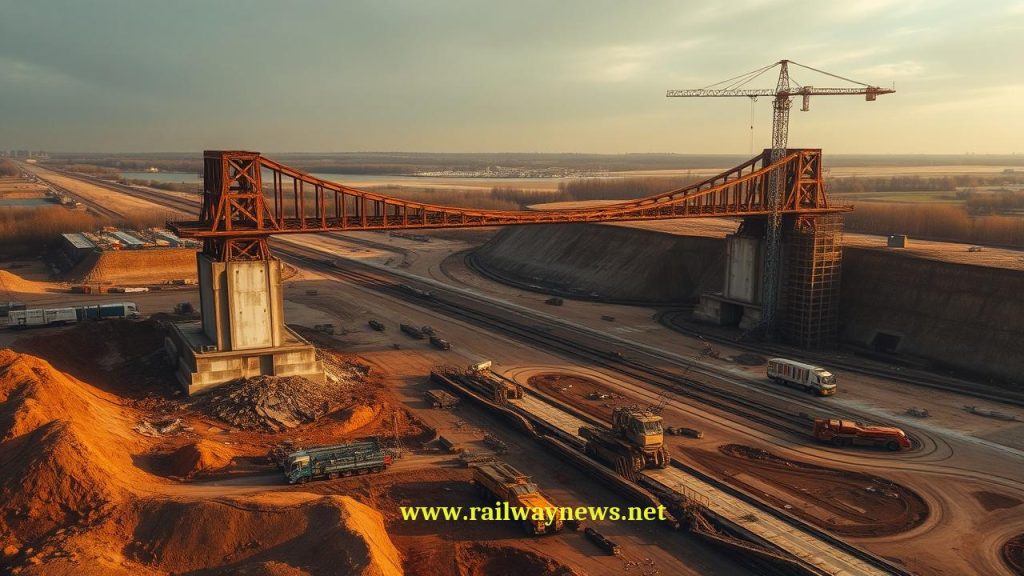
⚡ In Brief: HS2 engineers, supported by Network Rail, will demolish two structures near Birmingham over two weekends in June, disrupting three major UK rail routes as a necessary step for the delayed and over-budget high-speed line.
BIRMINGHAM, UK – Network Rail is facilitating the demolition of the Saltley Viaduct and Aston Church Road bridge over two weekends, June 6-7 and 13-14, to enable construction of the High Speed 2 (HS2) railway. The work will disrupt three key passenger routes originating from Birmingham New Street, requiring rail replacement bus services.
What Is the Full Scope of This Project?
The work involves the complete demolition of two structures spanning the existing railway between Birmingham and Derby to create the necessary clearance for the new HS2 line. While this is a localised engineering task, it is an integral part of the much larger HS2 Phase 1 project, which continues to face significant challenges. The latest official updates project the completion of the line between Old Oak Common and Birmingham Curzon Street between 2036 and 2039, with total costs estimated to be between £87.7bn and £102.7bn. (Source: Construction News, 2026).
Key Project Data
| Parameter | Value |
|---|---|
| Project / Contract Name | Saltley Viaduct & Aston Church Road Bridge Demolition (HS2 Enabling Works) |
| Total Value | Not disclosed |
| Parties Involved | HS2, Network Rail, CrossCountry |
| Timeline / Completion | June 6-7 & 13-14 |
| Country / Corridor | UK / Birmingham – Derby |
How Does This Compare to Similar Projects?
The planned disruption from the HS2 works provides a contrast to recent unplanned service shutdowns on other major networks. The two-weekend closure in Birmingham is a controlled engineering possession. By comparison, an unscheduled five-day strike on North America’s largest commuter system, the Long Island Rail Road, recently affected approximately 250,000 daily commuters before a deal was reached to end the action. (Source: NBC New York, 2026). While the HS2 work impacts fewer passengers over a shorter duration, it highlights how both planned capital projects and labour disputes can cause significant network interruptions.
Editor’s Analysis
This localised demolition work is a microcosm of the wider challenge facing UK rail infrastructure: balancing essential, forward-looking upgrades with immediate operational reliability. The disruption, while necessary for HS2’s eventual operation, adds to the project’s complex public and political profile. The execution of such enabling works is critical, especially as global trends show a divergence in high-speed rail strategy, with Germany focusing on enhancing international routes while jurisdictions like California explore complementary transport modes like high-speed buses to mitigate project delays. (Source: Tourism Review, 2025).
FAQ
Q: Which specific train services are affected by the demolition work?
A: Services on three main corridors are impacted: Birmingham New Street to Leicester and Stansted Airport; Cardiff Central to Nottingham via Birmingham; and long-distance services from Scotland and the North East to the South West. Rail replacement buses will operate between Birmingham New Street and Coleshill Parkway.
Q: What is the overall status of the HS2 project these demolitions are for?
A: This work is part of HS2 Phase 1. The latest official government update estimates project completion for the London to Birmingham section between May 2036 and October 2039, with total costs projected at £87.7bn to £102.7bn in 2025 prices. (Source: Construction News, 2026).
Q: How long will the passenger disruption last?
A: The disruption to train services and the use of rail replacement buses will occur across two full weekends: Saturday, June 6 to Sunday, June 7, and Saturday, June 13 to Sunday, June 14.

Railway infrastructure, rolling stock and transport technologies specialist focused on global rail industry developments, high-speed rail systems, signaling technologies and freight transportation. Covering railway investments, public transport modernization, rail operations and international mobility projects across Europe, Asia and North America.
RELATED POSTS

October 8, 2026 12:18 pm
Siemens Mobility signed an agreement with VinSpeed to supply 350...

October 5, 2026 6:12 pm
AECOM and Jacobs secured a contract in September 2026 to...

October 4, 2026 11:08 pm
Sound Transit confirmed the September 30 opening of Seattle Pinehurst...

October 5, 2026 1:13 pm
New York MTA confirmed a late 2026 DEIS release for...

October 6, 2026 9:17 am
Illinois approved $1.1M in state funds to upgrade two McHenry...
October 6, 2026 5:12 pm
Cleveland RTA confirmed the deferral of planned bus and rail...