
HS2 Completes 880m Cut-and-Cover Green Tunnel in London
HS2 Ltd completed the 880-metre Copthall green tunnel in London using cut and cover, reusing 1.2 million m3 of spoil to eliminate 100,000 truck trips.
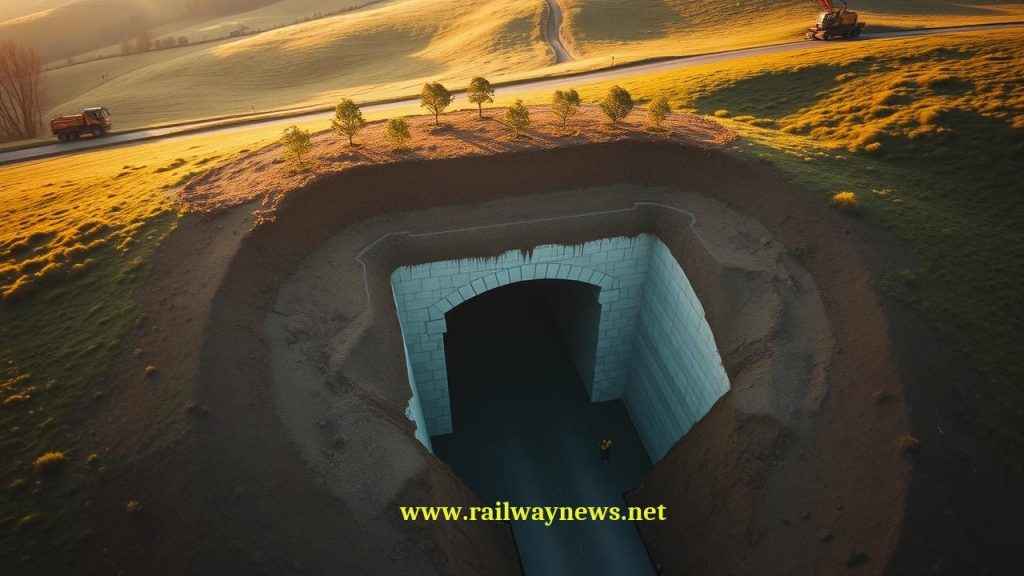
⚡ In Brief: HS2 Ltd completed the 880-metre Copthall green tunnel near West Ruislip, London, using a cut-and-cover method that reused 1.2 million cubic metres of spoil from an adjacent tunnel project, eliminating approximately 100,000 truck trips.
LONDON – HS2 Ltd has structurally completed the Copthall Tunnel, an 880-metre green tunnel on the western outskirts of London, the first of five such cut-and-cover tunnels on the London–West Midlands high-speed route to be fully backfilled. The single-tube tunnel reused all 1.2 million m³ of excavated material from the nearby Northolt twin-tube tunnel project, avoiding roughly 100,000 lorry movements. No separate contract value for the Copthall Tunnel was disclosed.
What Is the Full Scope of This Project?
The Copthall Tunnel is the only single-tube structure on the 225-km HS2 corridor, positioned between the Northolt Tunnel and the completed Colne Valley Viaduct — the UK’s longest railway bridge. Designed to withstand forces from trains at 200 mph (320 km/h), the tunnel is over 800 metres long, approximately 12 metres high, and up to 16 metres wide inside, fitted with five natural ventilation shafts. The SCS consortium — Skanska, Costain, and Strabag — delivered the civil engineering works as part of the southern section of HS2.
Key Project Data
| Parameter | Value |
|---|---|
| Project / Contract Name | Copthall Tunnel (HS2 green tunnel) |
| Total Value | Not disclosed |
| Parties Involved | HS2 Ltd; SCS consortium (Skanska, Costain, Strabag) |
| Timeline / Completion | Structural completion announced; landscaping over the next two years; HS2 corridor operational target not stated for this segment |
| Country / Corridor | United Kingdom, London–West Midlands HS2 corridor |
How Does This Compare to Similar Projects?
In 2023, Poland’s Budimex secured a €34 million contract to prepare for the drilling of a 4-km high-speed rail tunnel in Łódź, as part of the Warsaw–Łódź high-speed line. Unlike the cut-and-cover Copthall Tunnel, the Łódź tunnel will be bored, a method typically associated with greater cost and longer construction timelines. While the Copthall costs remain undisclosed, Budimex’s deal covers preparatory works only and gives a benchmark for a bored tunnel roughly 4.5 times longer. Poland’s CPK delivery body aims to develop 2,000 km of high-speed rail, and 19 firms bid for the Warsaw–Łódź line contracts, signalling comparable European competition for HS2’s contractor pool. (Source: Global Construction Review, 2023)
Editor’s Analysis
Copthall’s completion is a small but telling marker of HS2’s attempt to align on-site engineering with Whitehall’s cost-cutting mandate. The Department for Transport estimates that design simplification across the programme could yield up to £2.5 billion in savings and shave about one year off construction, and the full reuse of spoil — which eliminated 100,000 truck trips — directly supports that goal. However, Poland’s accelerating high-speed rail procurement may pull specialist resources away from UK projects, tightening the market for the remaining four green tunnels and future HS2 phases. (Source: Department for Transport, as reported by HS2 Ltd; Global Construction Review, 2023)
FAQ
Q: How long is the Copthall Tunnel and what speed is it built for?
A: The tunnel is 880 metres long and engineered to handle trains travelling at up to 200 mph (320 km/h). It is the only single-tube tunnel on the HS2 route.
Q: Will the tunnel be visible after the project is finished?
A: No. Over the next two years, the surface will be planted with trees, shrubs, and vegetation to integrate the structure into the natural landscape and reduce visual impact.
Q: What was saved by using cut-and-cover instead of the original open-cut method?
A: The cut-and-cover approach allowed all 1.2 million cubic metres of excavated material from the Northolt Tunnel to be reused on site, eliminating approximately 100,000 truck trips that would have been needed for off-site disposal.

Railway infrastructure, rolling stock and transport technologies specialist focused on global rail industry developments, high-speed rail systems, signaling technologies and freight transportation. Covering railway investments, public transport modernization, rail operations and international mobility projects across Europe, Asia and North America.
RELATED POSTS

October 8, 2026 1:15 pm
Alstom secured a €1bn contract to build 13 automated trains,...

October 1, 2026 7:09 am
United States regulators confirmed a September 30 deadline for the...

October 8, 2026 12:18 pm
Siemens Mobility signed an agreement with VinSpeed to supply 350...

October 4, 2026 5:14 pm
Alstom secured a CA$4.7 billion order from VIA Rail Canada...

October 1, 2026 12:13 am
Illinois approved $1.5 billion annually for the Northern Illinois Transit...

October 5, 2026 6:12 pm
AECOM and Jacobs secured a contract in September 2026 to...