
Future of Grand Paris Express Line 18: Rail Innovation Guide
Grand Paris Express Line 18’s first metro train unveiled, marking testing phase start. New automated line aims to improve Île-de-France transport.
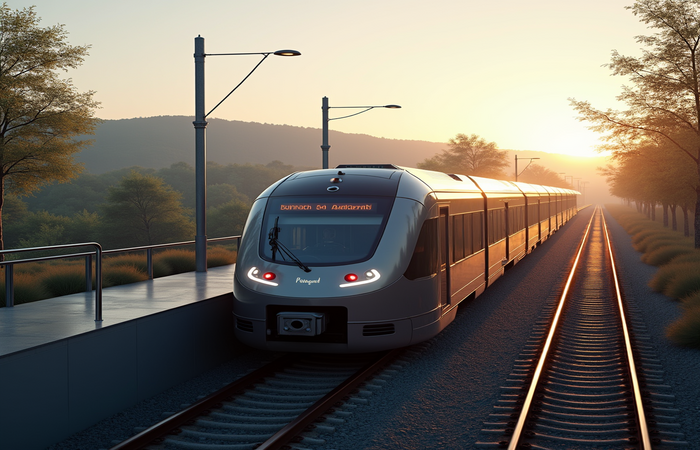
Grand Paris Express Line 18 Unveils First Metro Train, Ushering in Testing Phase
The future of Parisian public transport took a significant step forward on June 17, 2025, as the first metro train for Line 18 of the Grand Paris Express was officially unveiled at the Palaiseau operations centre. This milestone, announced jointly by Société des grands projets, Île-de-France Mobilités, and Alstom, marks the commencement of rigorous testing on the new automated line. The delivery of this inaugural trainset, which arrived in May, signifies the beginning of dynamic testing ahead of the planned launch of the initial section between Massy – Palaiseau and Christ de Saclay in late 2026. This article explores the key aspects of this project, exploring its innovative features, technical advancements, and the significant impact it will have on the Île-de-France region’s transportation landscape.
Rolling Stock and Testing Regimen
Île-de-France Mobilités has invested €199 million in a fleet of 15 trainsets for Line 18. These trains are being delivered to the Palaiseau site in phases, supporting the operational rollout in two distinct segments. Ten units will service the first segment, spanning from Massy – Palaiseau to Christ de Saclay, while five additional trains are designated to support the southern extension to Orly Airport, slated to open by the end of 2027. The testing program is multi-faceted. Initial “static” tests, involving track energization and onboard system verification, began in June. These trials are centrally coordinated from the newly completed central control centre in Palaiseau, where Alstom has installed advanced line supervision systems. Alstom will continue to oversee the testing phase until operational responsibility is transferred to Keolis, the operator selected by Île-de-France Mobilités. By the end of 2025, ten trainsets will be deployed for dynamic testing across the full 8.5 km stretch of completed track. Dynamic tests will meticulously assess the interaction between the train and the infrastructure, including platform edge doors, communication systems, and signalling systems.
Design and Engineering Excellence
The rolling stock for Line 18 represents a culmination of design and engineering expertise tailored specifically for an automated metro system. Each three-car train is 47 metres long, 2.5 metres wide, and can accommodate up to 350 passengers. Designed and built by Alstom at its Valenciennes facility, with support from five other French sites, these trains prioritize passenger comfort, accessibility, and the integration of cutting-edge technology. Interior features include: air conditioning, real-time passenger information systems, and dedicated areas for people with reduced mobility. Exterior design, selected through a public consultation by Île-de-France Mobilités in late 2021, incorporates a panoramic windscreen framed by a distinctive luminous “diamond” signature. This aesthetic choice enhances visibility and contributes to the overall onboard space and passenger experience.
Route Overview and Connectivity
Upon completion, Line 18 will stretch across 33 kilometres, encompassing ten new stations, three of which will be elevated. The line is designed to link key destinations across the Île-de-France region, including Antony, Massy, the Saclay plateau, Saint-Quentin-en-Yvelines, and Versailles. It will establish strong multimodal connections with a range of existing services, improving travel options. Crucially, Line 18 is intended to serve the rising transportation demands of local residents, students, and workers across significant academic and research hubs.
Operational Efficiencies and Environmental Performance
Line 18 is designed to operate as a fully automated and electric metro system, promising high-frequency service, with a train every 90 seconds during peak hours. The trains will achieve an average operating speed of 65 km/h, with the capability to reach 100 km/h. Environmental considerations are central to the project’s design. The system will incorporate regenerative braking to reduce power consumption. A unique feature within the Île-de-France network is the use of a ground-level third rail with reverse collection to power the trains at 1,500 V, eliminating the need for overhead lines and preserving the visual integrity of the landscape, particularly along elevated sections.
Conclusion
The unveiling of the first train for Line 18 signifies a critical juncture in the Grand Paris Express project, representing the culmination of years of planning, design, and engineering. The commencement of the testing phase highlights the commitment to delivering a state-of-the-art automated metro system poised to transform the transport landscape in the Île-de-France region. The project’s focus on advanced technology, passenger comfort, and environmental sustainability sets a high standard for future urban rail projects. The successful integration of these technologies, along with the meticulous testing regimen, will be key to ensuring the reliability and efficiency of the line when it begins passenger service. The impact of Line 18 will extend beyond transportation, fostering connectivity and supporting economic growth within the region. Looking ahead, the Grand Paris Express program, with Line 18 as a flagship project, serves as a model for other urban areas looking to modernize their public transit systems and improve the quality of life for their citizens. The scheduled opening of the initial section in late 2026 and the subsequent expansion to Orly Airport by the end of 2027 indicate a phased approach that allows for careful monitoring, adjustment, and seamless integration of each segment.

Railway infrastructure, rolling stock and transport technologies specialist focused on global rail industry developments, high-speed rail systems, signaling technologies and freight transportation. Covering railway investments, public transport modernization, rail operations and international mobility projects across Europe, Asia and North America.
RELATED POSTS

October 8, 2026 1:15 pm
Alstom secured a €1bn contract to build 13 automated trains,...

October 1, 2026 7:09 am
United States regulators confirmed a September 30 deadline for the...

October 4, 2026 5:14 pm
Alstom secured a CA$4.7 billion order from VIA Rail Canada...

October 1, 2026 12:13 am
Illinois approved $1.5 billion annually for the Northern Illinois Transit...

October 5, 2026 1:13 pm
New York MTA confirmed a late 2026 DEIS release for...

October 6, 2026 9:17 am
Illinois approved $1.1M in state funds to upgrade two McHenry...