
FS Italiane Group Confirms 1,300 Construction Sites by 2026
FS Italiane Group confirmed 1,300 active railway construction sites nationwide by 2026 under the NRRP and a 7% punctuality increase in early June 2026 vs 2025.
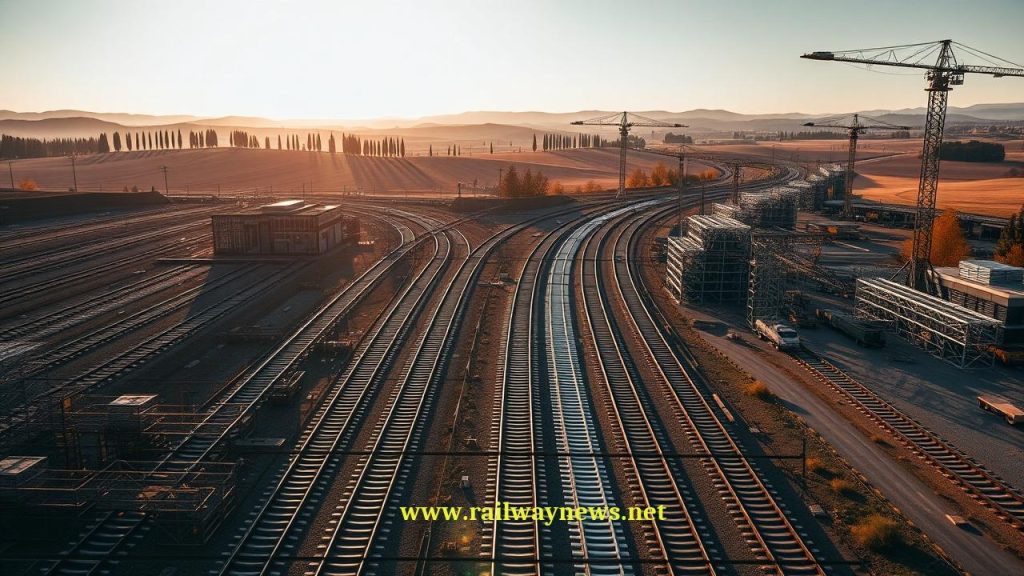
⚡ In Brief: FS Italiane Group and Italy’s Ministry of Infrastructure confirmed approximately 1,300 active railway construction sites nationwide by 2026 under the NRRP, with 60 backup buses deployed and rail punctuality up over 7% in early June 2026 versus the prior year.
ROME, Italy – Deputy Prime Minister and Minister of Infrastructure Matteo Salvini met with FS Italiane Group CEO Stefano Antonio Donnarumma in June 2026 to review the status of Italy’s largest railway infrastructure investment program in recent history. The meeting confirmed that approximately 1,300 construction sites will be active across the national network by 2026, with authorities stating all NRRP objectives and milestones remain on track. Rail punctuality in the first 15 days of June 2026 rose by more than 7% compared to the same period in 2025.
What Is the Full Scope of This Project?
The Italian national railway modernization program under the NRRP encompasses network-wide infrastructure expansion and upgrades managed by FS Italiane Group’s operating companies—Rete Ferroviaria Italiana (RFI), Trenitalia, and ANAS. The 2026 Summer Plan introduces specific operational measures to mitigate construction-related disruption: additional customer service teams deployed at major stations, approximately 60 backup buses on standby for service continuity, and continuous rail traffic monitoring via dedicated operational centers. FS officials stated that the central challenge is executing modernization without significantly degrading passenger experience or train service reliability.
Key Project Data
| Parameter | Value |
|---|---|
| Project / Contract Name | Italian National Railway Modernization Program (NRRP Rail Component) |
| Total Value | Not disclosed at the meeting |
| Parties Involved | Ministry of Infrastructure and Transport, FS Italiane Group, RFI, Trenitalia, ANAS |
| Timeline / Completion | 2026 (NRRP milestone deadline); 1,300 active construction sites by 2026 |
| Country / Corridor | Italy, entire national railway network |
How Does This Compare to Similar Projects?
Italy’s 1,300-site nationwide railway program is one of Europe’s most distributed infrastructure undertakings. By comparison, the $16 billion Hudson Tunnel project in the United States—awarded in 2024–2025—concentrates investment on a single corridor linking New York and New Jersey (Source: Construction Dive, 2025). California’s high-speed rail program, which secured a $3.5 billion contract for a single segment in the same period, has shifted toward private co-development models; by June 2026 a global consortium agreement was in place to deliver the project “faster, smarter, and more economically” (Source: Newsweek, 2026). Italy’s approach differs in two respects: it distributes work across the entire national network simultaneously, and it prioritizes maintaining existing service levels during construction—a challenge the Hudson and California projects address through phased corridor shutdowns rather than parallel operations. Indian Railways’ Rs 2.7 billion Kavach collision avoidance system deployment in Odisha reflects a comparable demand surge for rail infrastructure globally, though at a smaller scale and focused on safety technology rather than network-wide civil works (Source: Construction World, 2025).
Editor’s Analysis
Italy’s strategy of running 1,300 concurrent construction sites while committing to measurable service-quality metrics—such as the 7% punctuality improvement—signals an operational philosophy that treats passenger experience as a contractual deliverable, not an afterthought. This aligns with a broader trend visible in California’s high-speed rail evolution toward private consortium involvement, where financial sustainability and commercial viability have become non-negotiable project parameters. The NRRP’s climate adaptation components also place Italy’s rail program within a wider European pattern: the UK’s Department for Environment, Food & Rural Affairs published a 25-year Farming Roadmap in June 2026 with parallel resilience objectives, using nature-based solutions against extreme weather (Source: Defra, 2026). Israel’s State Comptroller, by contrast, found in June 2026 that many government ministries lacked practical climate-preparedness plans entirely—underscoring that Italy’s integration of resilience into infrastructure programming is not yet a global standard.
FAQ
Q: How many construction sites will be active on Italy’s rail network?
A: FS Italiane Group confirmed approximately 1,300 construction sites will be active across the entire national network by 2026, representing one of the most intensive investment periods in the operator’s recent history.
Q: What measures are in place to protect passengers from disruption during the works?
A: The 2026 Summer Plan—jointly developed by RFI, Trenitalia, and ANAS—includes additional customer service teams at major stations, roughly 60 backup buses, and continuous rail traffic monitoring from dedicated operational centers.
Q: Has the total investment value of these railway works been disclosed?
A: The total investment figure specific to the rail component was not publicly disclosed during the June 2026 meeting between Minister Salvini and FS CEO Donnarumma. The broader NRRP encompasses multiple funding streams, and a disaggregated railway-only figure has not been officially confirmed at the time of publication.

Railway infrastructure, rolling stock and transport technologies specialist focused on global rail industry developments, high-speed rail systems, signaling technologies and freight transportation. Covering railway investments, public transport modernization, rail operations and international mobility projects across Europe, Asia and North America.
RELATED POSTS

October 8, 2026 1:15 pm
Alstom secured a €1bn contract to build 13 automated trains,...

October 1, 2026 7:09 am
United States regulators confirmed a September 30 deadline for the...

October 4, 2026 5:14 pm
Alstom secured a CA$4.7 billion order from VIA Rail Canada...

October 1, 2026 12:13 am
Illinois approved $1.5 billion annually for the Northern Illinois Transit...
October 6, 2026 2:14 am
Union Pacific launched export rail shipments with Ferromex to deliver...

October 1, 2026 6:10 am
Amtrak approved a System Expansion Committee on July 30 to...