
Beijing-Shanghai High-Speed Rail Project: China’s Technological Marvel
Beijing-Shanghai high-speed rail: 1,318km at up to 350km/h. A $33bn marvel of engineering that cut travel time from 10 hours to under 5. Was this the world’s most ambitious railway infrastructure project?
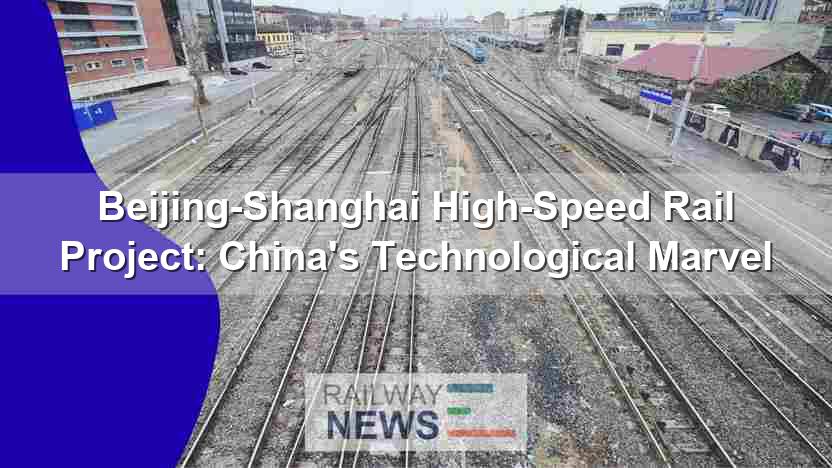
This article explores the engineering and technological advancements behind the Beijing-Shanghai High-Speed Railway (HSR), a landmark project in China’s infrastructure development. The project aimed to dramatically reduce travel time between China’s two most significant metropolitan areas, alleviate congestion on the existing Beijing-Shanghai railway line, and showcase China’s burgeoning high-speed rail capabilities to the world. The existing line, while crucial, was severely overloaded, hindering efficient passenger and freight transport. The construction of the HSR presented unique challenges, necessitating innovative solutions in civil engineering, rolling stock design, and signaling systems. This analysis will explore the various aspects of this ambitious undertaking, from its initial conception and planning to the technological innovations deployed and the lasting impact on China’s transportation network.
Project Planning and Development
The initial design work for the Beijing-Shanghai HSR was completed by the Chinese Ministry of Railways (MOR) in June 1998. However, it wasn’t until March 2006 that feasibility studies were approved, highlighting the significant planning and assessment required for such a large-scale project. The existing Beijing-Shanghai railway line, spanning 1464km, served as the blueprint for the parallel HSR route. The project was deemed essential given the existing line’s status as China’s busiest, carrying a significant portion of the nation’s passenger and freight traffic, particularly considering that over a quarter of China’s population lives in close proximity. The HSR dramatically reduced travel time from the previous 14 hours to a mere 5 hours, accommodating an estimated daily ridership of 220,000 passengers.
Engineering Challenges and Solutions
The construction of the 1318km HSR presented significant engineering challenges. A substantial portion (two-thirds) of the line was built on embankment, while the remaining third utilized bridges, significantly spanning major rivers like the Yellow and Yangtze. The Shanghai-Nanjing section, crossing the soft terrain of the Yangtze delta, proved particularly demanding. Early rebuilding of this section of the existing main line facilitated crucial testing and development of construction techniques. The project’s design targeted a maximum operational speed of 380 km/h, though the initial implementation settled on 300 km/h. Extensive testing, including trials with modified locomotives on the Beijing-Zhengzhou mainline, informed the development of optimized fixed-formation 200km/h electric multiple units (EMUs). The lightweight construction of these EMUs, achieving a 21t axleload for the first time in China on a four-bogied traction unit, was a critical technological achievement.
Rolling Stock and Operational Systems
In March 2009, the MOR signed an agreement with China North Railway (CNR) Corporation (now part of CRRC) for the supply of 100 high-speed CRH (China Railway High-speed) trains at a cost of CNY 39.2 billion. These trains, based on Siemens CRH3 technology, formed the backbone of the HSR’s operational fleet. By the end of 2011, 92 pairs of CRH380BL trains were in service, with a mix of 300 km/h and 250 km/h operational speeds. The incident involving a high-speed train crash and subsequent recall of 54 trainsets in 2011 underscored the importance of rigorous safety protocols and continuous system improvements. The automatic braking system issue was addressed, and the trains were returned to service after thorough inspections and modifications. The HSR’s signaling system incorporates an LKJ-93 automatic train protection system, providing speed monitoring and recording capabilities. The seamless variation of current fed to the motors allows for automated constant speed maintenance by the driver. The communication infrastructure incorporated a Wireless Fiber Optic Distribution System (WFDS)-enabled unified access network, ensuring advanced communication services for major telecom operators.
Project Summary and Conclusion
The Beijing-Shanghai High-Speed Railway stands as a testament to China’s engineering prowess and commitment to modernizing its transportation infrastructure. The project successfully reduced travel times, increased passenger capacity, and stimulated economic growth along its route. While challenges were encountered, particularly during construction and in initial operational phases, these were effectively addressed through technological innovation and diligent safety measures. The project’s success has paved the way for further HSR expansion throughout China, setting a benchmark for high-speed rail projects globally.
| Project Parameter | Value |
|---|---|
| Route Length | 1,318 km |
| Total Project Cost | CNY 160 billion (approximately USD 23 billion at the time of construction) |
| Project Type | High-Speed Passenger Railway |
| Connecting Cities | Beijing and Shanghai |
| Number of Stations | 24 |
| Design Speed | 380 km/h (initial implementation: 300 km/h) |
| Civil Engineering Cost | CNY 83.7 billion |
| Rolling Stock Supplier | CNR Corporation (now part of CRRC) |
Company Information:
- Chinese Ministry of Railways (MOR): The former governmental body responsible for the planning and oversight of China’s railway system. It has since been reorganized.
- China North Railway (CNR) Corporation: A former state-owned rolling stock manufacturer. It merged with CSR (China South Railway) to form CRRC (China Railway Rolling Stock Corporation).
- CRRC (China Railway Rolling Stock Corporation): The world’s largest rolling stock manufacturer, formed by the merger of CNR and CSR.
- China Railway Construction Company: One of the major state-owned construction companies involved in the Beijing-Shanghai HSR project.
- China Railway Group: Another large state-owned company that played a significant role in the project’s construction.
- Siemens: A German multinational conglomerate that provided technology for some aspects of the CRH trains.

Transport and railway industry editor covering global rail infrastructure, sustainable mobility, urban transit systems and next-generation railway technologies with a focus on accessible and industry-focused reporting.
RELATED POSTS
Huawei confirmed a fixed royalty rate of $0.50 per consumer...