
Aleșd-Hungarian Border Rail: Romanian Rail Modernization Progress
Romania’s Aleșd-Hungarian border railway line’s first 7km section is operational. This marks progress in rail modernization, funded by PNRR.
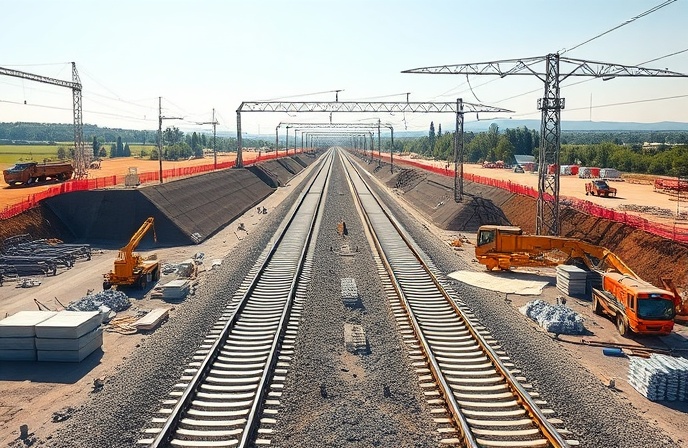
First Section of Aleșd–Hungarian Border Railway Line Commissioned, Signaling Progress in Romanian Rail Infrastructure
A significant step forward in Romania’s railway modernization initiative was marked on July 31, 2025, with the official commissioning of the initial 7 km of the Aleșd–Hungarian Border section, part of the Cluj-Napoca–Oradea–Episcopia Bihor–Border railway line. This project, funded by Romania’s National Recovery and Resilience Plan (PNRR), represents a critical milestone in the ongoing rehabilitation of the key rail corridor. Led by CFR Infrastructura, the project sees Egis, a global engineering and consultancy firm, providing essential supervision and consultancy services. The newly commissioned segment, located between Episcopia Bihor and the Hungarian border, signifies the commitment to improving rail transport efficiency and cross-border connectivity. This article will delve into the specifics of this commissioning, the progress achieved to date, the challenges faced, and the anticipated future benefits for Romania’s railway network.
Rapid Completion of Critical Infrastructure
The rapid commissioning of this 7 km segment within just two months highlights the effective collaboration between stakeholders. Construction work on Lot 4, which encompasses 46.74 km of the Aleșd-Hungarian Border section, commenced in August 2024. The work on the newly commissioned section, situated between km 0+660.74 and km 7+088.32, included construction of critical infrastructure elements such as embankments and rail superstructure at Episcopia Bihor station and along the line. Additionally, the project delivered catenary poles, anchors, signalling cables, 13 underpasses, and two culverts. The successful completion demonstrates the capabilities of the contractors and the efficiency of the project management under Egis’s supervision. The current temporary speed restrictions, capped at 50 km/h, are a necessary measure while the wider project continues. This phase emphasizes the commitment to delivering high-quality infrastructure improvements within ambitious timelines.
Egis’s Supervisory Role: Ensuring Quality and Efficiency
Egis’s role is paramount in ensuring that the project meets the highest standards of quality and efficiency. Appointed in April 2023 by the National Railway Company CFR S.A., Egis oversees both electrification and rehabilitation works on two key sections of the route: Lot 3 (Poieni–Aleșd) and Lot 4 (Aleșd–Hungarian Border). The firm’s responsibilities encompass the supervision of various project aspects, including the execution of works, ensuring compliance with technical specifications, and coordinating different project teams. Corina Mateaș, Project Coordinator at Egis in Romania, highlighted the project team’s excellent teamwork and the contractor’s exemplary mobilization in achieving this milestone. This commitment to quality supervision is essential for the successful delivery of railway infrastructure projects, particularly those involving large-scale rehabilitation and modernization programs.
Advancing Towards Enhanced Operational Capabilities
The ultimate goal of the project is to significantly upgrade the operational capabilities of the railway line. Upon the completion of the entire Lot 4, passenger trains will be able to operate at speeds of up to 160 km/h, while freight trains will run at 120 km/h. This increase in speed, along with improvements in track geometry and signalling, will dramatically improve travel times, enhance safety, and facilitate interoperability with intelligent transport systems (ITS). The broader project along the Cluj-Napoca to border corridor, spanning 166.42 km, is divided into four lots, each with its specific focus on different elements of the railway infrastructure, including track and sleeper replacement, electrification, bridge construction, embankment strengthening, the installation of the European Rail Traffic Management System (ERTMS), and station upgrades. These measures are critical to create a modern, efficient, and reliable railway network capable of supporting both passenger and freight transport.
Challenges and Innovations in Implementation
The implementation of Lot 4 presents several challenges, including the need to conduct construction activities under live traffic conditions. This requires a phased approach to ensure that rail services are maintained with minimal disruption. Works at stations such as Tileagd, Oșorhei, Oradea Est, Oradea, and Episcopia Bihor stations involve a high degree of coordination to balance ongoing rail operations with construction needs. The use of innovative construction techniques, careful planning, and rigorous adherence to safety protocols are necessary to mitigate disruptions and keep the project on schedule. The involvement of experienced teams and the proactive approach taken by Egis, as supervisor, are key in effectively managing these complexities.
Conclusion
The commissioning of the first 7 km of the Aleșd–Hungarian Border railway section is a promising start to the detailed rehabilitation of the Cluj-Napoca–Oradea–Episcopia Bihor–Border railway line. The project reflects Romania’s commitment to modernizing its rail infrastructure, which is crucial for enhancing connectivity, reducing travel times, and supporting economic growth. The involvement of experienced firms like Egis, with their expertise in engineering, consultancy, and project supervision, is vital to ensuring that the project is implemented successfully and that it meets the highest standards of quality and efficiency. The success of this phase offers valuable lessons for future railway projects and confirms the critical role of funding initiatives like PNRR in driving infrastructure advancements. Further commissioning of sections within Lot 4, expected in the near future, promises further improvements in travel times and freight capacity. By continuing to prioritize infrastructure investment and innovation, Romania is poised to significantly improve its railway network.
Egis
Egis is a leading global player in the consulting and engineering sector, operating across various sectors including railway infrastructure. Their railway division specializes in providing design, engineering, project management, and supervision services for railway projects worldwide. The company has a strong track record of successfully delivering complex railway infrastructure projects, including high-speed lines, urban rail systems, and conventional railway upgrades. Their detailed approach, encompassing technical expertise and project management capabilities, makes them a trusted partner for railway operators and infrastructure managers across the globe.

Railway infrastructure, rolling stock and transport technologies specialist focused on global rail industry developments, high-speed rail systems, signaling technologies and freight transportation. Covering railway investments, public transport modernization, rail operations and international mobility projects across Europe, Asia and North America.
RELATED POSTS

October 1, 2026 7:09 am
United States regulators confirmed a September 30 deadline for the...

October 8, 2026 1:15 pm
Alstom secured a €1bn contract to build 13 automated trains,...

October 4, 2026 5:14 pm
Alstom secured a CA$4.7 billion order from VIA Rail Canada...

October 1, 2026 12:13 am
Illinois approved $1.5 billion annually for the Northern Illinois Transit...

October 6, 2026 2:14 am
Union Pacific launched export rail shipments with Ferromex to deliver...

October 1, 2026 6:10 am
Amtrak approved a System Expansion Committee on July 30 to...