
Amtrak Opens Two-Track Portal North Bridge In New Jersey
Amtrak launched rail service on the Portal North Bridge in New Jersey on November 16, replacing an old swing span to cut Northeast Corridor train delays.
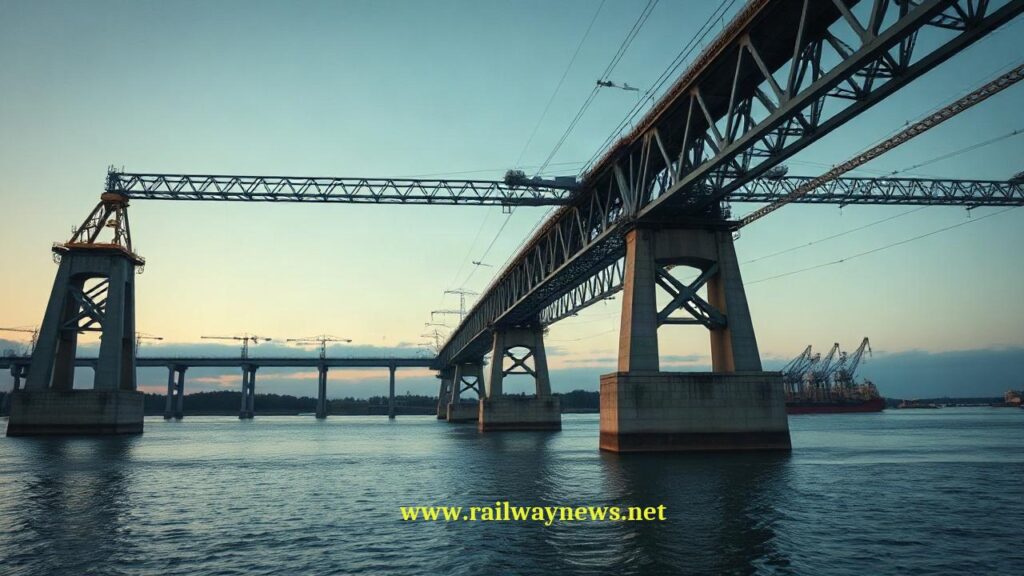
⚡ In Brief: Amtrak and NJ Transit have fully commissioned the Portal North Bridge across New Jersey’s Hackensack River, decommissioning a 116-year-old movable swing bridge after concluding a five-week second-track cutover on November 16.
NEWARK, UNITED STATES – Amtrak and NJ Transit completed the full service transition to the newly constructed Portal North Bridge on November 16, retiring the 116-year-old Hackensack River swing span. Both tracks on the new fixed-span structure entered revenue service following a phased cutover that began with the first track on February 13. The transition removes a critical Northeast Corridor bottleneck by eliminating maritime openings that caused regular passenger train delays.
What Is the Full Scope of This Project?
The Portal North Bridge replacement eliminates a mechanical swing structure by elevating two electrified mainline tracks onto a high-clearance, fixed-span railway crossing over the Hackensack River.
Constructed by a joint venture of Skanska and Traylor Bros, the project scope encompassed deep foundations, concrete piers, structural steel bridge spans, retaining walls, catenary structures, and track signalling systems. Following the commissioning of the first track between February 13 and March 15, crews completed the second track cutover between October 9 and November 16. The contractor joint venture will now execute the physical demolition of the decommissioned 1910 swing bridge. Total capital expenditure for the replacement package was not disclosed in the official cutover announcement, though financing is shared by the U.S. Department of Transportation, Amtrak, and the states of New York and New Jersey.
Key Project Data
| Parameter | Value |
|---|---|
| Project / Contract Name | Portal North Bridge Replacement |
| Total Value | Not disclosed |
| Parties Involved | Amtrak, NJ Transit, U.S. Department of Transportation, Skanska-Traylor Bros JV, State of New Jersey, State of New York |
| Timeline / Completion | Track 1 entered service March 15; Track 2 completed November 16 |
| Country / Corridor | United States / Northeast Corridor |
How Does This Compare to Similar Projects?
Comparable contract retirement data for a directly parallel movable rail bridge replacement in North America was not publicly available at time of publication.
On an international level, mainline rail operators are prioritising fixed structures over movable spans to support surging passenger volumes, as the global high-speed rail sector expands at an 8.5% compound annual growth rate (Source: Market Research Future, 2025). In Europe, where rail infrastructure generated USD 27.9 billion in 2025, infrastructure managers face similar asset renewals; for instance, France’s SNCF Réseau established long-term track and structure upgrades under a performance framework spanning 2024 to 2033 (Source: Hourrail Voyage, 2026). While the worldwide high-speed passenger rail market reached USD 32.4 billion in 2025 and is projected to hit USD 69.95 billion by 2035 (Source: Fairfield Market Research, 2025), the Northeast Corridor’s Portal North scheme focuses on replacing obsolete mechanical bottlenecks on existing shared commuter and intercity rights-of-way.
Editor’s Analysis
Retiring the 1910 swing bridge removes the single most vulnerable mechanical failure point on the southern approach to New York Penn Station, protecting daily reliability for hundreds of thousands of commuters. As global demand for efficient rail mobility pushes market investment toward USD 69.95 billion over the next decade (Source: Fairfield Market Research, 2025), North American transit authorities must modernise legacy civil assets to sustain higher corridor frequencies. The successful phased cutover by the Skanska-Traylor Bros joint venture proves that critical structural replacements can be integrated into high-density passenger corridors without prolonged system shutdowns.
FAQ
Q: Why was the original Portal Bridge decommissioned?
A: The 116-year-old movable swing bridge routinely malfunctioned during openings for maritime traffic, causing cascading delays across the Northeast Corridor. The new fixed-span structure provides high vertical clearance, allowing marine vessels to pass beneath without interrupting rail service.
Q: What was the timeline for the track transition process?
A: Rail service shifted onto the first track between February 13 and March 15 while the old bridge carried remaining movements. Work on the second track began on October 9 and concluded on November 16, completing full revenue commissioning.
Q: What happens next to the old swing bridge?
A: The Skanska-Traylor Bros joint venture will begin the full demolition and maritime removal of the decommissioned 116-year-old bridge structure. An official completion date for the final demolition was not disclosed.
Railway infrastructure, rolling stock and transport technologies specialist focused on global rail industry developments, high-speed rail systems, signaling technologies and freight transportation. Covering railway investments, public transport modernization, rail operations and international mobility projects across Europe, Asia and North America.
RELATED POSTS
November 2, 2026 5:15 pm
WSP secured an advisory contract from Transport for London in...
November 2, 2026 9:11 pm
Wabtec secured a $390 million deal with South Africa's Transnet...
November 1, 2026 6:16 am
CPKC signed a five-year labor contract with BLET covering 250...
November 3, 2026 5:14 pm
Conrail confirmed 28-year rail veteran John Wright as president and...
November 8, 2026 3:15 pm
HDR expanded its US rail and transit reach across 16...
November 1, 2026 7:12 am
Metra launched its draft rail plan across an 11-line Chicago...