Project Overview
| Project item | Details |
|---|---|
| Project name | Eastern Türkiye Middle Corridor Railway Development Project |
| Abbreviation | ETMIC |
| Country | Türkiye |
| Project authority | Directorate General of Infrastructure Investments (AYGM), Ministry of Transport and Infrastructure |
| Implementing institution | Republic of Türkiye, Ministry of Transport and Infrastructure |
| Project corridor | Divriği–Kars–Georgia border |
| Published corridor length | Approximately 660 km |
| Project type | Existing railway rehabilitation and modernisation |
| Main works | Infrastructure and superstructure rehabilitation, electrification, signalling and telecommunications |
| Main construction procurement | Three-lot design-and-build tender |
| Tender reference | AYGM-ETMIC-2026-YAP 01/1-2-3 |
| Tender announcement | 22 October 2026 |
| Scheduled bid submission deadline | 22 December 2026, 14:30 Türkiye time |
| Scheduled technical bid opening | 22 December 2026, 14:45 Türkiye time |
| International financing | World Bank, AIIB and IsDB, with government counterpart funding |
Route and Strategic Location
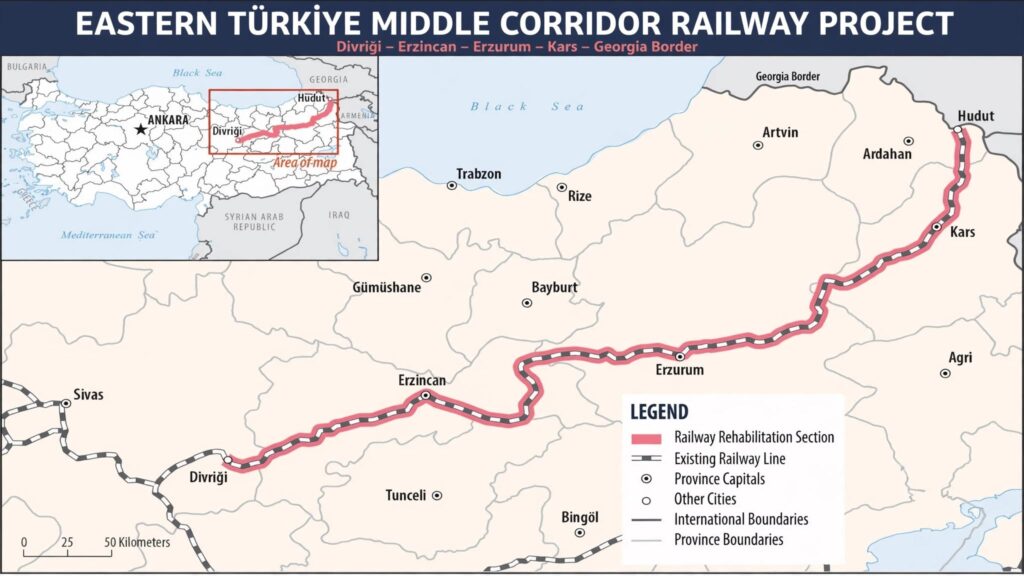
ETMIC focuses on the existing railway corridor extending from Divriği in Sivas Province through Erzincan, Erzurum and Kars to the Georgian border. The railway forms part of Türkiye’s east–west national network and provides an important connection to the wider Trans-Caspian International Transport Route, commonly known as the Middle Corridor.
At its eastern end, the corridor connects with the railway infrastructure leading to Georgia and the Baku–Tbilisi–Kars (BTK) railway. This connection provides access to the South Caucasus and onward rail routes towards Azerbaijan, the Caspian region and Central Asia.
The modernisation programme is intended to improve the performance of an existing railway rather than construct an entirely new 660-kilometre alignment. The project therefore focuses on upgrading infrastructure and railway systems within the established corridor, improving the ability of the line to handle passenger and freight traffic more safely and efficiently.
Project Scope and Technical Works
According to AYGM and the multilateral financing institutions, the project covers the rehabilitation and modernisation of the Divriği–Kars–Georgia border railway corridor. The principal investment includes signalling, telecommunications and electrification systems, together with the rehabilitation or construction of sidings, bridges, station buildings and other railway facilities.
Infrastructure and superstructure rehabilitation
The works are intended to improve the condition and operational performance of the existing railway infrastructure. The design-and-build procurement includes infrastructure and superstructure works, covering the relevant rehabilitation requirements along the three main tender sections.
Associated railway facilities, including sidings, bridges and station buildings, are also included in the broader project scope. These improvements are intended to address infrastructure constraints that affect train operations, maintenance requirements and the reliability of freight movements.
Electrification
Electrification is a central element of the modernisation programme. The project includes the installation of railway electrification systems along the relevant sections of the corridor. The works are expected to support more efficient railway operations and reduce the dependence on diesel traction on the electrified sections.
The electrification scope is not identical across every section of the corridor. The main three-lot procurement includes electrification works on specified sections, while the Kars–Georgia border section is addressed through a separate complementary investment package.
Signalling and telecommunications
The existing railway corridor has historically relied on outdated traffic-control arrangements in parts of the network. The AIIB project documentation identifies the use of manual traffic control, paper-based train orders and telephone communication as constraints affecting capacity, safety and operating efficiency.
ETMIC includes the installation of modern signalling and telecommunications systems to improve train control, operational safety and the coordination of railway movements. The project documentation identifies these systems as essential to improving the capacity and reliability of the corridor.
The final equipment configuration, technical specifications and detailed system architecture should be confirmed against the approved design and contract documents. The project should not be described as an ERTMS deployment unless the relevant technical documentation explicitly confirms that scope.
Three-Lot Main Construction Tender
AYGM published the main international design-and-build procurement on 22 October 2026 under reference AYGM-ETMIC-2026-YAP 01/1-2-3. The tender covers the design and construction of infrastructure and superstructure works, including electrification, and is divided into three lots.
| Lot | Railway section | Published section length | Main scope |
|---|---|---|---|
| Lot 1 | Divriği–Erzincan | 156 km | Infrastructure and superstructure rehabilitation and electrification |
| Lot 2 | Erzincan–Erzurum | 223 km | Infrastructure and superstructure rehabilitation and electrification |
| Lot 3 | Erzurum–Kars | 208 km | Infrastructure and superstructure rehabilitation |
The tender allows bidders to submit proposals for one or more lots. Evaluation and contract award are to be conducted on a lot-by-lot basis. The procurement follows a Request for Proposals for Works (Design and Build) procedure, using a two-envelope bidding process without initial selection.
The tender documents identify the Republic of Türkiye’s Ministry of Treasury and Finance as the borrower and AYGM as the employer. The Request for Proposals identifies a combined loan amount of EUR 830.8 million from the World Bank and the Asian Infrastructure Investment Bank (AIIB) for the relevant project financing framework.
Kars–Georgia Border Section and the BTK Connection
The Kars–Georgia border section is an important part of the wider ETMIC modernisation programme. It is also associated with a complementary investment package that includes the construction of a second railway track and electrification and signalling works towards the Georgian border.
The Ministry of Transport and Infrastructure has described this complementary work as part of the broader effort to complete the modernisation of the Divriği–Kars–Georgia border corridor and strengthen the connection with the BTK railway. The Kars–Georgia border works should be distinguished from the three-lot main rehabilitation tender, which covers Divriği–Erzincan, Erzincan–Erzurum and Erzurum–Kars.
The distinction is important when interpreting project length figures, financing amounts and procurement announcements. The 660-kilometre figure refers to the overall corridor in the AYGM and development-bank project descriptions; it should not be confused with the sum of the three main tender section lengths.
International Financing Structure
ETMIC is supported by a financing framework involving the World Bank, the Asian Infrastructure Investment Bank and the Islamic Development Bank, alongside counterpart funding from the Government of Türkiye.
The World Bank approved a EUR 607.4 million loan, equivalent to approximately US$660 million, for the project in December 2024. AIIB approved US$250 million in sovereign financing in December 2024. IsDB signed a EUR 246.4 million financing agreement with Türkiye in November 2024 to support the modernisation of the eastern railway corridor.
| Financing institution | Published amount | Financing information |
|---|---|---|
| World Bank (IBRD) | EUR 607.4 million / approximately US$660 million | Loan approved in December 2024 |
| Asian Infrastructure Investment Bank (AIIB) | US$250 million | Sovereign financing approved in December 2024 |
| Islamic Development Bank (IsDB) | EUR 246.4 million | Financing agreement signed in November 2024 |
| Government of Türkiye | US$183.9 million | Counterpart funding in the World Bank project financing plan |
The World Bank project appraisal documentation gives an overall financing plan of approximately US$1.345 billion, including US$660 million from the World Bank, US$250 million from AIIB, approximately US$250.7 million from IsDB and US$183.9 million in government counterpart funding. These figures represent the original project financing plan and should not be confused with the EUR 830.8 million loan amount identified in the main three-lot tender documents.
The distinction between the financing framework and the procurement package is important. The three-lot tender identifies World Bank and AIIB financing, while IsDB financing is associated with a separate component of the wider project. The individual financing amounts should therefore not be presented as if they all fund the same construction contracts.
Environmental and Social Management
ETMIC is being implemented within an existing railway corridor, but rehabilitation and modernisation activities still involve environmental and social risks that require assessment and management. The project documentation addresses construction impacts, biodiversity, land use, labour conditions, community health and safety, cultural heritage and stakeholder engagement.
AYGM has published a range of environmental and social instruments, including:
- Environmental and Social Impact Assessment (ESIA) Report
- Environmental and Social Management Plan (ESMP)
- Environmental and Social Commitment Plan (ESCP)
- Stakeholder Engagement Plan (SEP)
- Resettlement Framework (RF)
- Labour Management Procedure (LMP)
- Community Health and Safety Management Plan
- Emergency Preparedness and Response Plan
- Pollution Prevention and Waste Management Plan
- Traffic Management Plan
- Biodiversity Management Plan
- Cultural Heritage Management Plan
- Occupational Health and Safety Management Plan
AIIB identifies potential environmental issues including air pollution, noise and vibration, soil disturbance, vegetation management, waste disposal, construction-camp impacts, snow management, energy consumption and potential effects on protected areas and biodiversity. The railway corridor passes through or near environmentally sensitive areas and Key Biodiversity Areas.
The project documentation notes that the existing railway alignment has been in operation for decades and that the rehabilitation works are intended primarily to remain within the established railway corridor. Site-specific environmental and social screening and management plans will be prepared as required during implementation.
Social issues include potential impacts on livelihoods, land and assets, labour and working conditions, community health and safety, cultural heritage and the management of risks associated with the presence of construction workers. The project includes stakeholder engagement and grievance redress arrangements for affected communities and workers.
The publication of environmental and social documents represents part of the project preparation and financing requirements. It does not mean that all construction-related risks have already been resolved. Contractors and the Project Implementation Unit will be responsible for applying the relevant management plans and monitoring requirements during implementation.
Strategic Importance for the Middle Corridor
The Divriği–Kars–Georgia border railway is an important component of Türkiye’s east–west rail network. Its modernisation is intended to improve the performance of the Turkish section of the Trans-Caspian Middle Corridor, which connects European markets with the South Caucasus, the Caspian region and Central Asia.
The Middle Corridor offers an alternative Eurasian transport route linking China and Central Asia with Europe through Kazakhstan, the Caspian Sea, Azerbaijan, Georgia and Türkiye. Rail infrastructure capacity, border-crossing performance, interoperability and operational reliability are important factors in the corridor’s overall competitiveness.
ETMIC addresses several infrastructure constraints on the eastern part of Türkiye’s railway network. Modern signalling and telecommunications are expected to improve train control and operational safety, while electrification and infrastructure rehabilitation are intended to support more efficient train operations and improve the condition of the existing railway asset.
The project is also relevant to domestic freight transport. By improving the railway connection between eastern and western Türkiye, ETMIC is intended to strengthen access to national logistics centres, industrial regions and international markets.
Expected Transport and Logistics Benefits
The project’s development objective is to improve rail connectivity in eastern Türkiye along the Divriği–Kars–Georgia border section of the Trans-Caspian Middle Corridor. Its expected benefits include:
- Improved railway connectivity between central and eastern Türkiye and the Georgian border.
- Stronger rail integration with the Baku–Tbilisi–Kars railway and the wider Middle Corridor.
- Improved train control, operational safety and railway traffic management through modern signalling and telecommunications.
- Higher operational capacity through infrastructure rehabilitation and improvements to railway facilities.
- Improved freight transport reliability and reduced operational constraints.
- Potential reductions in transport costs through more efficient rail freight services.
- Support for a modal shift from road to rail and the associated potential for lower transport emissions.
- Improved railway asset management and reduced maintenance backlogs.
The World Bank and AIIB identify freight travel time, freight carrying capacity, access to transport services and greenhouse gas emissions per tonne-kilometre among the indicators used to assess project results. These indicators provide a framework for measuring the project’s performance during implementation; they should not be interpreted as achieved outcomes before the railway upgrades are completed.
Project Timeline and Procurement Status
- 5 November 2024: IsDB signed a EUR 246.4 million financing agreement for the modernisation of the eastern Türkiye Middle Corridor railway.
- 5 December 2024: The World Bank approved a EUR 607.4 million loan for ETMIC.
- 13 December 2024: AIIB approved US$250 million in sovereign financing for the project.
- 2025: AYGM and the development banks continued project preparation, procurement planning and environmental and social work.
- 22 October 2026: AYGM published the main three-lot design-and-build tender under reference AYGM-ETMIC-2026-YAP 01/1-2-3.
- 28 October 2026: The Ministry of Transport and Infrastructure announced that the main construction tender would be held on 22 December 2026 and that construction works were planned to be completed within four years.
- 5 November 2026: AYGM updated the main tender information.
- 22 December 2026: Scheduled deadline for submission of technical and financial proposals and opening of technical proposals.
Project status as of 19 November 2026: The project is in the procurement and implementation-preparation stage. The main three-lot design-and-build tender has been published, and the bid submission deadline is scheduled for 22 December 2026. The Ministry has stated that construction works are planned to take four years. The main construction contracts had not yet been awarded as of the date of this profile.
Official Sources and Project Documents
- AYGM – Eastern Türkiye Middle Corridor Railway Development Project
- AYGM – Three-Lot Design-and-Build Tender
- Ministry of Transport and Infrastructure – 667 Kilometres of Railway to Be Modernised, 28 October 2026
- World Bank – Eastern Türkiye Middle Corridor Railway Development Project (P179128)
- AIIB – Eastern Türkiye Middle Corridor Railway Development Project
- IsDB – EUR 246.4 Million Financing Agreement, 5 November 2024
- World Bank – Project Appraisal Document and Financing Plan
- AYGM – Specific Procurement Notice (ETMIC Works)
Editorial note: This project profile is based on official AYGM, Ministry of Transport and Infrastructure, World Bank, AIIB and IsDB information available as of 19 November 2026. Project scope, procurement status and financing details should be updated when new tender results, contract awards and implementation reports are published.