Project Overview
| Item | Details |
|---|---|
| Project name | Istanbul North Rail Crossing Project (INRAIL) |
| Country | Türkiye |
| Project authority | Directorate General of Infrastructure Investments (AYGM), Ministry of Transport and Infrastructure |
| Route | Çayırova – Yavuz Sultan Selim Bridge – Çatalca |
| Published project length | Approximately 127 km |
| Main construction tender scope | 125 km of double-track railway, according to the Ministry’s November 2026 announcement |
| Railway configuration | Double track, electrified and fully signalled |
| Traffic | Passenger and freight |
| Key structures in tender announcement | 42 bridges and viaducts (22.4 km); 44 tunnels (59.1 km) |
| Cross-Bosphorus connection | Railway provision on Yavuz Sultan Selim Bridge |
| International financing framework | Six multilateral development finance institutions; approximately US$6.75 billion announced |
| Main tender reference | AYGM-INRAIL-2025-YAP 01/1-2-3-4 |
| Latest tender milestone | 25 bids received on 11 November 2026 |
| Implementing authority | AYGM |
Route and Strategic Connectivity
INRAIL is designed to provide a new northbound railway crossing of the Istanbul Strait, bypassing the central metropolitan area and creating an additional high-capacity connection between the Asian and European sides of Türkiye. The route begins in the Çayırova area, in Kocaeli Province, and continues westwards towards Çatalca, crossing the Bosphorus via the Yavuz Sultan Selim Bridge.
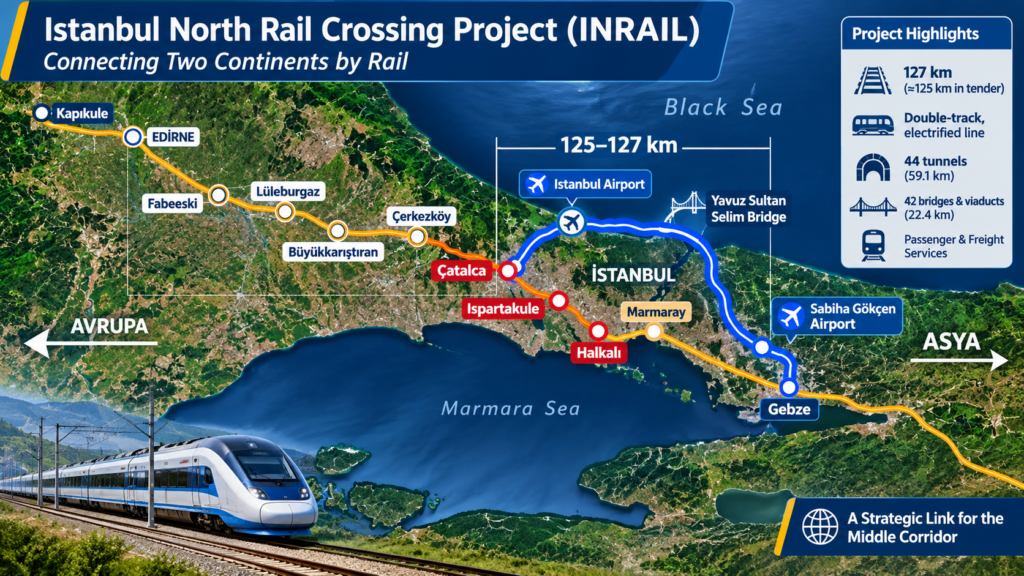
The planned railway will connect with two of Türkiye’s most important aviation hubs: Sabiha Gökçen Airport on the Asian side and Istanbul Airport on the European side. The corridor is also intended to connect with the wider national railway network and international freight routes. At Çatalca, the project is planned to integrate with the Halkalı–Çerkezköy railway corridor, which is under construction.
The route is intended to serve both domestic passenger services and long-distance freight traffic. By providing an alternative to the existing rail crossing through Marmaray, INRAIL is expected to increase the resilience of railway operations across the Istanbul Strait and reduce the operational constraints affecting freight movements through the metropolitan area.
Technical Characteristics and Civil Works
The project is planned as a new, greenfield, double-track railway line with full electrification and signalling. It is designed for mixed passenger and freight operation. AIIB project information identifies operating speeds of up to 160 km/h for passenger trains and 80–120 km/h for freight trains. These figures should be read as published project design parameters, rather than confirmation of the final operating timetable.
The Turkish Ministry of Transport and Infrastructure announced that the main construction tender covers 125 kilometres of double-track railway, including 42 bridges and viaducts with a combined length of 22.4 kilometres and 44 tunnels with a combined length of 59.1 kilometres. The extensive use of tunnels and viaducts reflects the challenging topography and built environment along the northern Istanbul corridor.
The project will use the railway provision incorporated into the Yavuz Sultan Selim Bridge. This allows the new railway to cross the Bosphorus without relying on the Marmaray tunnel for the same cross-strait movement. The new corridor is expected to complement existing railway infrastructure rather than replace the Marmaray connection.
Published railway length figures
Different official project documents currently use different route-length figures. AYGM, the World Bank, ADB and several other project descriptions refer to approximately 127 kilometres. The Ministry’s announcement on the main construction tender specifies 125 kilometres, while an AIIB project document describes a 122-kilometre line. These figures are reproduced as published by the respective institutions. The available information does not establish whether the differences result from design revisions, financing scope or measurement methodology; they should therefore not be treated as interchangeable.
International Financing and Development Bank Participation
INRAIL is being prepared through a coordinated financing framework involving six multilateral development finance institutions: the World Bank, Asian Infrastructure Investment Bank (AIIB), Asian Development Bank (ADB), European Bank for Reconstruction and Development (EBRD), Islamic Development Bank (IsDB) and OPEC Fund for International Development.
On 31 March 2026, the World Bank announced approval of a US$2 billion loan and said it was leading a coordinated effort by six development banks to mobilise approximately US$6.75 billion for the project. The financing framework is intended to complement funding from the Government of Türkiye.
| Institution | Published financing information | Status reported in available sources |
|---|---|---|
| World Bank | US$2 billion | Loan approved on 31 March 2026 |
| Asian Infrastructure Investment Bank (AIIB) | Up to US$1.5 billion | Financing package approved; first phase signed in July 2026 |
| Asian Development Bank (ADB) | US$750 million | Loan approved on 9 June 2026 |
| Islamic Development Bank (IsDB) | EUR 660 million | Financing agreement signed on 12 November 2026; approved by the IsDB Board in June 2026 |
| European Bank for Reconstruction and Development (EBRD) | Up to EUR 500 million | Proposed sovereign loan; subject to the Bank’s review and approval process |
| OPEC Fund for International Development | Individual amount not specified in the sources cited here | Listed among the six institutions in the coordinated financing framework |
The figures above reflect different stages of the financing process and are not a consolidated disbursement statement. They should not be added together as if every amount had already been signed and disbursed. The approximately US$6.75 billion figure is the overall financing mobilisation announced by the World Bank and the Turkish Ministry.
On 12 November 2026, the IsDB and the Republic of Türkiye signed a EUR 660 million financing agreement for INRAIL during COP31 in Antalya. IsDB described the transaction as its largest sovereign financing transaction for Türkiye and the first Forward Lease agreement signed between the Bank and the Republic of Türkiye.
The European Investment Bank (EIB) also lists INRAIL under appraisal, with proposed financing of approximately US$250 million. This is a separate financing proposal and is not included in the six-institution US$6.75 billion framework announced by the World Bank and the Ministry. It should not be presented as an approved contribution.
Main Tender and Procurement Status
AYGM published the main design-and-build procurement for the infrastructure and superstructure works, including electrification, under reference AYGM-INRAIL-2025-YAP 01/1-2-3-4. The procurement is structured as a Request for Proposals for Works using a two-envelope bidding process without initial selection.
The procurement notice was published on 21 July 2026. The Request for Proposals followed on 23 September 2026. AYGM subsequently published procurement addenda and technical documents, including clarification responses, mass-spring system technical specifications, the INRAIL project design technical specification, rail expansion joint specifications and superstructure type information drawings. Addenda No. 3 and No. 4 were published on 6 November 2026.
According to the Ministry of Transport and Infrastructure, 25 bids were received on 11 November 2026. The announcement referred to participation by Turkish companies and four foreign companies from China and Italy. This confirms that the bid-submission stage had reached a major milestone. The sources cited in this profile do not establish that the main construction contract had been awarded by 19 November 2026.
Environmental and Social Assessment
INRAIL is a large-scale infrastructure project in a geographically and environmentally sensitive region. Its environmental and social assessment covers issues associated with land acquisition, resettlement, biodiversity, cultural heritage, construction impacts, labour management, community safety and stakeholder engagement.
AYGM has published an environmental and social documentation package, including an updated Environmental and Social Impact Assessment (ESIA) and Environmental and Social Management Plan (ESMP) dated September 2026. Other published documents include the Stakeholder Engagement Plan, Resettlement Framework and Labour Management Procedures, updated in August 2026, as well as cultural heritage and other project-level documents.
EBRD classifies the project as Category A under its environmental and social policy. Its disclosure describes potential issues including land acquisition and economic displacement, impacts on forest habitats and watercourses, noise and vibration, excavated material management, groundwater, community health and safety, labour conditions, climate resilience and cultural heritage. EBRD has also described supplementary environmental and social due diligence, including biodiversity assessment and a review of existing project documentation.
The availability of these documents is an important part of the project’s preparation and financing process. Their publication should not, however, be interpreted as evidence that all environmental and social risks have already been resolved. Implementation will depend on the application of the relevant management plans, mitigation measures, monitoring and stakeholder-engagement commitments.
Role in the Middle Corridor and International Freight Transport
INRAIL is positioned as a missing railway link in Türkiye’s cross-continental transport network. The World Bank and EBRD identify its relevance to three major rail-served trade corridors:
- Trans-Caspian International Transport Route (Middle Corridor): linking China and Central Asia with Europe through the Caspian region, the South Caucasus and Türkiye.
- Iraq Development Road: the planned transport corridor connecting the Gulf region and Iraq with Türkiye and onward European markets.
- Türkiye–European Union corridor: supporting rail freight movements between Türkiye and European markets.
The project is intended to provide additional capacity across the Istanbul Strait and improve the reliability of international freight movements. The new route is expected to complement Marmaray by offering a separate railway crossing for freight and passenger services. The Ministry has stated that the line is expected to support 24-hour railway operations and reduce pressure on freight movements through Marmaray.
According to the Ministry’s November 2026 announcement, the completed railway is projected to carry up to 33 million passengers and 30 million tonnes of freight annually. These are projected capacity figures, not current traffic volumes or guaranteed operating results.
Expected Transport and Economic Impact
By creating a new railway crossing north of central Istanbul, INRAIL is expected to improve the continuity of national and international rail services. Its potential benefits include:
- Additional cross-Bosphorus railway capacity for passenger and freight services.
- Improved connectivity between Istanbul Airport and Sabiha Gökçen Airport through the national railway network.
- More direct integration with the Middle Corridor and other international freight routes.
- Greater operational flexibility by providing an alternative to the existing Marmaray rail crossing.
- Potential modal shift from road to rail, supporting lower transport emissions.
- Improved access to logistics, industrial and passenger markets on both sides of Istanbul.
The World Bank has also highlighted the project’s potential contribution to employment and private-sector activity along Türkiye’s national and international rail corridors. These are expected development impacts and will depend on the project’s delivery, subsequent railway operations and the development of connecting logistics services.
Project Timeline and Current Status
- 31 March 2026: The World Bank announced approval of a US$2 billion loan and the coordinated six-bank financing framework.
- 9 June 2026: ADB approved a US$750 million loan for INRAIL.
- 21 July 2026: AYGM published the main design-and-build procurement notice; AIIB announced its financing package of up to US$1.5 billion.
- 23 September 2026: AYGM published the Request for Proposals for the main works procurement.
- 28 October 2026: AYGM published technical specifications and clarification documents, including the mass-spring system and rail expansion joint specifications.
- 6 November 2026: AYGM published Addenda No. 3 and No. 4.
- 11 November 2026: The main tender received 25 bids, according to the Ministry of Transport and Infrastructure.
- 12 November 2026: Türkiye and IsDB signed the EUR 660 million financing agreement during COP31 in Antalya.
Status as of 19 November 2026: The main design-and-build tender has received bids. The financing framework involves six multilateral development institutions, with individual financing instruments at different approval and signing stages. A main works contract award and a confirmed construction completion or opening date have not been verified in the official sources cited here.
Official Sources and Project Documents
- AYGM – Istanbul North Rail Crossing Project (INRAIL)
- AYGM – Main Design-and-Build Tender and Procurement Documents
- Ministry of Transport and Infrastructure – 25 Bids Received for INRAIL, 12 November 2026
- World Bank – US$2 Billion Financing Approval, 31 March 2026
- AIIB – Financing Package of up to US$1.5 Billion, 21 July 2026
- Asian Development Bank – INRAIL Project 59346-001
- EBRD – INRAIL Project Disclosure
- IsDB – EUR 660 Million Financing Agreement, 12 November 2026
- European Investment Bank – INRAIL Project 20260445
Editorial note: This project profile is based on official project, procurement and multilateral development bank information available as of 19 November 2026. Figures and project status should be updated when AYGM publishes further tender results, contract awards or revised technical documentation.