
Konecranes Delivers Six RMG Cranes To Port Of Virginia
Konecranes delivered six RMG cranes to the Port of Virginia on November 9 under a $150 million order for 36 units to expand container terminal capacity.
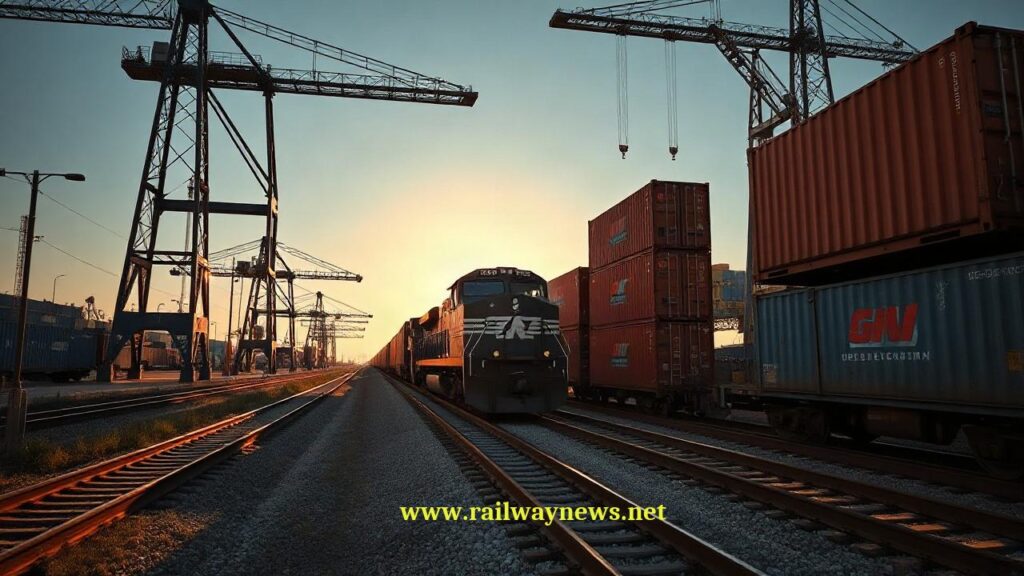
⚡ In Brief: The Port of Virginia received six Konecranes rail-mounted gantry units on Nov. 9 as part of a nearly $150 million order for 36 cranes to boost Norfolk International Terminals’ annual capacity by 1.4 million TEUs by spring 2027.
NORFOLK, USA – The Virginia Port Authority took delivery of six rail-mounted gantry (RMG) cranes on Nov. 9 for installation at Norfolk International Terminals’ North Berth. The units form part of a 36-crane, nearly $150 million equipment package procured from Finland-based manufacturer Konecranes in 2023. The terminal redevelopment aims to expand the site’s annual cargo throughput capacity by 1.4 million 20-foot equivalent units (TEUs) upon final completion in spring 2027.
What Is the Full Scope of This Project?
The Norfolk International Terminals North Berth modernization will expand facility capacity to 1.4 million TEUs annually using 36 rail-mounted gantry cranes. The capital program pairs the new RMGs with ship-to-shore container cranes delivered earlier in the spring, rebuilding the container stack yard to achieve higher storage density across existing acreage. The reconfigured transfer blocks will directly serve container flows moving between ocean vessels, highway drayage trucks, and on-dock intermodal rail spurs. The total capital expenditure for civil works beyond the $150 million crane order was not disclosed by port officials.
Key Project Data
| Parameter | Value |
|---|---|
| Project / Contract Name | Norfolk International Terminals North Berth Modernization |
| Total Value | Nearly $150 million (crane package); total civil investment not disclosed |
| Parties Involved | Virginia Port Authority (VPA), Konecranes |
| Timeline / Completion | Spring 2027 |
| Country / Corridor | United States / U.S. East Coast Intermodal Rail Corridor |
How Does This Compare to Similar Projects?
Terminal automation and intermodal rail efficiency drives heavy rolling stock and equipment spending across North America, exemplified by Metrolinx allocating €340 million to modernize 181 rail passenger cars as part of a €3.4 billion regional equipment intake (Source: Alstom, 2025). The Virginia project procures its industrial handling fleet from Finland, where national rail freight accounts for 93.2% of domestic rail movements and overall Nordic tonnage continues to climb despite shorter average freight hauls (Source: Railmarket, 2025). Independent verification of the delivery schedule for the remaining 30 RMG units was not available at time of publication.
Editor’s Analysis
Intermodal terminals are increasingly deploying fixed-rail gantries over diesel rubber-tired equipment to maximize yard density without acquiring expensive waterfront real estate. Higher stacking ratios directly improve container turnover for Class I rail carriers serving the East Coast, where road freight competition continues to pressure rail market share across international supply corridors (Source: Railmarket, 2025). By completing the 36-crane integration by 2027, the Port of Virginia establishes the crane automation necessary to handle projected container surges without creating inland rail bottlenecks.
FAQ
Q: When will the North Berth modernization at Norfolk International Terminals be completed?
A: The Virginia Port Authority expects full project completion in spring 2027. At that stage, all 36 rail-mounted gantry cranes will be operational across the reconfigured yard.
Q: What is the total financial value of the crane procurement contract?
A: The contract with Finland-based Konecranes covers 36 rail-mounted gantry cranes valued at nearly $150 million. The port authority purchased the equipment package in 2023.
Q: How does the new yard configuration impact intermodal rail operations?
A: The reconfiguration integrates RMG cranes to create higher stacking density and accelerate container transfers directly between vessels, highway trucks, and intermodal trains. Specific container dwell-time reduction targets have not been officially confirmed.

Railway infrastructure, rolling stock and transport technologies specialist focused on global rail industry developments, high-speed rail systems, signaling technologies and freight transportation. Covering railway investments, public transport modernization, rail operations and international mobility projects across Europe, Asia and North America.
RELATED POSTS

November 1, 2026 6:16 am
CPKC signed a five-year labor contract with BLET covering 250...

November 2, 2026 5:15 pm
WSP secured an advisory contract from Transport for London in...

November 2, 2026 9:11 pm
Wabtec secured a $390 million deal with South Africa's Transnet...

November 1, 2026 7:12 am
Metra launched its draft rail plan across an 11-line Chicago...

November 2, 2026 8:15 pm
Network Rail confirmed the installation of a new Church Fenton...

November 3, 2026 5:14 pm
Conrail confirmed 28-year rail veteran John Wright as president and...