
Union Pacific Tests Two Wabtec FLXdrive Units in California
Union Pacific launched tests of two 2.7 MWh Wabtec FLXdrive battery locomotives in California to evaluate yard switching ahead of two units in October 2024.
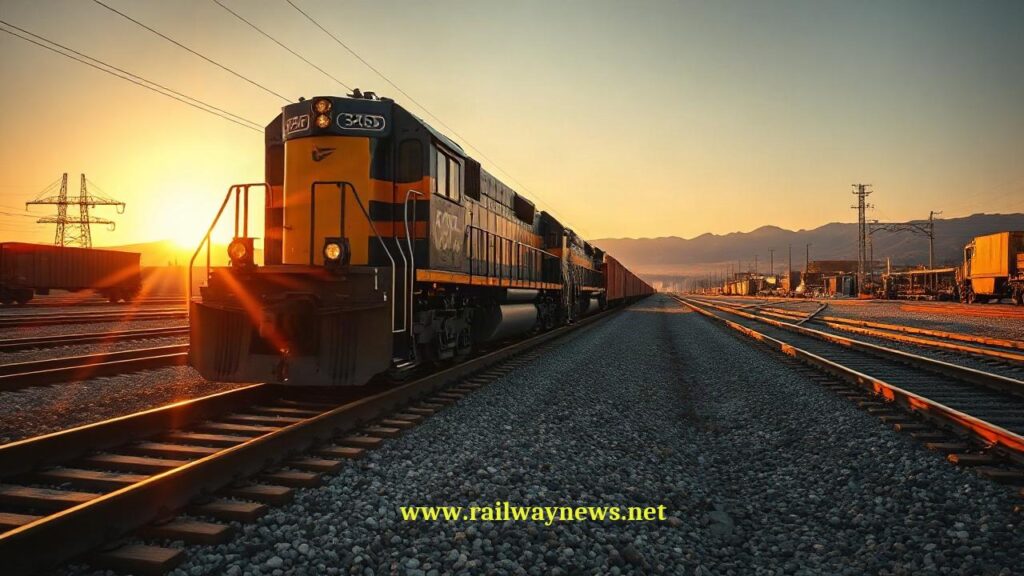
⚡ In Brief: Union Pacific has taken delivery of its first two 2.7-megawatt-hour Wabtec FLXdrive battery-electric locomotives for switching and local freight trials in Southern California, ahead of two additional units arriving in October.
LOS ANGELES, UNITED STATES – Union Pacific Railroad took delivery of two Wabtec FLXdrive battery-electric locomotives in September 2024 to commence operational testing in the Los Angeles basin. The two units represent the first half of a four-locomotive procurement order, with the final pair scheduled for delivery in October. The Class I carrier will deploy the units across yard switching and local freight service to evaluate heavy-haul zero-tailpipe-emission traction under real-world yard cycles.
What Are the Technical Specifications?
Each Wabtec FLXdrive locomotive features approximately 7,000 battery cells supplying 2.7 megawatt-hours (MWh) of onboard energy storage capacity. This configuration provides total energy reserve dedicated to low-speed shunting and regional switching tasks without direct tailpipe emissions. The four-unit batch will centralize testing in Southern California’s South Coast Air Basin, an area subject to stringent particulate and nitrogen oxide limits. Detailed technical performance under extreme thermal loading and high-cycle shunting duty cycles will determine final energy discharge rates and charging turnaround requirements.
Key Technical Data
| Parameter | Value |
|---|---|
| Technology / System Name | Wabtec FLXdrive Battery-Electric Locomotive |
| Total Value | Not disclosed |
| Parties Involved | Union Pacific Railroad, Wabtec Corporation |
| Timeline / Completion | First 2 units delivered September; 2 units arriving October |
| Country / Corridor | United States / Greater Los Angeles Area, California |
Where Does This Technology Stand in the Market?
Battery-electric shunting and line-haul prototypes are competing directly against dual-mode and catenary-electric alternatives across global freight corridors. Wabtec’s 2.7 MWh FLXdrive configuration delivers dedicated battery storage for non-electrified terminals, whereas European freight operators prioritize electro-diesel flexibility; for example, Northrail ordered 50 Siemens Vectron Dual Mode locomotives capable of switching between 15 kV AC electric overhead lines and a 950 kW diesel engine (Source: Siemens Mobility, 2025). In parallel, Progress Rail markets the EMD Joule battery-electric locomotive with scalable battery capacity ranging from 2.4 MWh up to 14.5 MWh for heavy-haul operations, outpacing Wabtec’s initial yard-test unit capacity (Source: Progress Rail, 2024). Meanwhile, Stadler Rail secured a framework deal with SBB Cargo for multi-system electric shunting locomotives designed for mainline and terminal feeder duties (Source: SBB Cargo, 2024). Fleet acquisition costs for the Union Pacific order were not disclosed by either party.
Editor’s Analysis
Class I operators are focusing zero-emission testing on captive yard switchers because localized battery duty cycles avoid the acute charging and range limitations of transcontinental line-haul routes. With the global rail market projected to grow at a compound annual growth rate of 5.57% through 2034, equipment manufacturers must validate heavy-axle battery reliability before freight carriers commit major capital (Source: Market Data Forecast, 2024). Union Pacific’s dual-batch deployment serves primarily as an operational testbed to quantify high-voltage battery degradation under cyclic shunting shocks.
FAQ
Q: How much energy storage does each Wabtec FLXdrive locomotive provide?
A: Each locomotive contains roughly 7,000 battery cells providing approximately 2.7 megawatt-hours of total energy storage. The units emit zero direct tailpipe emissions during yard switching and customer freight delivery.
Q: When will Union Pacific receive all four FLXdrive units?
A: Union Pacific took delivery of the first two units in September, while the final two units are scheduled to arrive in October. All four locomotives will operate within freight yards and local branches across the greater Los Angeles basin.
Q: How much did Union Pacific spend on this four-unit order?
A: The contract value for the procurement and testing agreement was not disclosed by Union Pacific or Wabtec. Independent verification of the total unit capital expenditure was not available at time of publication.

Railway infrastructure, rolling stock and transport technologies specialist focused on global rail industry developments, high-speed rail systems, signaling technologies and freight transportation. Covering railway investments, public transport modernization, rail operations and international mobility projects across Europe, Asia and North America.
RELATED POSTS

October 1, 2026 7:09 am
United States regulators confirmed a September 30 deadline for the...

October 4, 2026 5:14 pm
Alstom secured a CA$4.7 billion order from VIA Rail Canada...

October 6, 2026 2:14 am
Union Pacific launched export rail shipments with Ferromex to deliver...

October 1, 2026 12:13 am
Illinois approved $1.5 billion annually for the Northern Illinois Transit...

October 1, 2026 6:10 am
Amtrak approved a System Expansion Committee on July 30 to...

October 8, 2026 1:15 pm
Alstom secured a €1bn contract to build 13 automated trains,...