
BTS Reports $17.7B North American Rail Freight in May 2026
BTS reported $17.7 billion in cross-border rail freight between the U.S., Canada, and Mexico in May 2026, up 11.1% from $16.0 billion in May 2025.
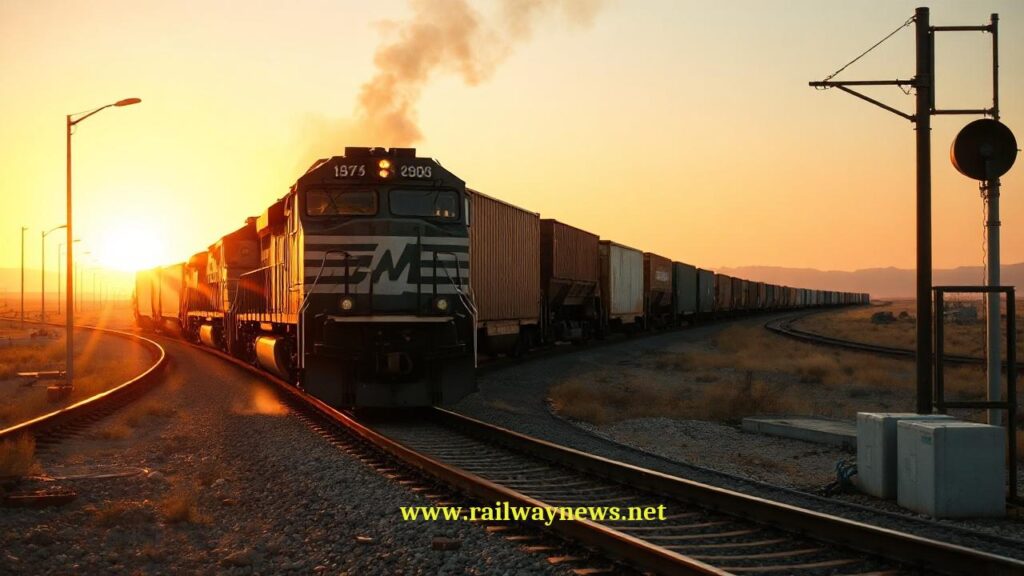
⚡ In Brief: The Bureau of Transportation Statistics reported that railroads moved $17.7 billion in cross-border freight between the U.S., Canada, and Mexico in May 2026, an 11.1% increase from $16.0 billion in May 2025.
WASHINGTON, D.C. – The U.S. Bureau of Transportation Statistics (BTS) reported that rail moved $17.7 billion in transborder freight in May 2026, up 11.1% from $16.0 billion in May 2025. Rail ranked second by value among modes, behind trucks at $99.7 billion, while total all-mode transborder freight reached $153.4 billion, a 16.1% annual increase. The data covers U.S.-Canada and U.S.-Mexico freight movements.
How Is the Funding Structured?
The $17.7 billion rail total splits into $8.6 billion in U.S.-Canada freight and $9.1 billion in U.S.-Mexico freight for May 2026. U.S.-Canada rail value moved primarily through Detroit and Port Huron, Michigan, and International Falls, Minnesota. U.S.-Mexico rail value concentrated at Laredo, Eagle Pass, and El Paso, Texas.
Key Funding Data
| Parameter | Value |
|---|---|
| Fund / Programme Name | BTS TransBorder Freight Data – May 2026 |
| Total Value | $153.4 billion all modes; $17.7 billion rail |
| Parties Involved | Bureau of Transportation Statistics; U.S., Canadian, and Mexican freight carriers across rail, truck, water, pipeline, and air |
| Timeline / Completion | May 2026 data release; commodity-level and rail-carrier breakdowns not disclosed |
| Country / Corridor | U.S.-Canada and U.S.-Mexico border corridors |
How Does This Compare to Similar Funding Programs?
In March 2026, total North American transborder freight increased only 3.2% year-over-year, compared with 16.1% in May 2026 (Source: BTS, 2026). The rail-specific May 2026 growth of 11.1% also trails global rail freight market growth projections. Future Market Insights estimated the global rail freight market at USD 370.0 billion in 2025, projected to reach USD 602.7 billion by 2036, a 4.5% CAGR (Source: Future Market Insights, 2025). A separate Market Research Future estimate places the rail freight transport market at USD 1,605.99 billion in 2025, reaching USD 2,125.44 billion by 2035, a 2.84% CAGR (Source: Market Research Future, 2024). These alternative estimates reflect definitional differences in rail freight scope but provide global context for the North American corridor’s $17.7 billion monthly rail value.
Editor’s Analysis
May 2026 data shows rail lagging other modes in annual value growth, which indicates that higher-value, time-sensitive cross-border shipments continue to favor truck and air. The U.S.-Mexico rail corridor at $9.1 billion exceeded U.S.-Canada’s $8.6 billion for the month, reinforcing the shift in North American freight gravity toward southern border trade. This aligns with long-term forecasts that rail freight value growth may remain below other logistics segments; one projection puts the rail freight transport market at a 2.84% CAGR through 2035 (Source: Market Research Future, 2024).
FAQ
Q: How much freight did rail move across North American borders in May 2026?
A: Rail moved $17.7 billion, with $8.6 billion between the U.S. and Canada and $9.1 billion between the U.S. and Mexico, according to BTS.
Q: Why did rail have the lowest year-over-year increase among freight modes in May 2026?
A: Rail’s value rose 11.1%, below truck’s 15%, pipeline’s 24%, water’s 37.7%, and air’s 53.6%. BTS did not disclose commodity-level drivers for the gap.
Q: Which border crossings handled the highest rail freight values?
A: For U.S.-Canada, Detroit and Port Huron, Michigan, and International Falls, Minnesota. For U.S.-Mexico, Laredo, Eagle Pass, and El Paso, Texas.

Railway infrastructure, rolling stock and transport technologies specialist focused on global rail industry developments, high-speed rail systems, signaling technologies and freight transportation. Covering railway investments, public transport modernization, rail operations and international mobility projects across Europe, Asia and North America.
RELATED POSTS

October 1, 2026 7:09 am
United States regulators confirmed a September 30 deadline for the...

October 1, 2026 12:13 am
Illinois approved $1.5 billion annually for the Northern Illinois Transit...

October 4, 2026 5:14 pm
Alstom secured a CA$4.7 billion order from VIA Rail Canada...

October 1, 2026 6:10 am
Amtrak approved a System Expansion Committee on July 30 to...

October 1, 2026 3:12 am
Greenbrier confirmed Brian Comstock as new president and CEO effective...

October 6, 2026 2:14 am
Union Pacific launched export rail shipments with Ferromex to deliver...