
Port of Long Beach Awards Jacobs Rail Contract under $2.2B
Port of Long Beach awarded Jacobs a contract to manage on-dock rail facility expansion at its Southern California port, part of $2.2 billion capital programme.
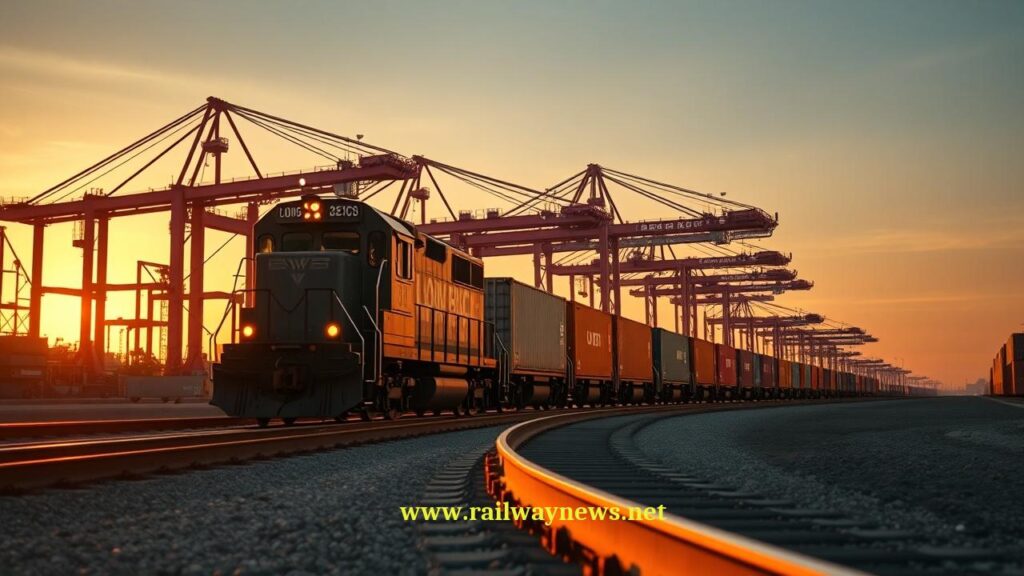
⚡ In Brief: The Port of Long Beach processed 779,331 TEUs in June 2026—its third-busiest June—while Jacobs secured a contract to manage on-dock rail facility expansion under the port’s US$2.2 billion capital programme.
LONG BEACH, USA – The Port of Long Beach moved 779,331 twenty-foot equivalent units in June 2026, a 10.6% increase from June 2025, as imports surged 11% to 387,025 TEUs. Jacobs separately won a contract to manage expansion of an on-dock rail facility, funded through the port’s US$2.2 billion capital programme. First-half 2026 volumes reached 4,829,578 TEUs, up 1.7% from the same period in 2025.
What Is the Full Scope of This Project?
The Port of Long Beach is executing a US$2.2 billion capital programme that includes on-dock rail facility expansion to increase intermodal capacity at the San Pedro Bay port complex. Jacobs was awarded a programme management contract for the rail component, though the specific contract value was not disclosed. The investment arrives as the port handles sustained volume pressure: June 2026 marked the third-busiest June on record, January 2026 volumes of 847,765 TEUs surpassed neighbouring Port of Los Angeles (812,000 TEUs), and the port processed 9,047,477 TEUs through the first eleven months of 2025—a 2.9% increase over 2024. Export volumes remain a weak point, dropping 1.3% year-on-year to 86,446 TEUs in June, while empty container movements rose 14.1% to 305,860 TEUs, signalling repositioning demand tied to import-heavy trade flows.
Key Project Data
| Parameter | Value |
|---|---|
| Project / Contract Name | Port of Long Beach On-Dock Rail Facility Expansion (Jacobs programme management contract) |
| Total Value | Part of US$2.2 billion capital programme (Jacobs contract value not disclosed) |
| Parties Involved | Port of Long Beach; Jacobs (programme manager) |
| Timeline / Completion | Not disclosed |
| Country / Corridor | USA / Southern California – San Pedro Bay port complex (Alameda Corridor intermodal link) |
How Does This Compare to Similar Projects?
The Port of Long Beach’s US$2.2 billion capital programme—encompassing rail, terminal, and bridge infrastructure—parallels the nearby Alameda Corridor, a 32-kilometre dedicated freight rail expressway linking the San Pedro Bay ports to downtown Los Angeles rail yards, completed in 2002 at approximately US$2.4 billion. On-dock rail capacity has become a competitive differentiator between the two adjacent ports: in January 2026, Long Beach surpassed Los Angeles in monthly TEU throughput (847,765 vs. 812,000), which Long Beach’s CEO attributed partly to service consolidations and blank sailings favouring its terminals. Globally, port-rail investment is accelerating alongside containerised freight growth; one forecast projects the rail freight market reaching USD 534.6 billion by 2034 at a 5.5% compound annual growth rate, while another estimates USD 2,125.44 billion by 2035 at 2.84% CAGR. Containerised freight and full carload services remain the dominant segments driving this expansion. (Sources: Construction Dive, 2025; Market.us, 2025; MarketResearchFuture, 2025; Railmarket News, 2025)
Editor’s Analysis
Long Beach’s simultaneous volume records and rail capacity investment reflect a structural shift in West Coast port strategy: intermodal fluidity now determines market share as much as berth depth or terminal acreage. The port’s ability to attract service consolidations—evidenced by January 2026 volumes overtaking Los Angeles—suggests carriers are routing cargo based on inland rail dispatch speed, not just maritime access. The Jacobs contract, though its value remains opaque, signals that the US$2.2 billion programme is moving from planning to execution phase. With the broader rail freight market projected to add between USD 500 billion and USD 900 billion in value over the coming decade, port-rail interfaces on this scale will increasingly dictate corridor competitiveness. The 14.1% jump in empty container movements also warrants monitoring: sustained import-export imbalances can erode rail efficiency if empty repositioning consumes capacity that loaded exports would otherwise fill.
FAQ
Q: Why does the Port of Long Beach need to expand its on-dock rail facilities?
A: On-dock rail allows containers to transfer directly from vessel to train without truck drayage, cutting emissions, reducing road congestion, and accelerating inland delivery. With June 2026 imports reaching 387,025 TEUs and first-half volumes up 1.7% year-on-year, existing rail capacity faces throughput pressure.
Q: What is the value of the Jacobs contract for the rail facility expansion?
A: The specific value of Jacobs’ programme management contract has not been publicly disclosed by the Port of Long Beach. The contract falls within the port’s broader US$2.2 billion capital programme, which funds multiple infrastructure projects across the port complex.
Q: How does the Port of Long Beach’s rail infrastructure compare to the Port of Los Angeles?
A: Both ports connect to the Alameda Corridor, a dedicated freight rail line to inland intermodal terminals. However, on-dock rail capacity and terminal-specific rail infrastructure differ between the two facilities. Long Beach’s current rail expansion aims to increase its direct on-dock loading capability, which the port’s CEO identified as a factor in January 2026 volumes surpassing Los Angeles for the first time in recent months.

Railway infrastructure, rolling stock and transport technologies specialist focused on global rail industry developments, high-speed rail systems, signaling technologies and freight transportation. Covering railway investments, public transport modernization, rail operations and international mobility projects across Europe, Asia and North America.
RELATED POSTS

October 1, 2026 7:09 am
United States regulators confirmed a September 30 deadline for the...

October 1, 2026 12:13 am
Illinois approved $1.5 billion annually for the Northern Illinois Transit...

October 4, 2026 5:14 pm
Alstom secured a CA$4.7 billion order from VIA Rail Canada...

October 1, 2026 6:10 am
Amtrak approved a System Expansion Committee on July 30 to...

October 1, 2026 3:12 am
Greenbrier confirmed Brian Comstock as new president and CEO effective...

October 6, 2026 2:14 am
Union Pacific launched export rail shipments with Ferromex to deliver...