
ÖBB Upgrades Terfener Tunnel Passing Station With 8 Switches
ÖBB activated a passing station in the Terfener Tunnel, installing 8 switches on the Kundl–Baumkirchen line in Tyrol from 10 July to 14 September 2026.
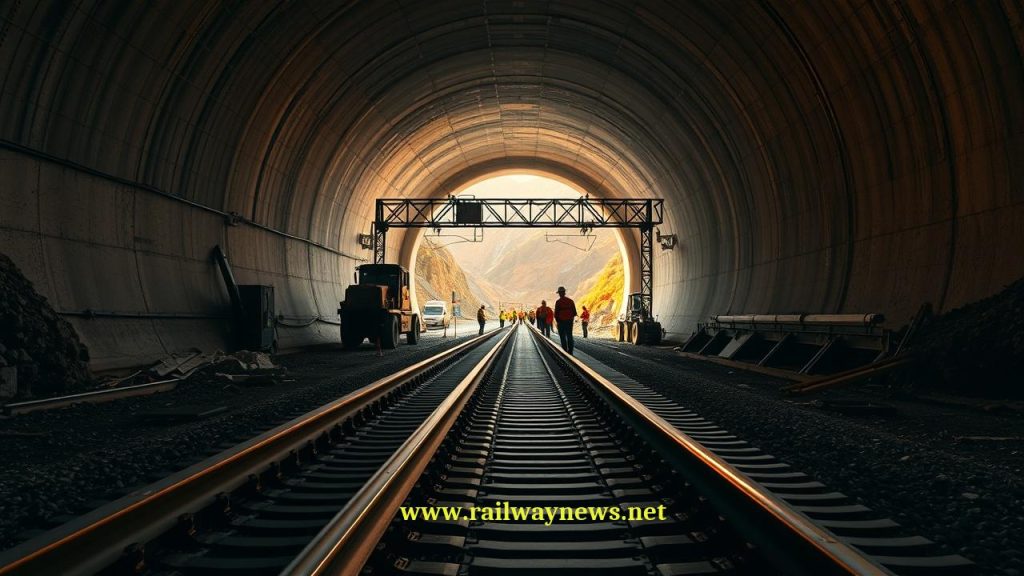
⚡ In Brief: ÖBB began activating a tunnel passing station and installing 8 switches on the Kundl–Baumkirchen line in Tyrol, with works lasting from 10 July to 14 September 2026.
VIENNA, Austria – On 10 July 2026, ÖBB started upgrading the Lower Inn Valley new line to increase capacity by converting a pre-built two-kilometre four-track section inside the Terfener Tunnel into an operational passing station, with no top-speed increase but a focus on shorter train intervals.
What Is the Full Scope of This Project?
The project equips a previously passive section of the Terfener Tunnel with 8 new switches on slab track, signalling modifications for passing operations, and removal of wayside light signals to reduce ETCS block distances, enabling freight trains to pull into siding while passenger services overtake inside the tunnel.
The works cover approximately 2,000 m of track installation, 25,000 m of new cables, 800 m of overhead wire, and modernisation of safety systems in both the Münsterer and Terfener tunnels. ETCS is already operational on the route; this phase digitises block boundaries further. No additional track kilometres outside the existing four-track section are being added.
Key Project Data
| Parameter | Value |
|---|---|
| Project / Contract Name | Lower Inn Valley New Line Capacity Increase (Terfener Tunnel passing station) |
| Total Value | Not disclosed |
| Parties Involved | ÖBB-Infrastruktur AG (infrastructure manager); signalling and construction subcontractors not named |
| Timeline / Completion | 10 July 2026 – 14 September 2026; full service resumes before the school year start |
| Country / Corridor | Austria, Tyrol; Kundl–Baumkirchen new line, part of the TEN-T Scandinavian–Mediterranean Corridor |
How Does This Compare to Similar Projects?
ÖBB’s tunnel passing station represents an incremental capacity intervention typical of Alpine corridor upgrades. By contrast, the Warsaw–Łódź section of Poland’s “Y” high-speed railway—a greenfield 140 km line—is scheduled to open only in 2032, highlighting the differing capital strategies: Austria favours bottleneck elimination on existing corridors while Poland is still building its first dedicated high-speed backbone. (Source: Industry data, 2026)
No cost figure has been provided for the Austrian works, but a comparable tunnel passing loop with ETCS infill and block optimisation on the Gotthard Base Tunnel required an investment in the mid-double-digit million euro range. ÖBB’s project is smaller in scale, covering only 2 km of active four-track section. The programme’s budget remains undisclosed.
Editor’s Analysis
This project confirms a broader European pattern of sweating existing assets before building new alignments. With the Austria railway signalling market already forecast to grow on the back of ETCS deployment (Source: Industry analysis, 2026), ÖBB’s decision to remove light signals and tighten block spacing inside tunnels is a textbook capacity release—adding passing capability without a single new surface structure. The real capacity gain, measured in trains per hour, was not published, but the move suggests the operator anticipates a freight growth scenario that makes even minor overtaking time savings valuable on this transalpine freight artery. Austria’s approach contrasts with neighbouring Germany, where similar in-tunnel passing infrastructure is rare outside the new Stuttgart–Ulm project.
FAQ
Q: Will long-distance Railjet services be cancelled during the works?
A: No. Long-distance trains will be diverted via the old surface line and may arrive in Innsbruck a few minutes later, while Railjets will make additional stops at Jenbach to compensate for suspended Interregio services between Wörgl and Innsbruck from 22 August.
Q: How many new switches are being installed and where?
A: Eight new switches are being installed on the slab track inside the Terfener Tunnel, connecting the existing third and fourth tracks to create an operational passing loop of roughly 2 km length.
Q: What new technology is ÖBB adding beyond the switches?
A: The signalling system is being modernised by removing light signals and reducing ETCS block distances, which permits trains to run at shorter headways digitally. The tunnel also receives 25,000 m of new cables and 800 m of overhead line.

Railway infrastructure, rolling stock and transport technologies specialist focused on global rail industry developments, high-speed rail systems, signaling technologies and freight transportation. Covering railway investments, public transport modernization, rail operations and international mobility projects across Europe, Asia and North America.
RELATED POSTS
July 4, 2026 11:41 pm
Eurostar cancelled all direct London–Amsterdam trains through July 2 after...
July 1, 2026 1:37 pm
NRHS awarded $187K to 34 U.S. rail heritage projects in...
July 1, 2026 6:37 am
Amtrak launched a small-plate dining program for Acela First Class...

July 1, 2026 1:42 am
UK government launched a £30bn Better Connected plan, allocating £15.6bn...
July 4, 2026 11:02 pm
Eurostar suspends all direct London–Dutch trains through 2 July after...

July 1, 2026 8:49 am
The Short Line Training Center launched FRA-funded online DSLE and...