
British Columbia Awards CA$74.2M CPKC Overpass Contract
British Columbia awarded a CA$74.2 million contract to replace a crash-prone CPKC rail overpass in Fraser Valley work starts summer 2025 and completion by 2029.
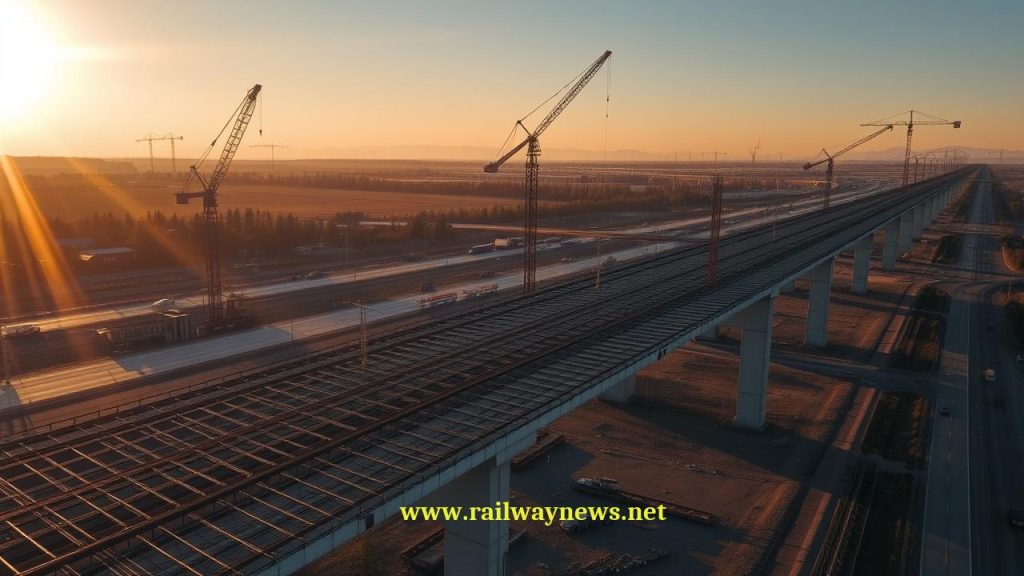
⚡ In Brief: British Columbia awarded a CA$74.2 million contract to a local joint venture to replace a crash-prone CPKC rail overpass in the Fraser Valley, with construction starting summer 2025 and completion by 2029.
LANGLEY, BRITISH COLUMBIA – The Province of British Columbia awarded a CA$74.2 million contract to a joint venture of Norland Ltd. and Kingston Construction Ltd. to replace a CPKC rail overpass between 216th Street and 264th Street. Construction is scheduled to begin in summer 2025 and the new structure will be completed in 2029.
What Does This Contract Cover?
The contract covers the design and construction of a new rail-overpass structure that increases vertical clearance for commercial vehicles and enables future widening of Highway 1 to add high-occupancy vehicle (HOV) lanes in both directions. The existing overpass has been the site of repeated crashes, prompting the height increase.
The work is part of Phase 2 of the Fraser Valley Highway 1 Corridor Improvement Program. No specific clearance height target was disclosed in the announcement.
Key Contract Data
| Parameter | Value |
|---|---|
| Contract Name | CPKC rail overpass replacement (216th St–264th St, Langley) |
| Total Value | CA$74.2 million |
| Parties Involved | Province of British Columbia; Norland Ltd.–Kingston Construction Ltd. joint venture; CPKC (rail corridor owner) |
| Timeline / Completion | Construction start: summer 2025; completion: 2029 |
| Country / Corridor | Canada / British Columbia – Fraser Valley, Highway 1 corridor |
How Does This Compare to Similar Contracts?
No directly comparable Canadian rail-overpass replacement contract was publicly available at time of publication. However, the CA$74.2 million figure falls within the typical cost range of CA$50 million to CA$150 million for grade-separation projects of this scale in North America. The broader context shows sustained government spending on transport-corridor modernization: Phase 2 of the Fraser Valley program is backed by CA$383 million from the province and CA$98 million from the federal government through the New Building Canada Fund.
Globally, rail-adjacent infrastructure investment is increasingly tied to decarbonization and sustainability goals. Indonesia’s state railway operator KAI, for instance, is pursuing a net-zero decarbonisation roadmap with support from UK PACT, integrating solar panels and tree planting (Source: UK PACT/ecobiz.asia, 2025). Meanwhile, German battery production hit a record high in 2025, signalling growing industrial capacity for electrified transport technologies that can complement railway corridor upgrades (Source: Reuters, 2025). While the BC overpass project is a conventional road-rail grade separation, its inclusion of HOV lanes supports modal shift and emission reductions, aligning with these trends.
Editor’s Analysis
British Columbia’s award confirms that provinces continue to prioritize safety-driven, multimodal corridor improvements even amid broader rail innovation. The 2029 completion timeline—spanning over four years—reflects the complexity of replacing a busy overpass while maintaining CPKC freight operations. The repeated crash history at this location gave the project urgency. Funding from the New Building Canada Fund illustrates how senior-level infrastructure transfers remain essential for projects that blend highway expansion with railway safety. Globally, the market context shows that even traditional civil works are happening alongside a record push into battery-electric and autonomous freight technologies, which could reshape how future rail-overpass projects are integrated into supply chains.
FAQ
Q: Why is the overpass being replaced?
A: The existing structure has been struck repeatedly by commercial vehicles, creating safety hazards. The new overpass will have increased height clearance and also allow Highway 1 to be widened with HOV lanes.
Q: What is the total cost of Phase 2 of the Fraser Valley Highway 1 Corridor Improvement Program?
A: Phase 2 is funded by CA$383 million from British Columbia and CA$98 million from the Government of Canada, for a total of CA$481 million. The CA$74.2 million contract is one component of this program.
Q: Will CPKC train operations be affected during construction?
A: Construction staging and temporary rail closures are typical for overpass replacements, but CPKC has not publicly disclosed specific service impacts as of this announcement.

Railway infrastructure, rolling stock and transport technologies specialist focused on global rail industry developments, high-speed rail systems, signaling technologies and freight transportation. Covering railway investments, public transport modernization, rail operations and international mobility projects across Europe, Asia and North America.
RELATED POSTS

October 1, 2026 7:09 am
United States regulators confirmed a September 30 deadline for the...

October 1, 2026 12:13 am
Illinois approved $1.5 billion annually for the Northern Illinois Transit...

October 4, 2026 5:14 pm
Alstom secured a CA$4.7 billion order from VIA Rail Canada...

October 1, 2026 6:10 am
Amtrak approved a System Expansion Committee on July 30 to...
October 1, 2026 3:12 am
Greenbrier confirmed Brian Comstock as new president and CEO effective...

October 6, 2026 2:14 am
Union Pacific launched export rail shipments with Ferromex to deliver...