
Warrington Council Launches 4,500 Homes Liverpool-Manchester Corridor
Warrington Council launched the Bank Quay Gateway masterplan, proposing 4,500 homes in Warrington along the £45 billion Liverpool-Manchester rail link.
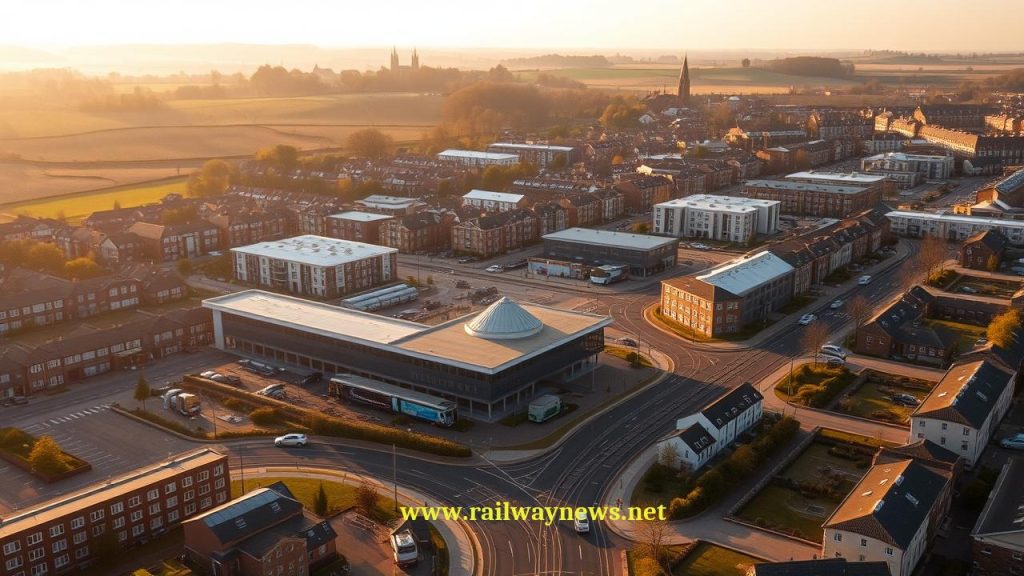
⚡ In Brief: Warrington Borough Council has unveiled the Bank Quay Gateway masterplan in Cheshire, UK, leveraging the planned £45 billion Liverpool-Manchester rail link to deliver 4,500 homes and two million square feet of commercial space.
WARRINGTON, UNITED KINGDOM – Warrington Borough Council formally unveiled the Bank Quay Gateway masterplan in May 2026, targeting the regeneration of underutilised brownfield land surrounding the Bank Quay railway station. The blueprint, designed by master planners WSP and Aecom, proposes up to 4,500 new homes and 2 million square feet of commercial space to accommodate approximately 10,000 workers. The scheme is strategically positioned to leverage the town’s role as a central hub on the proposed £45 billion Liverpool-Manchester railway line.
What Is the Full Scope of This Project?
The Bank Quay Gateway project is a high-density, transit-oriented development designed to transform underutilised industrial land in Warrington into a mixed-use urban quarter. Developed over 14 months by the Warrington Bank Quay Advisory Board—comprising the local council, the Department for Transport (DfT), Homes England, and other government departments—the plan integrates housing and speculatively developed commercial offices. By concentrating high-density residential units adjacent to the rail hub, the project aims to relieve greenfield development pressures across Cheshire. However, the full realisation of the masterplan is contingent on the delivery of the government’s Northern Powerhouse Rail (NPR) link, and the precise phased timeline for the gateway’s construction remains undisclosed.
Key Project Data
| Parameter | Value |
|---|---|
| Project / Contract Name | Warrington Bank Quay Gateway Masterplan |
| Total Value | Not disclosed (associated with £45bn Liverpool-Manchester rail line) |
| Parties Involved | Warrington Borough Council, WSP, Aecom, DfT, MHCLG, DBT, Homes England |
| Timeline / Completion | Not disclosed |
| Country / Corridor | United Kingdom / Liverpool-Manchester Corridor |
How Does This Compare to Similar Projects?
Transit-oriented development projects tied to major UK rail infrastructure reflect a broader trend of high-value, long-term investments in national transport connectivity. For comparison, High Speed 2 (HS2) has initiated market engagement for a £1.24 billion package of interim maintenance contracts to sustain its high-speed infrastructure from December 2027 through 2037 (Source: Construction News, 2026). While the HS2 contracts focus on maintaining existing and under-construction high-speed assets, the Warrington scheme represents a speculative, local-authority-led regeneration model that depends heavily on the realization of future state-funded rail links. Additionally, independent verification of the specific £45 billion funding allocation and alignment details for the Liverpool-Manchester railway line was not available at the time of publication.
Editor’s Analysis
The success of the Bank Quay Gateway rests on a dependency loop where local commercial viability is tied to national rail delivery timelines that are historically prone to delays. Speculative office developments have been absent from Warrington for 15 years, meaning regional authorities are taking a calculated gamble on Northern Powerhouse Rail to stimulate private sector demand. This localized strategy aligns with wider UK efforts to modernize the passenger experience, such as the government’s parallel plan to deploy low-earth satellite technology to upgrade train WiFi from 50% to 90% connectivity (Source: iNews, 2026).
FAQ
Q: What is the main objective of the Warrington Bank Quay Gateway masterplan?
A: The masterplan aims to construct 4,500 new homes and 2 million square feet of commercial space on brownfield land surrounding the Bank Quay station. It seeks to position Warrington as a central hub for 10,000 workers along the proposed Liverpool-Manchester rail route.
Q: How much funding has been allocated to the Warrington Bank Quay Gateway development?
A: The specific capital budget and funding split for the gateway development have not been publicly disclosed. However, the project is designed to capitalise on the UK government’s planned £45 billion Liverpool-Manchester railway corridor.
Q: How will the Bank Quay development affect local green spaces?
A: By building high-density housing on urban brownfield sites, the project aims to reduce development pressure on local green belts. Warrington Borough Council is collaborating with Cheshire East and Cheshire West and Chester councils to distribute regional housing targets strategically.

Railway infrastructure, rolling stock and transport technologies specialist focused on global rail industry developments, high-speed rail systems, signaling technologies and freight transportation. Covering railway investments, public transport modernization, rail operations and international mobility projects across Europe, Asia and North America.
RELATED POSTS

October 8, 2026 1:15 pm
Alstom secured a €1bn contract to build 13 automated trains,...

October 1, 2026 7:09 am
United States regulators confirmed a September 30 deadline for the...

October 8, 2026 12:18 pm
Siemens Mobility signed an agreement with VinSpeed to supply 350...

October 4, 2026 5:14 pm
Alstom secured a CA$4.7 billion order from VIA Rail Canada...

October 5, 2026 6:12 pm
AECOM and Jacobs secured a contract in September 2026 to...

October 1, 2026 12:13 am
Illinois approved $1.5 billion annually for the Northern Illinois Transit...