
Afcons Secures €677M Croatia Dugo Selo Novska Upgrade
Afcons Infrastructure secured a €677 million contract to double-track and upgrade Croatia’s 83-km Dugo Selo – Novska rail line.
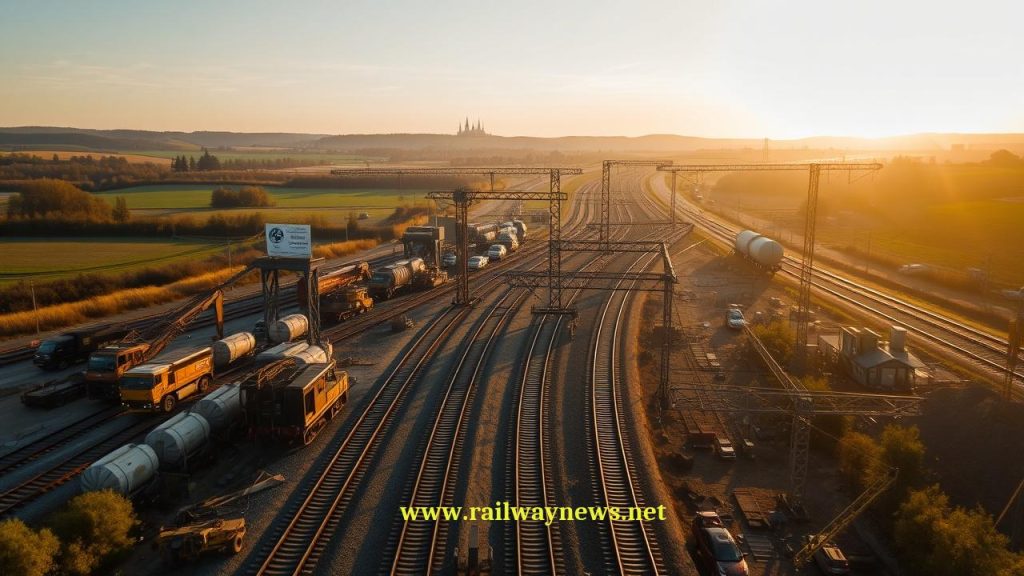
⚡ In Brief: India-based Afcons Infrastructure has secured a EUR 677 million contract to upgrade and double-track the 83-kilometre Dugo Selo – Novska railway line in Croatia, a key project on the TEN-T Mediterranean Corridor financed by the European Union.
ZAGREB, CROATIA – Croatia’s national rail infrastructure manager has awarded a EUR 677 million contract to Afcons Infrastructure Limited for the modernisation of the Dugo Selo – Novska line. The project covers an 83-kilometre corridor and is scheduled to last approximately five years and ten months upon finalisation. The work is a central component of Croatia’s EUR 6 billion rail investment programme running to 2030.
What Is the Full Scope of This Project?
The project entails a comprehensive upgrade of the Dugo Selo – Novska corridor, including full double-tracking, electrification, and the installation of modern signalling and telecommunications systems to allow train speeds of up to 160 km/h. Beyond the track work, the scope includes reconstructing 16 stations, building one new station, and removing all level crossings. A critical but less-publicised component is the enhancement of the railway’s energy subsystem, which will involve the installation of up to 200 MW of decentralised gas-fired power-generation capacity to ensure an uninterrupted energy supply for the network. (Source: European Bank for Reconstruction & Development).
Key Project Data
| Parameter | Value |
|---|---|
| Project / Contract Name | Dugo Selo – Novska Railway Line Upgrade |
| Total Value | EUR 677 million |
| Parties Involved | Croatian Rail Infrastructure Manager (client), Afcons Infrastructure Limited (contractor), European Union (funder) |
| Timeline / Completion | Approx. 5 years and 10 months from contract signing |
| Country / Corridor | Croatia / TEN-T Mediterranean Corridor |
How Does This Compare to Similar Projects?
The Dugo Selo – Novska project’s value of approximately EUR 8.15 million per kilometre is consistent with other major European corridor upgrades involving significant civil works and new systems. The reliance on international financing mirrors other strategic infrastructure developments, such as Tanzania’s Standard Gauge Railway, which has also secured substantial backing from global financial institutions for its multi-billion-dollar construction. The scale of the Croatian contract underscores the increasing complexity of major infrastructure tenders, where new frameworks like the UNCITRAL Model Clauses on Specialised Express Dispute Resolution are becoming more relevant for managing potential construction disputes efficiently. (Source: UNCITRAL, 2024). The full funding breakdown for the EUR 677 million contract value was not disclosed in the initial announcement.
Editor’s Analysis
This contract award is significant for two primary reasons: it marks a major European market entry for Afcons Infrastructure under the EU’s stringent technical and regulatory standards, and it highlights Croatia’s progress in leveraging EU funds to modernise its portion of the core TEN-T network. The inclusion of a dedicated 200 MW power-generation capacity reflects a growing strategic emphasis on energy resilience for critical transport infrastructure, a trend accelerated by recent geopolitical events in Europe. The signalling component of the project will also occur within a dynamic local market, influenced by Siemens Mobility’s recent acquisition of key MerMec signalling activities in the region. (Source: Siemens Mobility).
FAQ
Q: Who is funding the Dugo Selo – Novska railway project?
A: The project is co-financed primarily by the European Union through its Connecting Europe Facility (CEF) and the National Recovery and Resilience Plan (NRRP), with the Croatian state providing the remaining share. The total contract value awarded is EUR 677 million.
Q: What are the main technical improvements being made to the line?
A: The 83 km corridor will be fully double-tracked and electrified to support speeds of 160 km/h, with modern signalling and telecommunications. The project also includes installing up to 200 MW of dedicated power-generation capacity to ensure energy security for the railway.
Q: How will this upgrade impact Croatia’s connection to the wider European network?
A: As part of the TEN-T Mediterranean Corridor, this modernisation will significantly increase capacity and reduce travel times on the strategic Zagreb – Vinkovci – Serbian border axis. This strengthens a key freight and passenger link between Central Europe, the Port of Rijeka, and Southeast Europe.

Railway infrastructure, rolling stock and transport technologies specialist focused on global rail industry developments, high-speed rail systems, signaling technologies and freight transportation. Covering railway investments, public transport modernization, rail operations and international mobility projects across Europe, Asia and North America.
RELATED POSTS
July 4, 2026 11:41 pm
Eurostar cancelled all direct London–Amsterdam trains through July 2 after...
July 1, 2026 1:42 am
UK government launched a £30bn Better Connected plan, allocating £15.6bn...

July 4, 2026 11:02 pm
Eurostar suspends all direct London–Dutch trains through 2 July after...
July 1, 2026 4:22 pm
Správa železnic opened a €60M multimodal hub at Jihlava město...
July 1, 2026 11:26 am
SC Ports suspended container operations at Hugh K. Leatherman Terminal...

July 6, 2026 4:00 am
Turkey and the EU completed the U-IMT project, delivering an...