
PKP Cargo Signs Military Mobility Agreement Poland
PKP Cargo signed an indefinite agreement with Poland’s Ministry of National Defense to enhance military rail transport for NATO forces.
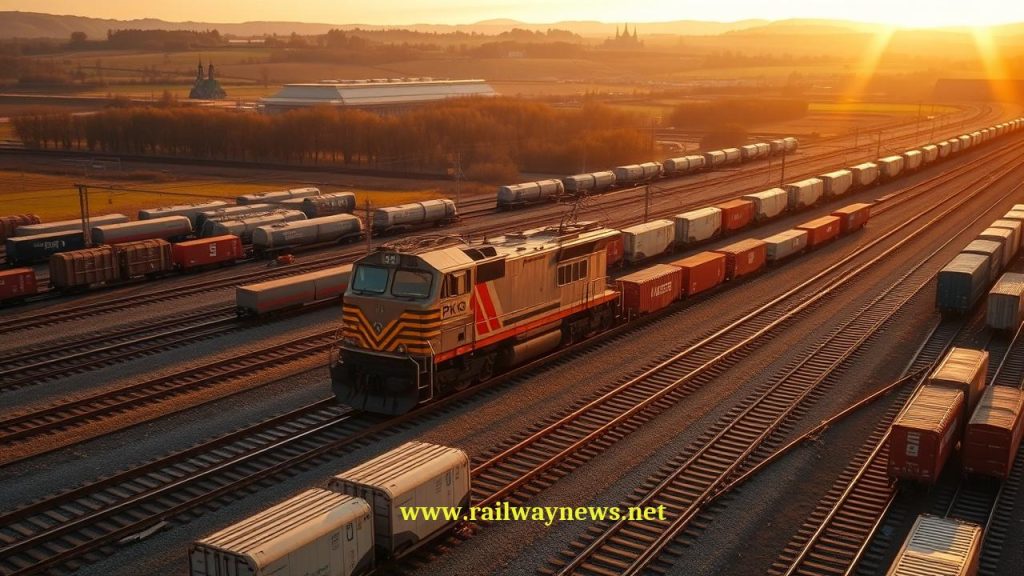
⚡ In Brief: Polish state-owned rail freight operator PKP Cargo, currently undergoing restructuring, has signed an indefinite framework agreement with the Ministry of National Defense to enhance military rail transport capabilities for Polish and allied NATO forces.
WARSAW, POLAND – The Polish state rail freight operator, PKP Cargo, has entered into a strategic partnership with the country’s Ministry of National Defense. The agreement, signed for an indefinite period, establishes a framework for developing rail logistics to support the Polish Armed Forces and allied troops. This move restores the company to a strategic national security role while it navigates a corporate restructuring process.
What Does This Contract Cover?
The agreement provides a formal structure for cooperation on military mobility without immediate financial obligations. It covers the use of PKP Cargo’s assets for the transport of heavy military equipment and machinery, access to the operator’s terminal infrastructure and industrial lines, and the deployment of locomotives capable of operating on non-electrified routes. The framework also includes developing joint solutions for transport security, communications, and rapid response protocols during crisis situations, both within Poland and for cross-border operations.
Key Contract Data
| Parameter | Value |
|---|---|
| Contract Name | Military Mobility Cooperation Agreement |
| Total Value | Not disclosed (Framework agreement; financial details tied to subsequent project-specific contracts) |
| Parties Involved | PKP Cargo, Polish Ministry of National Defense |
| Timeline / Completion | Indefinite period |
| Country / Corridor | Poland and cross-border allied operations |
How Does This Compare to Similar Contracts?
This agreement reflects a broader trend of transport and industrial companies pivoting to serve defense logistics needs. While the financial scope of the PKP Cargo framework is not yet defined, other public-private defense partnerships highlight the potential scale of such ventures. For instance, Jaguar Land Rover and General Motors are collaborating on a £900 million contract to build a new range of military trucks, demonstrating the high value placed on specialized mobility solutions by national governments (Source: The Guardian). The PKP Cargo deal focuses on leveraging existing state-owned rail infrastructure rather than new manufacturing.
Editor’s Analysis
This agreement firmly embeds the restructuring PKP Cargo within Poland’s national security apparatus, providing a strategic rationale for its future. The timing is notable, coming as Polish officials have publicly expressed frustration over the Pentagon’s abrupt cancellation of a planned U.S. troop rotation (Source: Defense News). By formalizing and strengthening its domestic military logistics capabilities, Poland is bolstering its self-reliance and cementing its role as a critical logistics hub for NATO in Eastern Europe, ensuring operational readiness regardless of specific deployment schedules of any single ally.
FAQ
Q: Why is this agreement important for NATO?
A: The agreement enhances military mobility, a key priority for NATO, by preparing Polish rail infrastructure for the rapid deployment of both national and allied troops. This strengthens the alliance’s eastern flank by ensuring efficient logistical support and movement of heavy equipment.
Q: What is the financial value of this deal for PKP Cargo?
A: The initial framework agreement carries no direct financial obligations. Value for PKP Cargo will be generated through future, project-specific contracts negotiated under this framework to provide transport and logistics services to the military.
Q: Does this agreement relate to recent US-Poland relations?
A: While not directly linked in the announcement, the deal to strengthen domestic and NATO mobility infrastructure was signed after Polish leaders, including Defense Minister Władysław Kosiniak-Kamysz, voiced concerns over a scrapped U.S. troop deployment (Source: Politico). Enhancing Poland’s own logistical capacity can be interpreted as a strategic move to increase its defense autonomy and value to the broader alliance.

Railway infrastructure, rolling stock and transport technologies specialist focused on global rail industry developments, high-speed rail systems, signaling technologies and freight transportation. Covering railway investments, public transport modernization, rail operations and international mobility projects across Europe, Asia and North America.
RELATED POSTS

September 6, 2026 5:19 am
Hitachi delivered Taiwan's first N700ST high-speed train from Japan in...

September 5, 2026 4:19 pm
CPK launched formal tender talks with four consortia to design...

September 5, 2026 7:14 pm
HS2 Ltd signed renegotiated civils contracts with EKFB and Align...

September 6, 2026 6:17 am
Hungary ordered a national ban on most freight trains from...

September 6, 2026 1:17 am
Hitachi Toshiba Supreme Consortium confirmed the first of 12 N700ST...
September 6, 2026 8:17 am
DB InfraGO reopened the Nuremberg-Regensburg line in Bavaria on 31...