
ProRail Launches Coevorden-Bad Bentheim Link by 2026
ProRail commenced construction on the cross-border Coevorden-Bad Bentheim rail link between the Netherlands and Germany, restoring passenger services by December 2026 after 87 years.
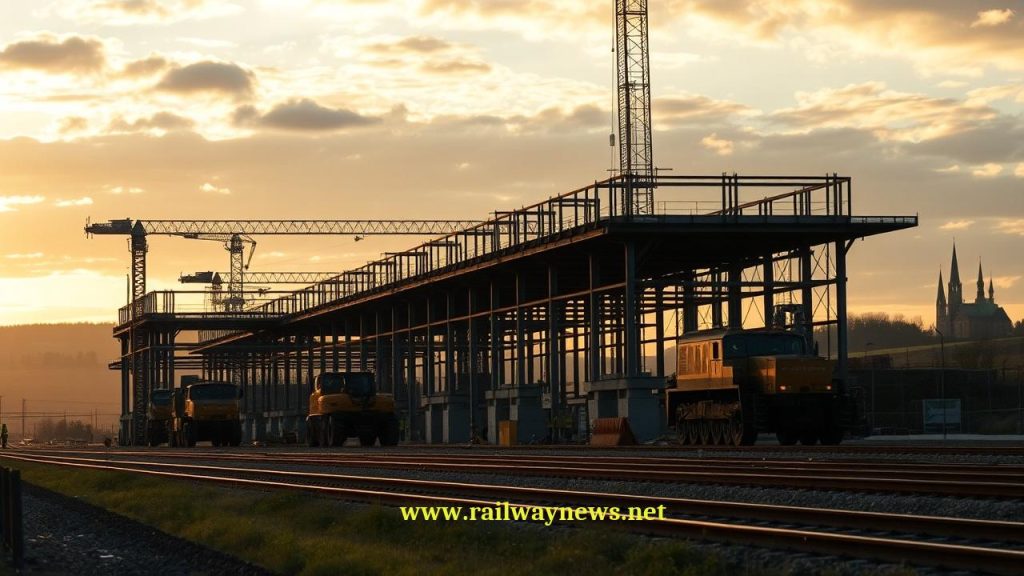
⚡ In Brief: Dutch infrastructure manager ProRail has commenced construction on a cross-border rail link between Coevorden, Netherlands, and Bad Bentheim, Germany, set to restore passenger services by December 2026 for the first time in 87 years.
COEVORDEN, NETHERLANDS – Dutch rail infrastructure manager ProRail has initiated major construction to re-establish a rail connection between Coevorden, Netherlands, and Bad Bentheim, Germany. The project, contracted to Dura Vermeer, aims to launch cross-border passenger services in December 2026, marking the first time in 87 years trains will run on the route. Key works include a new platform, track modifications, and the installation of a German rail safety system to ensure interoperability.
What Is the Full Scope of This Project?
The project’s scope extends beyond track work to include significant station and systems upgrades at Coevorden. A new platform will be built on the station’s west side, serviced by a new entrance and an elevator to the central tunnel. Crucially, a German rail safety system will be installed within the Dutch station to allow for seamless operations by German-based operator Bentheimer Eisenbahn. The project also includes modifications to switches, tracks, and signals to increase train throughput and improve the timetable reliability of the connecting Vechtdallijnen regional service.
Key Project Data
| Parameter | Value |
|---|---|
| Project / Contract Name | Coevorden-Bad Bentheim Rail Link Restoration |
| Total Value | Not disclosed |
| Parties Involved | ProRail (client), Dura Vermeer (contractor), Bentheimer Eisenbahn (operator) |
| Timeline / Completion | Construction started; passenger service launch scheduled for December 2026 |
| Country / Corridor | Netherlands / Germany (Drenthe / Lower Saxony) |
How Does This Compare to Similar Projects?
This project represents a focused investment in regional, cross-border connectivity, contrasting sharply with large-scale, resource-driven rail developments globally. For example, a new $1.3 billion rail line is being funded in Zambia to connect critical mineral mines to the port of Lobito in Angola, a project with a total estimated cost of up to $5 billion (Source: Mining.com, 2024). The Dutch-German link’s primary technical challenge is system interoperability, necessitating the installation of a German safety system on Dutch soil. This reflects a wider European Union objective to create a seamless rail network, a goal shared by projects like the GSM-R installation on Poland’s Central Railway Line to meet EU standards for cross-border traffic (Source: Developing Telecoms, 2024).
Editor’s Analysis
While modest in physical scale, the Coevorden-Bad Bentheim project is strategically important as a micro-level implementation of the EU’s macro-level goal for rail interoperability. It directly addresses the technical barriers that have historically fragmented European national rail networks. This investment also aligns with the current economic trend where escalating fuel costs are increasing the attractiveness of rail for both passenger and freight transport as a cost-effective alternative to road haulage (Source: Sourcing Journal, 2024).
FAQ
Q: Why was this rail line closed to passengers for so long?
A: Passenger services on this line were suspended 87 years ago, a period preceding World War II. The closure was likely due to a combination of geopolitical tensions and the subsequent post-war shift toward road-based transportation, a trend which is now reversing.
Q: What is the total cost of the Coevorden-Bad Bentheim rail project?
A: The total investment value for this specific construction project has not been publicly disclosed by ProRail or the contractor, Dura Vermeer. Infrastructure projects of this nature often involve multiple funding sources from regional and national bodies.
Q: How will this new link impact freight traffic?
A: The designated operator, Bentheimer Eisenbahn, provides both passenger and freight services. The planned upgrades to tracks and signals are designed to accelerate all train movements, creating more capacity and improving timetable reliability for freight trains using this cross-border corridor.

Railway infrastructure, rolling stock and transport technologies specialist focused on global rail industry developments, high-speed rail systems, signaling technologies and freight transportation. Covering railway investments, public transport modernization, rail operations and international mobility projects across Europe, Asia and North America.
RELATED POSTS

September 6, 2026 5:19 am
Hitachi delivered Taiwan's first N700ST high-speed train from Japan in...

September 5, 2026 4:19 pm
CPK launched formal tender talks with four consortia to design...

September 5, 2026 7:14 pm
HS2 Ltd signed renegotiated civils contracts with EKFB and Align...
September 6, 2026 1:17 am
Hitachi Toshiba Supreme Consortium confirmed the first of 12 N700ST...
September 6, 2026 6:17 am
Hungary ordered a national ban on most freight trains from...
September 7, 2026 8:16 am
Midea, Gree and TCL shipped air conditioners via China Railway...