
France Trials Dual-Mode Road/Rail on 5,700 Km Abandoned Lines
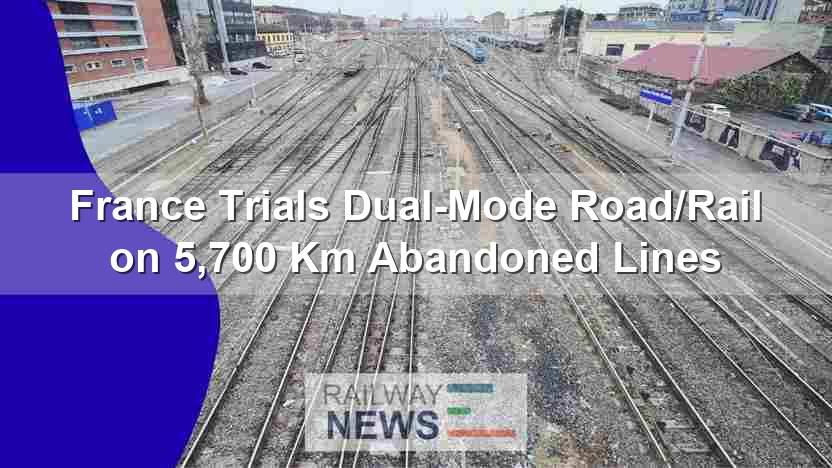
France is testing light electric vehicles called “Ferromobiles” on disused railway lines for a dual-mode operation that aims to provide low-cost mobility infrastructure in underserved rural areas, utilizing repurposed assets and reducing operational costs significantly.
📉 Market Brief:
- Event: France initiates trials for a dual-mode road/rail transport system.
- Key Data: 5,700 km of abandoned secondary railway lines targeted for reuse.
- Impact: Potential new mobility infrastructure for underserved rural areas.
An initiative in France is testing the viability of light electric vehicles, termed “Ferromobiles,” for operation on approximately 5,700 km of disused secondary railway lines. The project, part of the government’s France 2030 plan, aims to provide a low-cost mobility solution without requiring extensive modernization or electrification of the old infrastructure. The engineering company SICEF is developing the system within the Flexmove consortium, which is coordinated by AKKA Technologies.
The vehicles are adapted from the Peugeot e-Traveller model and are designed to carry up to eight passengers. The technical specifications allow for autonomous operation on rails and manual control by a driver on public roads. The concept is positioned as an intermediate transport solution for routes with demand too low for conventional trains but too high for exclusive reliance on private cars. Operation is 100% electric, resulting in zero emissions at the point of use.
Initial tests are underway on the Courpière – Vertolaye line in the Auvergne region. This line was selected due to its rural location and the long-term suspension of previous rail services. The Ferromobiles will operate exclusively on decommissioned lines, which eliminates the need for complex signaling integration and avoids traffic conflicts with the national rail network.
The operational framework allows for two service models: a fixed schedule with minimal waiting times or an on-demand service managed through a mobile application. This dual-mode approach offers flexibility to match service levels with fluctuating passenger demand in low-density areas. The project is described as an application of “frugal innovation” by repurposing existing assets to lower operational costs significantly compared to traditional rail services.
The government has assigned SICEF to coordinate the consortium, which also includes the transport engineering firm Systra, research institution Université Gustave Eiffel, and the technology start-up Entropy. These partners contribute expertise across vehicle engineering, rail systems, and operational logistics.
| Metric | Value / Specification |
|---|---|
| Target Infrastructure | 5,700 km of abandoned secondary lines |
| Vehicle Base Model | Peugeot e-Traveller |
| Passenger Capacity | Up to 8 |
| Propulsion System | 100% Electric |
| Lead Engineering Firm | SICEF (part of Flexmove consortium) |
| Initial Test Location | Courpière – Vertolaye line, Auvergne |
| Operational Modes | Scheduled or on-demand (via app) |
| Government Framework | France 2030 Plan |
If the pilot phase confirms the economic and operational feasibility of the Ferromobile concept, the program could be extended to other regions with extensive networks of unused lines, including Occitanie, Nouvelle-Aquitaine, and Brittany. The project’s success is contingent on demonstrating its financial self-sustainability and public acceptance.
Readers following this story from late 2025 will recall the announcement. Full coverage 📰

Railway infrastructure, rolling stock and transport technologies specialist focused on global rail industry developments, high-speed rail systems, signaling technologies and freight transportation. Covering railway investments, public transport modernization, rail operations and international mobility projects across Europe, Asia and North America.
RELATED POSTS

October 1, 2026 7:09 am
United States regulators confirmed a September 30 deadline for the...

October 8, 2026 1:15 pm
Alstom secured a €1bn contract to build 13 automated trains,...

October 4, 2026 5:14 pm
Alstom secured a CA$4.7 billion order from VIA Rail Canada...

October 4, 2026 11:08 pm
Sound Transit confirmed the September 30 opening of Seattle Pinehurst...
October 1, 2026 10:14 am
HS2 installed a 55-metre steel span in Birmingham, completing phase...

October 5, 2026 6:12 pm
AECOM and Jacobs secured a contract in September 2026 to...