
Santiago Metro Expands With $2.5 Billion Line 7 Project
Santiago Metro expands with a $2.5 billion Line 7 project, receiving 37 Alstom Metropolis trains for 26 kilometers of driverless operation.
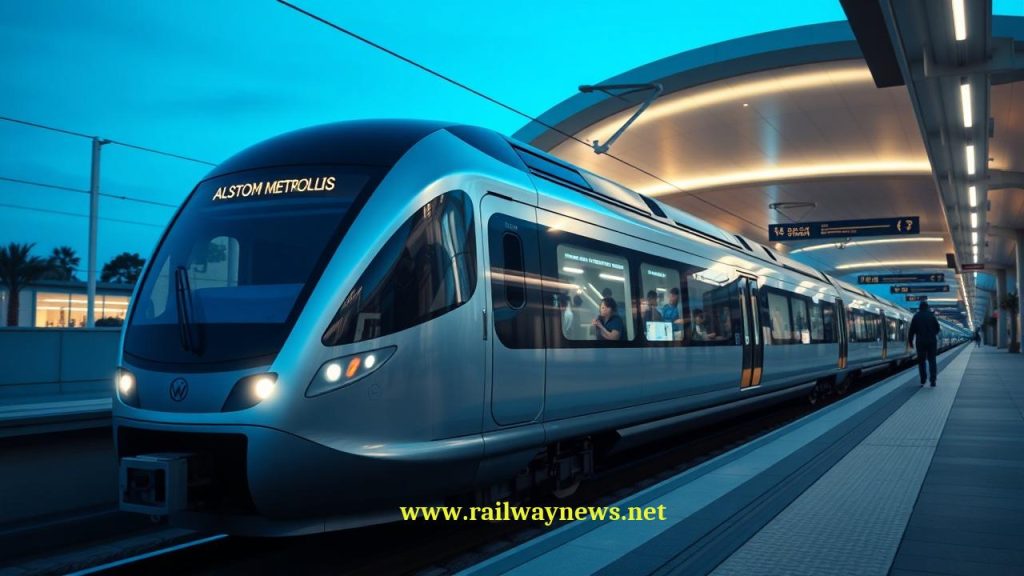
The first Metropolis AS-22-UTO trainset for Santiago Metro was presented at Alstom’s manufacturing facility in Taubaté, Brazil. The unit is part of a 37-train order for the city’s new Line 7, a project with a total investment of USD 2.5 billion.
Each of the 37 trains is a five-car configuration, measuring 102 meters in length with a total capacity for 1,247 passengers. The car bodies are constructed from stainless steel and are equipped with air conditioning, passenger information systems, and USB-C charging ports. Two dedicated spaces for passengers with reduced mobility are included in every trainset.
Operations on the 26-kilometer Line 7 will be managed by Alstom’s Urbalis communications-based train control (CBTC) system. This technology facilitates Grade of Automation 4 (GoA4), enabling fully driverless operation. The system integrates high-resolution cameras and passenger intercoms directly with the central control center.
The Line 7 infrastructure project includes 19 stations and is scheduled to become operational in 2028. The initial delivery of rolling stock from the Taubaté plant to Chile is planned for the second half of 2026. The project is expected to generate 24,000 jobs during its construction and operational phases.
Upon completion, the new line will reduce end-to-end travel time between its terminals from 72 to 37 minutes and will serve an estimated 1.6 million residents. With planned extensions, the Metro de Santiago network is projected to reach a total length of 231.5 kilometers by 2033.

Railway infrastructure, rolling stock and transport technologies specialist focused on global rail industry developments, high-speed rail systems, signaling technologies and freight transportation. Covering railway investments, public transport modernization, rail operations and international mobility projects across Europe, Asia and North America.
RELATED POSTS

October 1, 2026 7:09 am
United States regulators confirmed a September 30 deadline for the...

October 8, 2026 1:15 pm
Alstom secured a €1bn contract to build 13 automated trains,...

October 4, 2026 5:14 pm
Alstom secured a CA$4.7 billion order from VIA Rail Canada...

October 1, 2026 12:13 am
Illinois approved $1.5 billion annually for the Northern Illinois Transit...
October 6, 2026 2:14 am
Union Pacific launched export rail shipments with Ferromex to deliver...

October 1, 2026 6:10 am
Amtrak approved a System Expansion Committee on July 30 to...