
EN 16235: Europe’s New Path To Faster Freight Wagon Approval
EN 16235 streamlines freight wagon authorization, allowing variants to skip full on-track testing via rigorous comparative analysis. Save costs and accelerate market entry safely.
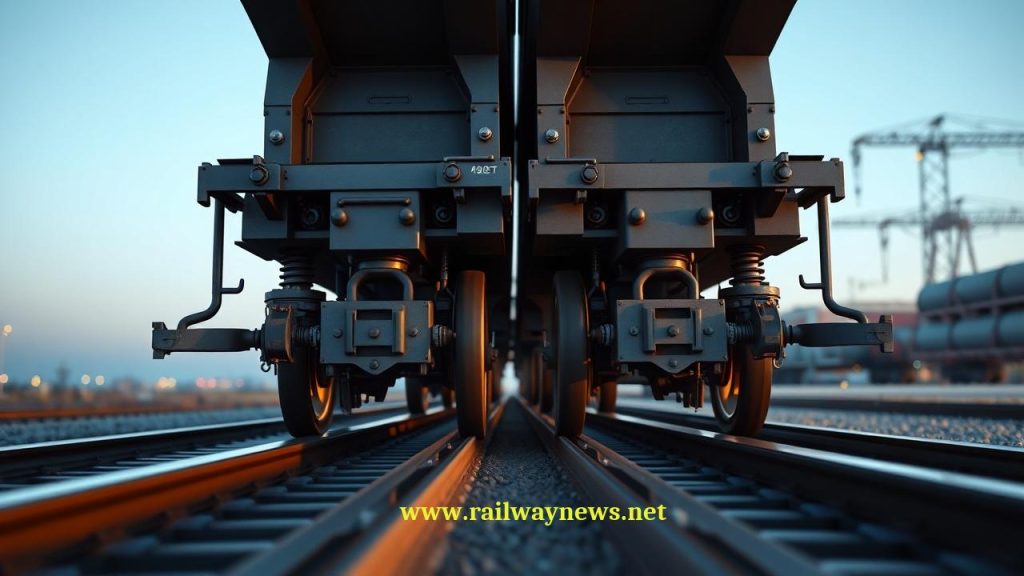
Understanding EN 16235: Dispensation for Freight Wagon On-Track Testing
EN 16235 is a European Standard that specifies the conditions under which a new or modified freight wagon can be exempted, or ‘dispensed’, from the full on-track testing procedures detailed in EN 14363. It provides a structured, evidence-based methodology to demonstrate that a wagon’s running characteristics are safe and compliant without undergoing extensive and costly physical tests.
In the railway industry, ensuring the safe running characteristics of any new vehicle is paramount. The primary standard for this is EN 14363, which involves detailed on-track tests to measure vehicle dynamic behaviour. However, for freight wagons that are variants of an already approved design, performing these full tests is often redundant. EN 16235 addresses this by establishing a framework for a comparative assessment against a previously tested and approved “reference wagon.”
The Core Principle: Comparison with a Reference Wagon
The fundamental concept of EN 16235 is to avoid re-testing what is already known. If a ‘candidate wagon’ is sufficiently similar to a ‘reference wagon’ that has already successfully passed EN 14363 tests, its dynamic performance can be reliably predicted. This dispensation process is not a loophole; it is a rigorous engineering assessment that requires detailed documentation and justification.
The process involves:
- Identification of a Reference Wagon: A suitable, previously approved wagon with a known and documented performance history.
- Comparative Analysis: A detailed comparison of the key parameters of the candidate wagon against the reference wagon.
- Justification: A technical report proving that any differences between the two wagons do not negatively impact safety or running characteristics.
Key Technical Parameters for Assessment
The standard outlines specific characteristics that must be meticulously compared to justify dispensation. The assessment focuses on any parameter that could influence the vehicle’s dynamic behaviour on the track.
1. Suspension Characteristics
The suspension is critical to a wagon’s stability and track-holding ability. The comparison must cover:
- Springs: The stiffness characteristics of both primary and secondary suspension springs.
- Dampers: The damping force-velocity characteristics of all dampers.
- Links and Bushes: The stiffness and properties of elements like axlebox guides and control arms.
- Friction Elements: The characteristics of friction wedges or Lenoir links used for damping in many freight bogies.
Any change in these components can significantly alter the wagon’s response to track irregularities, its stability at speed, and its curving performance.
2. Mass and Geometric Data
The distribution and value of mass are fundamental to vehicle dynamics. The following must be assessed:
- Tare and Gross Mass: The empty and fully laden weights of the wagon.
- Centre of Gravity: The height of the centre of gravity in both tare and laden conditions.
- Moments of Inertia: The moments of inertia of the carbody and bogies around the roll, pitch, and yaw axes.
- Geometric Dimensions: Key measurements such as bogie pivot pitch, wheelbase, and overall body length.
3. Wheel-Rail Interface
The interaction between the wheel and the rail dictates the safety and stability of the vehicle.
- Wheel Profile: The candidate wagon must use a wheel profile that is identical or has been proven to be equivalent in performance to that of the reference wagon.
- Wheel Diameter: The nominal wheel diameter must be within an acceptable range of the reference.
- Axle and Wheelset Design: The overall design of the wheelset, including its mass and stiffness, is considered.
Comparison Table: EN 16235 Dispensation vs. EN 14363 Full Testing
The following table contrasts the two approaches for the acceptance of running characteristics.
| Aspect | EN 14363 (Full On-Track Testing) | EN 16235 (Dispensation Process) |
|---|---|---|
| Methodology | Physical on-track tests using instrumented wheelsets and sensors to measure forces, accelerations, and displacements. | Comparative analysis based on design data, calculations, and simulations. Relies on existing test data from a reference vehicle. |
| Cost | High. Involves test train organization, track access charges, instrumentation, and extensive data analysis. | Significantly Lower. Primarily involves engineering man-hours for analysis and documentation. |
| Time to Market | Long. Can take several weeks or months to plan, execute, and report on the tests. | Short. The assessment and documentation process is much faster than physical testing. |
| Applicability | Required for entirely new vehicle designs or those with significant modifications to dynamic-related components. | Applicable for variants of existing, approved designs where differences are minimal and their effects are well understood. |
| Primary Output | A detailed test report with measured data proving compliance with safety limits. | A detailed assessment report justifying why the candidate wagon is equivalent to the reference wagon in terms of safety. |
Benefits and Limitations of the Dispensation Route
Benefits
- Cost-Effectiveness: Drastically reduces the high costs associated with organizing and conducting on-track tests.
- Reduced Time to Market: Speeds up the authorization process for new freight wagon variants, allowing them to enter service more quickly.
- Efficiency: Avoids redundant testing, freeing up valuable track capacity and engineering resources for novel developments.
- Environmental Impact: Reduces the need for dedicated test trains, thus lowering energy consumption and emissions.
Limitations
- Limited Scope: Only applicable to wagons that are demonstrably similar to an existing, approved reference wagon. It cannot be used for completely new or innovative designs.
- Data Dependency: The quality of the dispensation case is entirely dependent on the availability and quality of data for the reference wagon.
- Risk of Overlooking Effects: A poorly executed comparative analysis could fail to identify a critical difference, potentially compromising safety.
- Regulatory Acceptance: The final decision for acceptance rests with the relevant National Safety Authority (NSA) or approval body, which may still require additional information or limited testing.
Conclusion: A Pragmatic Tool for the Rail Industry
EN 16235 represents a mature and pragmatic approach to vehicle authorization in the railway sector. It acknowledges that not every design variation warrants a full-scale, expensive testing campaign. By providing a robust, engineering-led framework for comparison, it strikes a critical balance between maintaining the highest safety standards and promoting efficiency and innovation. It is an essential tool for manufacturers and operators, enabling the streamlined introduction of new freight wagon variants while ensuring their dynamic performance remains safe and reliable.

Railway infrastructure, rolling stock and transport technologies specialist focused on global rail industry developments, high-speed rail systems, signaling technologies and freight transportation. Covering railway investments, public transport modernization, rail operations and international mobility projects across Europe, Asia and North America.