
EN 14601: Europe’s Foundation For Rail Pneumatic Safety
EN 14601 is the European standard for railway end cocks, guaranteeing critical pneumatic system safety, interoperability, and reliable braking across the network.
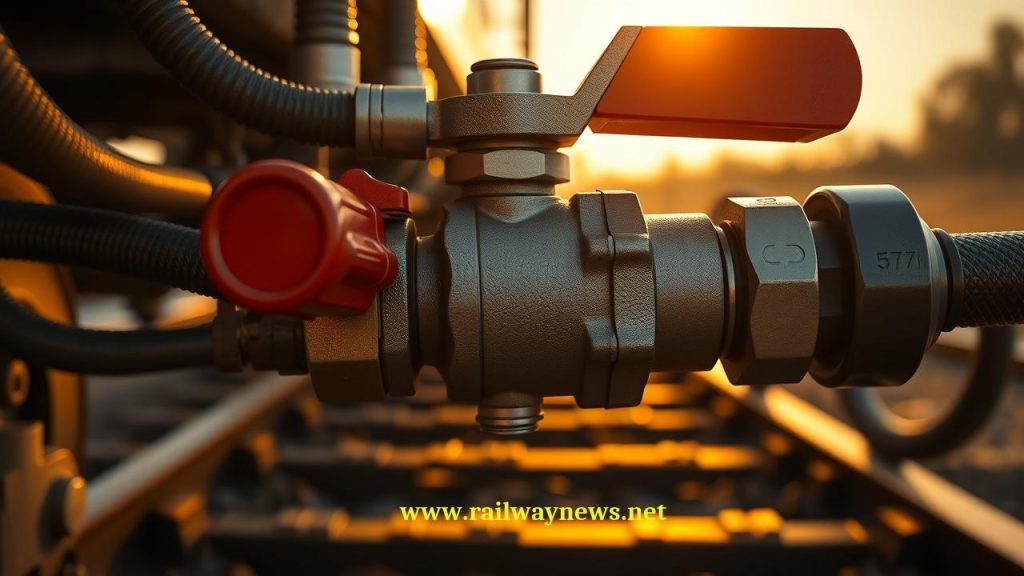
Understanding EN 14601: The European Standard for Railway End Cocks
EN 14601 is a European technical standard that specifies the requirements for the design, performance, and testing of straight and angled end cocks used in railway vehicle pneumatic systems. These components are critical for the safe and reliable operation of the brake pipe and main reservoir pipe, forming an essential part of the train’s compressed air network.
The primary purpose of this standard is to ensure interoperability, safety, and reliability across the European railway network. By defining uniform dimensions, material properties, and performance criteria, EN 14601 guarantees that end cocks from different manufacturers are interchangeable and function predictably, which is vital for trains operating across international borders.
The Critical Role of End Cocks in Railway Pneumatic Systems
End cocks are manually operated ball valves located at the ends of the flexible air hoses that connect railway vehicles. Their function is simple but absolutely critical:
- Isolating Air Lines: When a vehicle is at the end of a train, its end cock is closed to seal the pneumatic system and maintain pressure.
- Coupling and Uncoupling: Before uncoupling vehicles, the end cocks on both sides of the connection are closed to prevent a sudden and uncontrolled loss of air pressure, which would trigger an emergency brake application.
- System Maintenance: They allow individual vehicles or sections of the train to be pneumatically isolated for maintenance or inspection without depressurizing the entire train.
A failure in an end cock—whether through leakage, mechanical seizure, or fracture—can have severe consequences, potentially leading to brake failure or an inability to control the train. This underscores the importance of a robust standard like EN 14601.
Key Technical Requirements of EN 14601
EN 14601 provides a detailed set of technical specifications that an end cock must meet to be compliant. These requirements cover every aspect of the component’s life, from design to in-service performance.
Design and Dimensions
To ensure interchangeability, the standard strictly defines key physical characteristics:
- Connection Interfaces: The dimensions and thread types for connecting to the air hose coupling head and the fixed vehicle piping are standardized.
- Handle (Lever) Design: The standard specifies the length, shape, and operating arc of the handle. It mandates a clear visual indication of the open and closed positions. The handle must be designed to prevent unintentional operation due to vibration or minor impacts.
- Overall Envelope: Maximum dimensions are specified to ensure the end cock fits within the clearance profile (kinematic envelope) of various rolling stock types.
Materials and Construction
Railway environments are harsh, exposing components to extreme temperatures, humidity, vibration, and mechanical shock. Therefore, EN 14601 mandates the use of durable and resilient materials.
- Body: Typically made from high-strength materials like forged steel, spheroidal graphite cast iron, or brass, chosen for their mechanical strength and resistance to fatigue.
- Ball and Stem: Often made from stainless steel or chrome-plated materials to ensure a smooth, corrosion-resistant surface for sealing and operation.
- Seals: Sealing elements (e.g., O-rings, ball seats) must be made from elastomers like NBR (Nitrile Butadiene Rubber) or FKM (Fluoroelastomer) that can withstand compressed air, lubricating oils, and a wide temperature range (typically -40°C to +70°C).
Performance and Testing Criteria
This is the core of the standard, defining how the end cock must perform under simulated operational conditions. A compliant component must pass a rigorous series of type tests.
- Pressure Tests: The end cock must withstand a static hydraulic test pressure significantly higher than its maximum operating pressure without any deformation or failure.
- Leakage Tests: Both internal (across the closed ball) and external (to the atmosphere) leakage rates are specified at various pressures. The allowable leakage is extremely low to ensure the integrity of the brake system.
- Operating Torque Test: The force required to turn the handle from open to closed (and vice-versa) must fall within a specified range. It must be low enough for manual operation but high enough to prevent accidental movement.
- Endurance Test: The end cock is subjected to thousands of open-close cycles to simulate its operational life and verify its long-term durability and sealing capability.
- Vibration and Shock Tests: The component is tested on a shaker table to simulate the severe vibrations and shocks experienced during train operation, ensuring no parts loosen and functionality is maintained.
- Low-Temperature Performance: The end cock must remain fully operational, with acceptable torque and leakage rates, at the lowest specified operating temperature.
Comparison of Brake Pipe and Main Reservoir Pipe End Cocks
While often physically similar, end cocks used for the brake pipe and the main reservoir pipe serve different functions within the pneumatic system. The standard applies to both, but their application context differs.
| Feature | Brake Pipe End Cock | Main Reservoir Pipe End Cock |
|---|---|---|
| Primary Function | Controls the continuous pneumatic pipe that directly manages the train’s automatic air brake system. | Controls the pipe that supplies compressed air from the locomotive’s compressor to charge the reservoirs on each vehicle. |
| Typical Operating Pressure | Nominally 5 bar. Pressure variations in this pipe control braking. | Typically higher, often between 8 to 10 bar. |
| Criticality for Safety | Extremely high. Any uncontrolled pressure loss in this pipe will trigger a brake application. Proper isolation is key to safe train operation. | Very high. It is essential for charging the brake system and powering auxiliary equipment (e.g., doors, suspension). |
| Visual Identification | Often identified by a red-painted handle or markings to signify its direct control over the braking function. | Often identified by a yellow or black handle, differentiating it from the critical brake pipe cock. |
Conclusion: The Foundation of Pneumatic Safety
EN 14601 is more than just a technical document; it is a fundamental pillar of railway safety and interoperability. By standardizing the design, materials, and performance of a seemingly simple component like an end cock, it ensures that trains can be assembled from vehicles of different origins and operated reliably across vast networks. Compliance with this standard provides assurance to operators, manufacturers, and maintenance providers that the pneumatic braking system—the most critical safety system on any train—is built upon a foundation of proven, robust, and dependable components.

Railway infrastructure, rolling stock and transport technologies specialist focused on global rail industry developments, high-speed rail systems, signaling technologies and freight transportation. Covering railway investments, public transport modernization, rail operations and international mobility projects across Europe, Asia and North America.