
Rail Rivals Challenge UP-NS Merger: Regulatory Battle Begins
Rival railroads challenge the Union Pacific-Norfolk Southern merger, citing an incomplete application. This regulatory battle could reshape freight and impact communities.
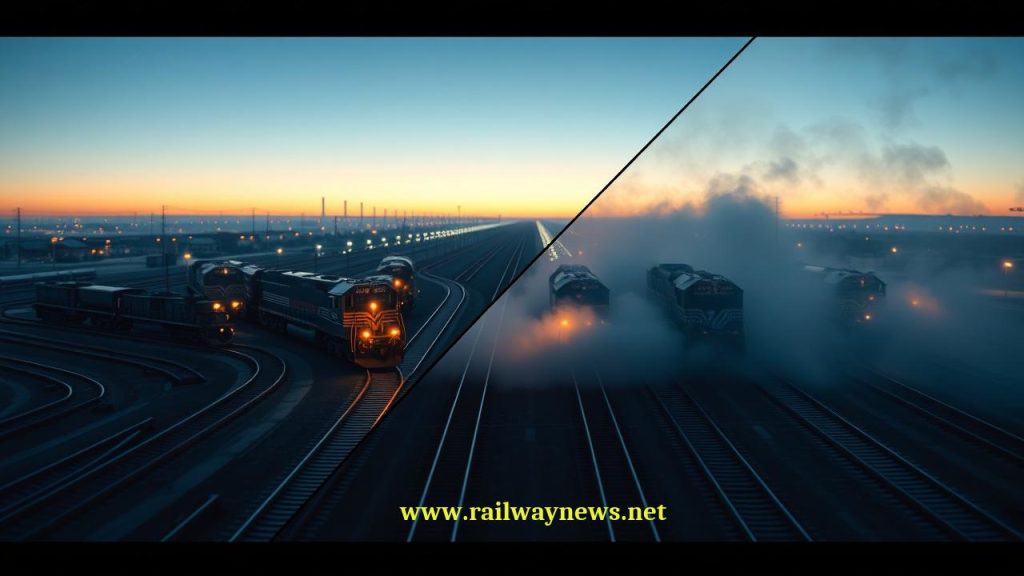
A formidable coalition of North America’s Class I railroads has formally requested that the U.S. Surface Transportation Board (STB) reject the merger application of Union Pacific Railroad and Norfolk Southern Railway, asserting the filing is procedurally incomplete. The challenge, mounted by BNSF, CPKC, CN, and CSX, signals the opening of a major regulatory battle over a consolidation that could drastically reshape the continent’s freight landscape and significantly increase train traffic in key corridors.
| Category | Details |
|---|---|
| Core Event | Challenge to Union Pacific & Norfolk Southern Merger Application |
| Applicants | Union Pacific Railroad (UP) & Norfolk Southern Railway (NS) |
| Opposing Parties | BNSF Railway, Canadian Pacific Kansas City (CPKC), CN, CSX |
| Regulatory Body | Surface Transportation Board (STB) |
| Cited Community Impact | Potential for >85 trains daily in corridors like Chesterton, IN |
Main Body:
In a unified filing with the Surface Transportation Board, every other Class I railroad in North America—BNSF Railway, Canadian Pacific Kansas City (CPKC), CN, and CSX—has argued that the landmark merger application submitted by Union Pacific (UP) and Norfolk Southern (NS) fails to meet the Board’s requirements for completeness. The coalition is urging the STB to reject the application outright, a move that would force the applicants back to the drawing board and represent a significant early setback for the proposed consolidation. In a swift rebuttal, UP and NS have already filed a formal response with the STB, defending the integrity and completeness of their submission and urging the board to proceed with its review.
The potential real-world impacts of the proposed merger are already drawing scrutiny at the local level, illustrating the stakes beyond corporate boardrooms. In communities like Chesterton, Indiana, which sits on a critical NS line, residents and officials are bracing for a substantial increase in rail traffic. The town’s 1.14-mile rail corridor already handles an average of 85 trains per day, and a successful merger is projected to add a significant volume of UP traffic, amplifying concerns over grade crossing delays, emergency vehicle access, and public safety. This scenario highlights the tangible infrastructure and quality-of-life challenges the STB will be forced to weigh against any claimed benefits of the merger.
This challenge unfolds against an industry backdrop of heightened regulatory and public scrutiny over rail safety and operational resilience. Recent incidents, such as a CSX derailment in Kentucky that led to a chemical leak and fire, serve as a stark reminder of the inherent risks in rail operations. While unrelated to the merger filing itself, such events keep safety performance at the forefront of any major regulatory proceeding. The opposition from competitors underscores a deep-seated concern that a further-consolidated network could introduce new operational complexities and risks, issues the STB is expected to scrutinize with extreme prejudice following its updated, more stringent merger review policies.
Key Takeaways
- Unified Opposition: For the first time in the modern era, all other Class I railroads have jointly opposed a major merger application at its initial filing stage.
- Regulatory Hurdle: The STB must now rule on the procedural issue of the application’s completeness before it can even begin to evaluate the competitive and public interest merits of the deal.
- Community Concerns: The proposal faces local-level resistance over projected increases in train volume, which would strain infrastructure and impact daily life in communities along key rail arteries.
Editor’s Analysis
The coordinated opposition from BNSF, CPKC, CN, and CSX is a clear declaration of war against what would be the most significant rail consolidation in a generation. This isn’t merely a procedural squabble; it’s a strategic move to bog down the UP-NS proposal from day one and signal to regulators that the industry itself views this level of consolidation as a threat to competitive balance. The move effectively creates a “rest of the industry vs. the applicants” dynamic. For the STB, this presents a critical test of its post-CPKC merger framework. The Board’s decision on the “completeness” of the application will be a bellwether for its appetite to oversee the creation of a new transcontinental giant and will set the tone for what is guaranteed to be a protracted and contentious regulatory saga.
Frequently Asked Questions
- Which railroads are opposing the UP/NS merger application?
- BNSF Railway, Canadian Pacific Kansas City (CPKC), CN, and CSX have all filed comments with the Surface Transportation Board opposing the application.
- What is the primary reason for their opposition at this stage?
- The opposing railroads claim that the merger application as filed by Union Pacific and Norfolk Southern is incomplete and does not meet the STB’s formal requirements for consideration.
- What are some potential local impacts of the proposed merger?
- Communities situated on key rail lines, such as Chesterton, Indiana, could experience a significant increase in daily train traffic, leading to heightened concerns about safety, blocked crossings, and environmental impact.

Railway infrastructure, rolling stock and transport technologies specialist focused on global rail industry developments, high-speed rail systems, signaling technologies and freight transportation. Covering railway investments, public transport modernization, rail operations and international mobility projects across Europe, Asia and North America.
RELATED POSTS

September 6, 2026 4:12 am
Alstom delivered the first of 100 new G Class trams...
September 6, 2026 6:17 am
Hungary ordered a national ban on most freight trains from...
September 7, 2026 8:16 am
Midea, Gree and TCL shipped air conditioners via China Railway...
September 6, 2026 8:17 am
DB InfraGO reopened the Nuremberg-Regensburg line in Bavaria on 31...
September 7, 2026 4:11 am
ÖBB Rail Cargo Group leased 500 Eanos-y scrap-metal wagons from...
September 5, 2026 11:20 pm
CN confirmed 70 shipper projects entered service in 2025, backed...