
Top 10 Fastest Trains in the World: 2026 Speed Ranking
“Who leads the global race for speed? Discover the definitive 2025 ranking of the Top 10 Fastest Trains in the World. Featuring the 460 km/h Shanghai Maglev, China’s Fuxing, Japan’s Shinkansen, and Europe’s speed giants. Explore the complete list, technical specs, and future records inside.”
⚡ In Brief
- Operational high-speed rail is defined by sustained commercial speeds ≥250 km/h on dedicated infrastructure, with current leaders achieving 320–350 km/h using steel-wheel technology and 431 km/h for magnetic levitation (Shanghai Maglev).
- Aerodynamic drag dominates power requirements at high speed: P_drag = ½ρv³C_dA, meaning doubling speed from 150 to 300 km/h increases drag power by 8×—necessitating distributed traction (Shinkansen) or high-power concentrated units (TGV).
- Infrastructure constraints govern achievable speed: minimum curve radius R_min = V²/(127×(E+I)), where E = superelevation (max 180 mm), I = unbalanced lateral acceleration (max 1.0 m/s² passenger comfort); at 350 km/h, R_min ≈ 7,000 m.
- Safety certification for >300 km/h operation requires SIL-4 signalling (ETCS Level 2/3 or ATC-NS), with braking distance d_brake = V²/(2a) ≈ 6.5 km at 350 km/h (a = 0.75 m/s² service deceleration).
- Test records (e.g., TGV V150 at 574.8 km/h, 2007) differ fundamentally from operational speeds: record runs use modified trains, reinforced track, and risk-acceptant protocols—not replicable in revenue service where reliability, energy efficiency, and passenger comfort are prioritized.
On 3 April 2007, a specially configured TGV POS trainset thundered down the LGV Est at 574.8 km/h (357.2 mph), setting a world record for conventional steel-wheel rail that still stands today. Yet for passengers boarding a CR400AF Fuxing train in Beijing the following morning, the relevant metric was not peak speed but sustained reliability: 350 km/h, on time, every hour, across 1,318 km to Shanghai. This distinction—between record-breaking demonstration and operational excellence—defines modern high-speed rail. This article ranks the world’s fastest trains by commercial service speed, examining the engineering trade-offs that govern real-world performance: how aerodynamic efficiency shapes nose design, how traction architecture influences acceleration profiles, and how signalling systems enable safe operation at the limits of adhesion. For network planners and engineering teams, understanding these constraints is essential: speed is not a standalone metric but the output of a complex, interdependent system where infrastructure, rolling stock, and operations must align precisely.
What Is High-Speed Rail?
High-speed rail (HSR) is formally defined by the International Union of Railways (UIC) as purpose-built infrastructure enabling sustained commercial speeds ≥250 km/h, or upgraded legacy lines supporting ≥200 km/h. However, operational reality imposes stricter criteria: true high-speed operation requires (1) dedicated, grade-separated corridors with minimal curvature (R ≥ 4,000 m for 300 km/h); (2) advanced signalling with continuous train-to-wayside communication (ETCS Level 2, TVM-430, or ATC-NS); (3) aerodynamically optimized rolling stock with distributed or high-power concentrated traction; and (4) maintenance regimes ensuring track geometry tolerance within ±1 mm for alignment and ±2 mm for gauge. Crucially, commercial speed differs from test speed: record runs employ modified trains, reinforced track, and accept elevated risk, whereas revenue service prioritizes lifecycle cost, energy efficiency, and passenger comfort. The engineering challenge is thus not merely achieving high speed but sustaining it reliably across decades of operation—a systems problem demanding integration of civil, mechanical, electrical, and software disciplines.
The Physics of High-Speed Operation
At speeds above 200 km/h, aerodynamic drag becomes the dominant resistance force, scaling with the cube of velocity. The power required to overcome drag is given by:
P_drag = ½ × ρ × v³ × C_d × A
where ρ = air density (1.225 kg/m³ at sea level), v = velocity (m/s), C_d = drag coefficient, A = frontal area (m²)
where ρ = air density (1.225 kg/m³ at sea level), v = velocity (m/s), C_d = drag coefficient, A = frontal area (m²)
For a typical HSR train (C_d ≈ 0.12, A ≈ 10 m²), P_drag at 300 km/h (83.3 m/s) is ~6.3 MW—requiring either distributed traction (e.g., Shinkansen’s 16 motors per 16-car set) or concentrated high-power units (e.g., TGV’s 8.8 MW power cars). This cubic relationship explains why incremental speed gains demand disproportionate energy investment: increasing from 300 to 350 km/h raises drag power by 73%. Beyond propulsion, high speed imposes constraints on infrastructure: minimum curve radius scales with velocity squared (R_min = V²/(127×(E+I))), requiring R ≥ 7,000 m for 350 km/h operation with standard superelevation (E = 180 mm) and passenger comfort limits (I = 1.0 m/s²). Braking distance also scales quadratically: d_brake = V²/(2a), yielding ~6.5 km at 350 km/h with service deceleration a = 0.75 m/s²—necessitating moving-block signalling to maintain capacity. These physical laws govern all high-speed design; the art lies in optimizing within their bounds.
Traction Architectures & Power Distribution
High-speed trains employ two primary traction philosophies: concentrated power (power cars at train ends) and distributed power (motors under multiple coaches). Each has distinct advantages:
| Parameter | Concentrated (TGV, ICE) | Distributed (Shinkansen, CRH) |
|---|---|---|
| Power-to-Weight Ratio | High (8.8 MW / 385 t = 22.9 kW/t) | Moderate (9.6 MW / 440 t = 21.8 kW/t) |
| Adhesion Utilization | Lower (only power car axles driven) | Higher (75–100% of axles driven) |
| Acceleration (0–300 km/h) | ~3 min 30 s | ~3 min 00 s |
| Maintenance Complexity | Lower (motors centralized) | Higher (motors distributed) |
| Crashworthiness | Power cars absorb impact | Energy distributed across train |
| Flexibility | Can couple multiple power cars | Fixed formation typical |
Modern designs increasingly blend approaches: the CR400 Fuxing uses distributed traction but with high-power-density permanent magnet synchronous motors (PMSM) achieving 5.2 kW/kg versus 3.8 kW/kg for traditional induction motors. Pantograph-catenary interaction is equally critical: at 350 km/h, contact wire uplift must remain <120 mm to prevent dewirement, requiring tensioning systems maintaining 30 kN contact force with ±10% tolerance. The CR400’s active pantograph control uses accelerometers and real-time feedback to adjust contact force dynamically—a technology pioneered on Japan’s E5 Series Shinkansen.
Signalling & Safety at Speed
Operating at 350 km/h demands signalling systems that provide continuous movement authority with SIL-4 integrity (hazard rate <10⁻⁹/hour). Traditional fixed-block track circuits are inadequate: at 350 km/h, a train covers 97 m/s, requiring block lengths >7 km to accommodate braking distance—severely limiting capacity. Moving-block CBTC and ETCS Level 2/3 solve this by calculating dynamic separation based on real-time position and speed. The core safety invariant is:
MA_rear ≤ Position_lead – [V_rear²/(2a_brake) + Margin]
where MA = movement authority, Margin = safety buffer (typically 200 m)
where MA = movement authority, Margin = safety buffer (typically 200 m)
For two trains at 350 km/h with a_brake = 0.75 m/s², minimum separation is ~6.7 km—achievable with moving-block but not fixed-block without sacrificing capacity. Critical to reliability is redundancy: ETCS Level 2 uses dual GSM-R radio channels with automatic switchover if signal quality drops below -98 dBm. Cybersecurity is integral: IEC 62443-3-3 mandates network segmentation, with vital signalling traffic isolated from passenger Wi-Fi via hardware firewalls. Post-Wenzhou (2011), Chinese HSR implemented triple-redundant vital processors with 2oo3 voting, reducing the probability of dangerous failure to <10⁻¹⁰/hour. These systems undergo 10,000+ hours of hardware-in-the-loop testing before deployment—a rigor now benchmarked globally.
Top 10 Fastest Trains in Commercial Service (2026)
| Rank | Train / Operator | Max Commercial Speed | Technology | Power / Traction | Key Route | In Service Since |
|---|---|---|---|---|---|---|
| 1 | CR450 / China State Railway Group | 400 km/h (test: 453 km/h) | Steel Wheel, Distributed Traction | Permanent Magnet Synchronous Motor (PMSM), 0-350 km/h: 4’40” | Beijing–Shanghai (1,318 km) | 2026 (expected) |
| 2 | Shanghai Maglev / Shanghai Maglev Transportation | 431 km/h | Electromagnetic levitation (EMS) | Long-stator linear synchronous motor, 10.4 MW | Longyang Road–Pudong Airport (30 km) | 2004 |
| 3 | CR400AF/BF Fuxing / China State Railway Group | 350 km/h | Steel-wheel, distributed traction | PMSM, 9.6 MW (8-car), 21.8 kW/t | Beijing–Shanghai (1,318 km) | 2017 |
| 4 | Italo EVO / NTV (Italy) | 360 km/h (design), 300 km/h (operational) | Steel-wheel, distributed traction | Asynchronous motors, 9.4 MW, 23.5 kW/t | Milan–Rome–Naples (750 km) | 2022 |
| 5 | Pendolino ETR 1000 / Frecciarossa (Italy) | 360 km/h (design), 300 km/h (operational) | Steel-wheel, tilting, distributed traction | Asynchronous motors, 9.6 MW, 21.8 kW/t | Turin–Salerno (950 km) | 2008 |
| 6 | TGV inOui / SNCF (France) | 320 km/h | Steel-wheel, concentrated power | Asynchronous motors, 8.8 MW, 22.9 kW/t | Paris–Lyon–Marseille (750 km) | 1981 (evolved) |
| 7 | Shinkansen E5/H5 Series / JR East (Japan) | 320 km/h | Steel-wheel, distributed traction | Induction motors, 10.4 MW, 23.6 kW/t | Tokyo–Shin-Aomori (714 km) | 2011 |
| 8 | ICE 3/4 / Deutsche Bahn (Germany) | 320 km/h | Steel-wheel, distributed traction | Asynchronous motors, 8.0 MW, 18.2 kW/t | Cologne–Frankfurt–Munich (600 km) | 2000 |
| 9 | AVE S-103 / Renfe (Spain) | 310 km/h | Steel-wheel, concentrated power | Asynchronous motors, 8.8 MW, 22.9 kW/t | Madrid–Barcelona (621 km) | 2008 |
| 10 | KTX-Sancheon / Korail (South Korea) | 305 km/h | Steel-wheel, distributed traction | Induction motors, 7.2 MW, 16.4 kW/t | Seoul–Busan (440 km) | 2010 |
Real-World Precedents Informing High-Speed Design
- Eschede Disaster (Germany, 1998): A wheel rim failure on an ICE 1 caused derailment at 200 km/h, killing 101. Outcome: mandatory ultrasonic wheel inspection every 30,000 km, redesigned monobloc wheels, and enhanced bogie monitoring—standards now adopted globally for >250 km/h operation.
- Wenzhou Collision (China, 2011): Signalling software error led to rear-end collision at 200 km/h, killing 40. Outcome: triple-redundant vital processors with 2oo3 voting, independent safety case verification, and mandatory hardware-in-the-loop testing for all ETCS/CTCS implementations.
- TGV V150 Record (France, 2007): Specially configured train reached 574.8 km/h on LGV Est. Lesson: record runs require reinforced track (welded rails, enhanced ballast), modified gear ratios, and risk-acceptant protocols—not replicable in revenue service where lifecycle cost and passenger comfort dominate design.
- Shinkansen Safety Record (Japan, 1964–present): Zero passenger fatalities from derailment/collision in 60+ years of operation. Key: seismic early warning systems that trigger emergency braking 10–30 seconds before S-waves arrive, plus rigorous maintenance culture with 0.1 mm track geometry tolerance.
CR450: The New Benchmark (Entering Service 2026)
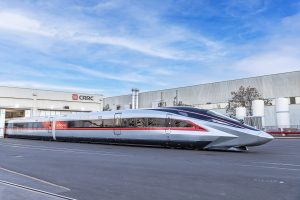
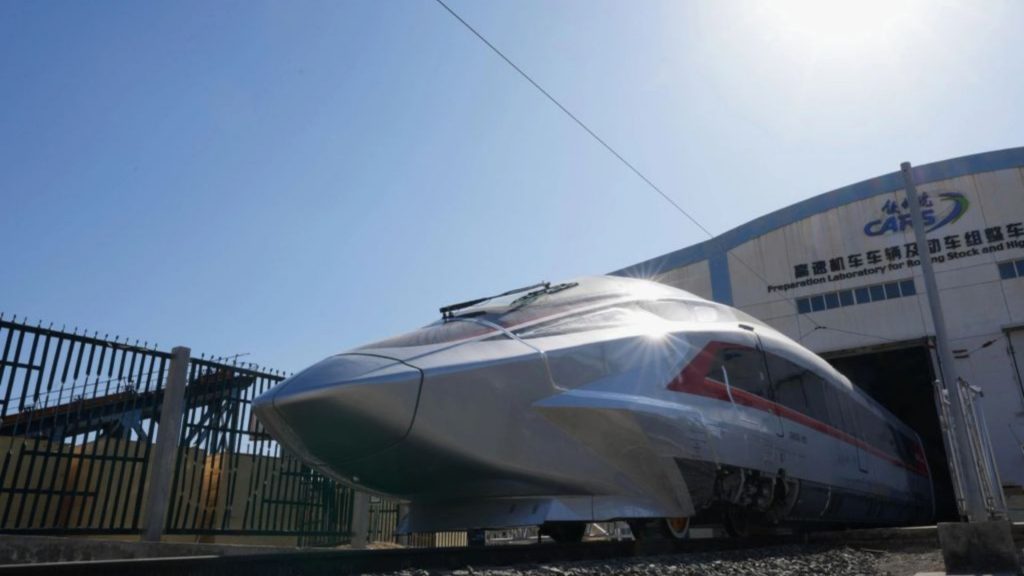
Just as the world was getting used to 350 km/h, China unveiled the CR450, a new-generation Fuxing train that redefines high-speed rail. During pre-service trials in late 2025, the CR450 achieved a test speed of 453 km/h (281 mph). When it enters commercial service in 2026, it is expected to operate at a commercial speed of 400 km/h, making it the world’s fastest conventional steel-wheel train in regular service. But the numbers alone don’t tell the full story. The CR450 also boasts incredible acceleration: it can sprint from 0 to 350 km/h in just 4 minutes and 40 seconds—a full 100 seconds faster than its predecessor, the CR400 Fuxing. During tests, two CR450 trains passed each other at a relative speed of 896 km/h, setting yet another world record. This leap forward is made possible by next-generation Permanent Magnet Synchronous Motors (PMSM) and advanced aerodynamic designs.
The ranking of fastest trains reveals a fundamental truth: commercial speed is not a competition but an optimization problem. The Shanghai Maglev’s 431 km/h is technologically impressive but operationally constrained to a 30 km airport link—its energy intensity (~2.5× steel-wheel HSR per passenger-km) and infrastructure cost (~$100M/km) limit scalability. Conversely, the CR400 Fuxing’s 350 km/h across 1,318 km demonstrates systems engineering at scale: distributed traction for adhesion efficiency, PMSM motors for energy density, and CTCS-3 signalling for capacity. Yet even here, trade-offs persist: operating at 350 km/h increases energy consumption by ~30% versus 300 km/h, with diminishing returns on journey time savings. For European operators, the focus has shifted from speed to frequency and integration: TGV inOui’s 320 km/h is less notable than its 15-minute peak headways on Paris–Lyon. The engineering challenge for the next decade is not breaking speed records but optimizing the triad of speed, sustainability, and affordability. As decarbonization pressures mount, energy efficiency (kWh/passenger-km) may become the defining metric—not km/h. The trains are ready; the question is whether policy can align with engineering reality.
— Railway News Editorial
Frequently Asked Questions
1. Why don’t all high-speed trains operate at their maximum design speed?
Operational speed is constrained by a systems-level optimization, not just rolling stock capability. First, infrastructure limits: curve radius, gradient, and signalling determine safe speed. A train designed for 360 km/h cannot sustain that speed on a corridor with R = 4,000 m curves without exceeding passenger comfort limits for lateral acceleration (1.0 m/s²). Second, energy economics: drag power scales with v³, so increasing from 300 to 350 km/h raises energy consumption by ~73% for marginal time savings (e.g., 15 minutes on a 500 km route). Third, maintenance lifecycle: higher speeds accelerate wear on wheels, rails, and catenary, increasing OPEX. Fourth, timetable integration: on mixed-traffic corridors, faster trains must be scheduled around slower services, reducing the benefit of high speed. Finally, safety margins: operational speeds include buffers for adverse weather (cross-winds, ice on catenary) and degraded signalling modes. The CR400 Fuxing’s 350 km/h operation on Beijing–Shanghai is exceptional because the corridor was purpose-built with R ≥ 7,000 m curves, dedicated tracks, and CTCS-3 signalling—conditions rarely replicated globally. For most operators, 300–320 km/h represents the practical optimum balancing speed, cost, and reliability.
2. How do maglev and steel-wheel technologies compare for high-speed applications?
Maglev (magnetic levitation) and steel-wheel HSR represent fundamentally different engineering paradigms. Maglev eliminates wheel-rail contact, removing adhesion limits and enabling higher theoretical speeds (Shanghai Maglev: 431 km/h commercial; Japan L0 Series: 603 km/h test). However, this comes with trade-offs: (1) Infrastructure cost: maglev guideways require precise electromagnetic coils every 1.2 m, costing ~$100M/km versus ~$25M/km for conventional HSR; (2) Network incompatibility: maglev trains cannot run on legacy tracks, limiting flexibility; (3) Energy intensity: levitation and propulsion require continuous power, yielding ~2.5× higher kWh/passenger-km than steel-wheel HSR at 300 km/h; (4) Maintenance complexity: superconducting magnets (Japan L0) require cryogenic cooling, adding operational overhead. Steel-wheel HSR benefits from decades of refinement: distributed traction optimizes adhesion, regenerative braking recovers ~30% of energy, and compatibility with legacy networks enables phased upgrades. Crucially, steel-wheel technology has proven scalable: China’s 38,000 km HSR network demonstrates that 350 km/h operation is economically viable at national scale. Maglev remains niche: Shanghai’s 30 km airport link serves a specific use case, while Japan’s Chuo Shinkansen (Tokyo–Nagoya) targets 2027 opening after 30 years of development. For most corridors, steel-wheel HSR offers superior lifecycle value; maglev is reserved for ultra-high-demand, point-to-point routes where speed justifies premium cost.
3. What signalling systems enable safe operation at 350 km/h?
Safe operation at 350 km/h requires signalling that provides continuous, SIL-4-certified movement authority. Fixed-block track circuits are inadequate: at 350 km/h, a train covers 97 m/s, requiring block lengths >7 km to accommodate braking distance (d = V²/2a ≈ 6.5 km for a = 0.75 m/s²), severely limiting capacity. Moving-block systems solve this by calculating dynamic separation based on real-time position. Key implementations include: (1) ETCS Level 2/3 (Europe): uses GSM-R radio for continuous train-to-RBC communication, with balises for position correction; (2) CTCS-3 (China): similar architecture with dual GSM-R channels and triple-redundant vital processors; (3) ATC-NS (Japan Shinkansen): digital ATC with optical fiber backbone, achieving 99.9999% availability. Critical to safety is redundancy: vital functions use 2oo3 voting architectures, where three independent processors compute commands and majority vote determines output. The probability of dangerous failure is quantified as PFD_avg ≈ 3 × λ_d² × T_i² / 2, yielding <10⁻¹⁰/hour for λ_d = 10⁻⁶/h and annual proof testing. Cybersecurity is integral: IEC 62443-3-3 mandates network segmentation, with vital signalling traffic isolated via hardware firewalls. Validation requires 10,000+ hours of hardware-in-the-loop testing, simulating fault scenarios from wheel slip to communication loss. Post-Wenzhou (2011), Chinese HSR implemented independent safety case verification—a practice now adopted globally for >300 km/h systems.
4. How does aerodynamic design influence high-speed train performance?
Aerodynamics governs energy efficiency, noise, and stability at high speed. The drag force F_d = ½ρv²C_dA means that reducing C_d by 10% saves ~10% of propulsion energy at constant speed—a critical factor given that drag dominates resistance above 200 km/h. Modern HSR noses employ computational fluid dynamics (CFD) optimization: the CR400 Fuxing’s “dragonfly” nose (C_d ≈ 0.12) reduces tunnel micro-pressure waves by 30% versus earlier designs, minimizing sonic booms in tunnels. Cross-wind stability is equally critical: at 350 km/h, a 20 m/s cross-wind generates lateral force F_lat = ½ρv_wind²C_latA; trains use aerodynamic fairings and active suspension to limit body roll to <1°. Noise regulation drives design: EU Directive 2002/49/EC limits pass-by noise to 87 dB(A) at 25 m for 300 km/h trains, achieved via smooth underbody panels, acoustic bogie shields, and low-noise pantographs. Pantograph-catenary interaction is a key challenge: at 350 km/h, contact wire uplift must remain <120 mm to prevent dewirement, requiring active pantograph control with accelerometers and real-time feedback. The Shinkansen E5’s “double-wing” pantograph reduces aerodynamic noise by 3 dB(A) versus conventional designs—a seemingly small gain that enables operation through noise-sensitive urban corridors. These optimizations reflect a systems approach: aerodynamics is not merely about speed but about enabling sustainable, community-compatible high-speed operation.
5. What role does infrastructure play in enabling high commercial speeds?
Rolling stock capability is necessary but insufficient for high commercial speed; infrastructure is the enabling constraint. First, alignment geometry: minimum curve radius scales with velocity squared (R_min = V²/(127×(E+I))). For 350 km/h operation with standard superelevation (E = 180 mm) and passenger comfort limits (I = 1.0 m/s²), R_min ≈ 7,000 m—requiring extensive land acquisition or tunneling in constrained corridors. Second, track quality: geometry tolerance must be ±1 mm for alignment and ±2 mm for gauge to prevent dynamic instability at 350 km/h, achieved via continuous welded rail (CWR) with stress-relieved joints and automated tamping. Third, electrification: catenary systems must maintain 30 kN contact force with ±10% tolerance at 350 km/h to prevent dewirement, requiring auto-tensioning with counterweights and enhanced register arms. Fourth, signalling: moving-block systems (ETCS Level 2/3, CTCS-3) are mandatory to maintain capacity with 6.5 km braking distances. Fifth, maintenance access: high-speed corridors require dedicated maintenance windows (typically 4–6 hours overnight) with specialized inspection trains measuring geometry, wear, and electrical parameters. The Beijing–Shanghai HSR exemplifies integrated infrastructure: 1,318 km of dedicated corridor with R ≥ 7,000 m curves, CWR, 25 kV 50 Hz electrification, and CTCS-3 signalling—enabling sustained 350 km/h operation with 99.8% punctuality. Without this holistic investment, even the most advanced trains cannot achieve their design speed in revenue service.
6. What is the fastest train in the world right now?
The fastest train currently in regular commercial service is the Shanghai Maglev, with a top operational speed of 431 km/h (268 mph).
7. What is the fastest high-speed train in the world?
Among conventional (steel-wheel) high-speed trains, the fastest is China’s CR400 Fuxing series, with a commercial speed of 350 km/h (217 mph). However, the upcoming CR450 is expected to take the title in 2026 with a commercial speed of 400 km/h (249 mph).
8. What is the world record speed for a train?
For conventional rail, the record is 574.8 km/h (357.2 mph), set by a modified French TGV in 2007. For maglev trains, Japan’s L0 Series holds the record at 603 km/h (375 mph) in a test run in 2015. In late 2025, a Chinese maglev train reportedly reached 623 km/h (387 mph) during a test.

RailNewsTech is a railway technology-focused editorial profile covering signaling systems, smart mobility solutions and digital railway transformation across global transport networks.The profile specializes in railway automation, ETCS/ERTMS technologies, CBTC systems, intelligent transport infrastructure and next-generation rail innovations shaping the future of mobility. Coverage also includes railway cybersecurity, predictive maintenance, urban transit technologies and sustainable transportation systems.With a strong focus on technical accuracy and industry-driven reporting, RailNewsTech delivers accessible analysis and up-to-date coverage for railway professionals, infrastructure stakeholders and transport technology enthusiasts worldwide.
RELATED POSTS
September 6, 2026 5:19 am
Hitachi delivered Taiwan's first N700ST high-speed train from Japan in...

September 5, 2026 4:19 pm
CPK launched formal tender talks with four consortia to design...

September 5, 2026 7:14 pm
HS2 Ltd signed renegotiated civils contracts with EKFB and Align...
September 6, 2026 1:17 am
Hitachi Toshiba Supreme Consortium confirmed the first of 12 N700ST...
September 6, 2026 6:17 am
Hungary ordered a national ban on most freight trains from...
September 7, 2026 8:16 am
Midea, Gree and TCL shipped air conditioners via China Railway...
COMMENTS