
AI & Digital Twins: Transforming Rail Infrastructure Operations
AI and digital twins revolutionize rail infrastructure: real-time monitoring, predictive maintenance, 30% lower downtime. Market to hit $150B by 2030.
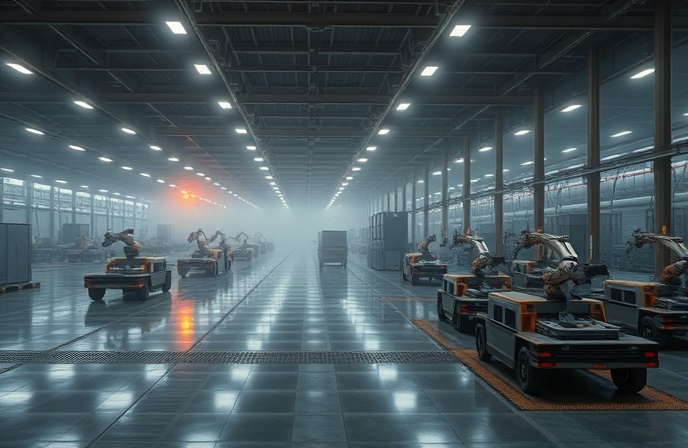
Artificial intelligence (AI) has become the core of smart manufacturing, offering investors a rare blend of technological and financial efficiency, with typical payback arriving within two years. New technologies are reshaping the competitive landscape of major industries, shifting from pilot projects to profit centers.
Software Revolution in Heavy Industry
A transformation is underway on the factory floor, with experimental automation migrating to the core, integrating data and software into production. These systems improve efficiency across throughput, quality, and uptime.
AI Becomes the Engine of Value Creation
AI has evolved into a central element of smart manufacturing. Machine-learning algorithms are optimizing working capital through planning. Demand forecasts and automated logistics reduce inventory by 10–15%. Computer-vision inspection systems reduce defect rates by 50–70% and trim warranty expenses by up to 30%. The challenge lies in integrating AI into existing control architectures, which can require significant capital expenditure. Patent filings related to AI in construction and heavy industry have increased, showing the impact of intelligent automation across traditional sectors.
Additive Manufacturing: From Novelty to Necessity
Additive manufacturing, specifically 3D printing, is changing production economics. Aerospace components printed with lattice structures are 20–30% lighter than conventionally machined parts, leading to immediate performance and fuel-efficiency gains. Adopting additive techniques for jigs, fixtures, tooling, or maintenance spares is more practical than a complete overhaul. Replacing machined or cast components with printed ones requires investment in hardware and certification, especially in regulated sectors like aerospace or defense.
Digital Twins: Virtual Becomes Vital
Digital-twin technology has become an essential management tool. Virtual replicas of assets and production lines enable real-time anomaly detection and “sandbox” testing. Engineering teams use twins to iterate product designs through simulations, accelerating development cycles. The market for digital twins is expected to exceed $150 billion by 2030. Data integration and cybersecurity pose challenges. Building a digital model requires synchronizing systems into a single source of truth. Linking operational technology to corporate IT increases the risk of cybercrime. The benefits include lower energy consumption, reduced material waste, and faster iteration.
Robotics Take the Stage
Industrial robotics are now mainstream. Collaborative robots are bringing automation to mid-sized plants, and autonomous mobile robots (AMRs) are transforming warehouse logistics. Robotics offer a structural response to labor shortages and wage inflation. High-risk tasks can be offloaded to machines, allowing human workers to focus on supervision. Brownfield sites often have multiple control layers and incompatible data protocols, creating silos. When connectivity improves, robots become part of a data-driven production ecosystem.
Last June 2025, we published an article about Renfe’s cutting-edge Aranjuez maintenance hub. Click here to read – Future of Rail: Renfe’s Railway Technology Hub, Aranjuez: Essential Guide
Conclusion
AI, robotics, digital twins, and additive manufacturing are proven tools to increase throughput, reduce costs, and de-risk transformation. Firms that integrate data, decisions, and devices effectively are positioned to gain a financial advantage.
Company Summary
No company names were mentioned in the source.
Technology
- AI: Artificial intelligence is used in smart manufacturing for planning, demand forecasting, automated logistics, and inspection systems.
- AMRs: Autonomous mobile robots are used in warehouse logistics for material moves, picking, and inventory management.

Transport and railway industry editor covering global rail infrastructure, sustainable mobility, urban transit systems and next-generation railway technologies with a focus on accessible and industry-focused reporting.
RELATED POSTS
September 6, 2026 5:19 am
Hitachi delivered Taiwan's first N700ST high-speed train from Japan in...

September 5, 2026 4:19 pm
CPK launched formal tender talks with four consortia to design...
September 6, 2026 1:17 am
Hitachi Toshiba Supreme Consortium confirmed the first of 12 N700ST...

September 6, 2026 4:12 am
Alstom delivered the first of 100 new G Class trams...

September 5, 2026 7:14 pm
HS2 Ltd signed renegotiated civils contracts with EKFB and Align...
September 6, 2026 6:17 am
Hungary ordered a national ban on most freight trains from...