
Netherlands’ Rail Modernization: 25kV AC Upgrade in Amsterdam
Netherlands’ 25kV AC rail upgrade: converting from 1.5kV DC to European standard, BB21 signaling for 30% expected capacity boost. Strategic focus on Amsterdam-Utrecht-Rotterdam arteries.
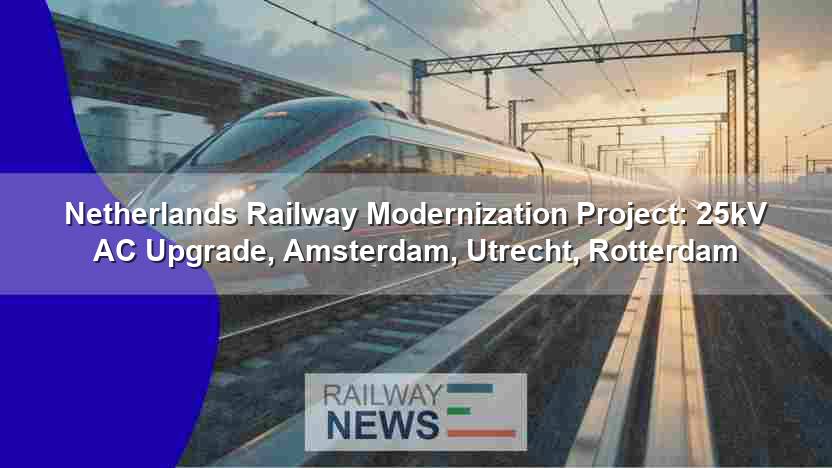
This article focuses to the significant railway infrastructure upgrades undertaken in the Netherlands, focusing on the transition from a 1.5kV DC (Direct Current) electrification system to the European standard 25kV AC (Alternating Current) system. The project’s aims were multifaceted: to enhance operational efficiency by increasing train capacity and speed, to improve interoperability with neighboring countries, and to future-proof the national rail network for increased passenger and freight demands. This involved not only the electrification upgrade but also a detailed modernization of signaling systems, addressing issues of inadequate power supply, voltage drops during peak periods, and signal interference caused by the new electrification. The project’s success hinges on careful planning, phased implementation, and the strategic integration of new technologies to maximize efficiency and minimize disruption to existing services. The economic and logistical challenges involved in such a large-scale undertaking are also examined, along with the long-term benefits for both the Dutch railway system and its integration into the broader European rail network.
Inadequate Power Supply and the Need for Modernization
The existing 1.5kV DC electrification system in the Netherlands suffered from several critical limitations. Inadequate traction power supplies frequently forced trains to operate at reduced power, significantly impacting train schedules and overall network capacity. This limitation was particularly evident during peak hours when multiple heavy trains attempted to draw power simultaneously, leading to substantial voltage drops. This severely undermined the effectiveness of new train control systems designed to reduce train intervals and increase line capacity. The adoption of the 25kV AC system, the standard across much of Europe, became essential for improved interoperability, allowing seamless cross-border train services across mainland Europe. This formed the cornerstone of the modernization project.
The 25kV AC Conversion Project
Railned, the Dutch railway planning business, advocated for a swift transition to 25kV AC, considering it the optimal solution based on cost-effectiveness, strategic advantages, financing options, and overall price-performance ratio. Following a government study confirming the superiority of complete conversion, a phased approach was adopted. The initial focus was on three primary international routes: the high-speed line (HSL) between Amsterdam, Brussels, and Paris; the upgraded line from Amsterdam and Utrecht to Emmerich and Cologne; and the planned Betuwe freight line connecting Rotterdam and Emmerich. This strategic approach minimized the initial financial burden and allowed for gradual expansion to other parts of the network as resources permitted and the operational benefits became apparent. The conversion involved significant infrastructural upgrades, such as installing larger insulators for the catenary system and constructing new 25kV substations. Where train speeds were below 160 km/h, existing overhead lines could be reused, minimizing costs and construction time. However, compatibility issues regarding signalling and Automatic Train Protection (ATP) systems were addressed in the project.
Signaling System Upgrades and Integration
The transition to 25kV AC necessitated modifications to both track circuits for train detection and ATP systems to mitigate interference. This project took advantage of the opportunity to implement a more modern, transmission-based train control system, known as BB21 (Block-Based system for 21st century), which uses moving blocks to enhance line capacity and eliminate the need for signal system immunisation against 25kV power supply interference. The implementation of BB21 would be key in solving the inadequate power issues alongside the electrification upgrades. The BB21 system, with its moving block technology, was designed to significantly improve the safety and efficiency of train operations. Its initial deployment was planned for the Betuwe freight route and the HSL Zuid high-speed line, with a gradual roll-out across the entire Dutch rail network. This upgrade also included addressing safety concerns through the elimination of level crossings wherever feasible.
Rolling Stock Considerations and Phased Implementation
Two scenarios were considered for rolling stock conversion: a slow, cost-effective approach involving gradual conversion of lines alongside the introduction of dual-voltage trains, and a faster approach requiring the conversion of existing rolling stock. The chosen strategy involved a phased implementation, aligning with the lifecycle of existing rolling stock to minimize premature obsolescence. This pragmatic approach balanced the benefits of rapid modernization with the need to manage costs and avoid unnecessarily discarding relatively new trains. This demonstrates a key consideration in such projects: to efficiently allocate resources whilst minimising disruptions. The project cost considerations were significant, with the complete 25kV AC network conversion estimated at ANG 3 billion (approximately £1.1 billion). This substantial cost necessitated a phased approach, minimizing financial strain and maximizing effectiveness. The long-term view and economic balance were crucial for the project’s success.
Conclusions
The modernization of the Dutch railway system, encompassing the transition to 25kV AC electrification and the implementation of the BB21 signaling system, represents a significant achievement in railway infrastructure development. The project successfully addressed challenges related to inadequate power supply, limited capacity, and signal interference. The phased approach, prioritizing key international routes and aligning with rolling stock lifecycles, proved to be a fiscally responsible and operationally effective strategy. While the substantial financial investment required careful management, the long-term benefits, including enhanced capacity, increased speeds, improved interoperability with neighboring countries, and heightened safety, outweigh the initial costs. This ambitious project demonstrates a forward-thinking approach to railway infrastructure management, ensuring that the Dutch railway system remains competitive and efficient in the face of growing demands. The integration of modern signaling technology, such as BB21, along with the adoption of the European standard 25kV AC electrification, places the Netherlands at the forefront of railway technological advancement, setting a benchmark for other countries looking to upgrade their railway networks. The successful completion of this project highlights the importance of strategic planning, phased implementation, and a holistic approach that considers all aspects of railway operations, from infrastructure to rolling stock to signaling systems. The future of the Dutch railway network is undoubtedly brighter, facilitated by this detailed and carefully executed modernization program.
Project Summary Table
| Project Aspect | Details |
|---|---|
| Project Name | Dutch Railway Electrification and Signalling Upgrade |
| Project Goal | Upgrade to 25kV AC, Implement BB21 signalling system |
| Electrification Conversion | From 1.5kV DC to 25kV AC |
| Total Estimated Cost | ANG 3 billion (approximately £1.1 billion) |
| Key Routes (Initial) | Amsterdam-Brussels-Paris HSL, Amsterdam-Emmerich-Cologne, Betuwe freight line |
| Signalling System | BB21 (Block-Based system for 21st century) |
| Timeline | Phased implementation; initial target 2005-2017 (Fast scenario) |
Company Information:
- NS Reizigers: Passenger rail operator in the Netherlands.
- NS Cargo: Freight rail operator in the Netherlands.
- Railned: Privatized railway planning business in the Netherlands.
- NS Railinfrabeheer: Dutch railway infrastructure manager.

Transport and railway industry editor covering global rail infrastructure, sustainable mobility, urban transit systems and next-generation railway technologies with a focus on accessible and industry-focused reporting.
RELATED POSTS
August 3, 2026 9:11 pm
Renfe invests €85.4 million in a hybrid 4G/5G and Starlink...
August 4, 2026 7:12 am
Poland’s PKP Cargo signed a freight rail planning pact with...
August 6, 2026 5:12 am
Alstom and Siemens secured São Paulo signalling contracts for a...
August 1, 2026 11:12 pm
HS2 Ltd completed the UK's 700-metre Burton Green tunnel in...
August 6, 2026 7:11 pm
Rocky Mountain Steel Mills delivered the first 328-foot rail to...
August 5, 2026 9:12 pm
Stadler and Siemens won a contract to supply 350 new...