
Kuala Lumpur Airport Express Rail Project: Malaysia, KLIA
Malaysia’s Kuala Lumpur Airport Express (ERL) high-speed rail link efficiently connects KLIA airport to Kuala Lumpur Sentral, showcasing advanced railway technology.
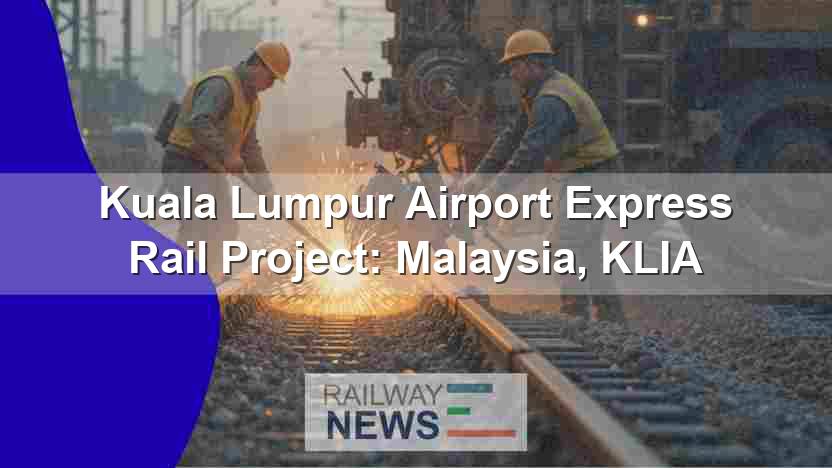
Kuala Lumpur Airport Express – Railway Technology
This article explores the Kuala Lumpur Airport Express (ERL), a high-speed rail link connecting Kuala Lumpur International Airport (KLIA) to Kuala Lumpur Sentral. The project represents a significant advancement in Malaysian railway technology and serves as a case study in efficient airport transit solutions. We will explore the technological aspects of the ERL, from its design and construction to the sophisticated signaling and train control systems employed. The analysis will also consider the integration of the ERL within the broader Kuala Lumpur transportation network and assess its operational performance and impact on the city’s infrastructure. Finally, the article will consider the project’s broader implications for future rapid transit projects in developing nations, highlighting successful strategies and potential challenges for replication and expansion.
System Design and Construction
The ERL is a standard-gauge railway, running 57.7 km from Kuala Lumpur Sentral to KLIA. The line incorporates three intermediate stations: Bandar Tasik Selatan, Putrajaya & Cyberjaya, and Salak Tinggi. The Salak Tinggi station also houses the ERL’s main depot, encompassing administrative offices, stabling yards, workshops, and a test track. Construction involved the building of 30 new bridges, reflecting the challenging terrain. The project benefited from international collaboration, sourcing rails from Europe, catenary mast fabrication equipment from South Korea and Japan, and electric multiple units (EMUs) from Siemens. The integration with Kuala Lumpur Sentral, a major transportation hub, was a critical design element, seamlessly connecting the ERL with other modes of transport, including the Commuter Rail Service (CRS), KTMB (Keretapi Tanah Melayu Berhad) mainline and commuter services, the PUTRA light rail system, and the KL Monorail. The airport terminal station features full check-in facilities, ensuring a smooth travel experience.
Rolling Stock and Train Control
The ERL utilizes a fleet of twelve four-car EMUs supplied by Siemens, based on the successful ET425 design used in Germany. Eight units are dedicated to ERL services, offering 156 seats each and a level of comfort comparable to business-class air travel. The remaining four units serve the CRS commuter lines, with a higher passenger capacity of 540 per unit (144 seated). The trains achieve a top speed of 162 km/h (100 mph). Crucially, the system employs the ZSL90 automatic train protection system, previously used on Swiss narrow-gauge railways. This system uses onboard memory chips storing route data (curves, gradients, turnouts, stations, depots) and real-time data from trackside cables conveying information about signals, points, level crossings, and temporary speed restrictions. This advanced technology ensures safe and efficient train operation.
Integration and Operational Performance
The ERL’s success is evident in its operational performance since its opening in April 2002. The seamless integration within Kuala Lumpur Sentral provides passengers with convenient connections to other transport modes, enhancing the city’s overall transportation network. The system’s initial capacity of four trains per hour has proven sufficient to manage passenger demand, although future expansion plans are being considered, particularly with regards to the expansion of commuter rail services in areas surrounding Bandar Tasik Selatan, Putrajaya, and Salak Tinggi. The ERL stands in contrast to other rapid transit projects in Kuala Lumpur, such as the Kuala Lumpur Monorail, which experienced significant delays and technical challenges. The ERL’s operational efficiency underscores the importance of careful planning, robust technology, and effective project management in large-scale infrastructure projects.
Project Summary and Future Outlook
The Kuala Lumpur Airport Express stands as a model of successful railway infrastructure development. Its advanced technology, seamless integration with existing systems, and efficient operations have transformed airport access in Kuala Lumpur. The project serves as a valuable case study for future rapid transit projects in similar contexts. The following table summarizes key project details:
| Parameter | Value |
|---|---|
| Project Length | 57.7 km |
| Project Budget | (Not specified in original text) |
| Project Type | High-speed rail link |
| Connection of Cities | Kuala Lumpur to Kuala Lumpur International Airport (KLIA) |
| Number of Stations | 4 (including KLIA and Kuala Lumpur Sentral) |
| Rolling Stock Supplier | Siemens |
To summarize, the Kuala Lumpur Airport Express represents a significant achievement in railway engineering and project management. The selection of proven technologies, coupled with effective integration within the existing transportation infrastructure, has resulted in a highly efficient and successful system. The ERL’s success highlights the importance of international collaboration, careful planning, and robust technology in delivering large-scale infrastructure projects. This case study provides valuable insights for future rapid transit projects, emphasizing the need for strategic planning, technological innovation, and effective integration with the broader transport network. The lessons learned from the ERL’s implementation can be applied to similar projects globally, facilitating the development of efficient and sustainable transportation systems in urban and suburban areas.
Company Information:
Express Rail Link (ERL): The private operator of the Kuala Lumpur Airport Express, holding a 30-year concession. Owned by Tabung Haji Technologies and YTL Corporation Berhad.
Siemens: A global technology company that supplied the electric multiple units (EMUs) for the ERL.
Keretapi Tanah Melayu Berhad (KTMB): Malaysia’s national railway company, whose infrastructure was partially utilized by the ERL.

Railway infrastructure, rolling stock and transport technologies specialist focused on global rail industry developments, high-speed rail systems, signaling technologies and freight transportation. Covering railway investments, public transport modernization, rail operations and international mobility projects across Europe, Asia and North America.