
Mumbai-Ahmedabad High-Speed Rail: 2026 Update
India’s Mumbai-Ahmedabad High-Speed Rail project, a technological marvel, drastically cuts travel time. This railway sector news highlights the project’s advancements and economic impact.
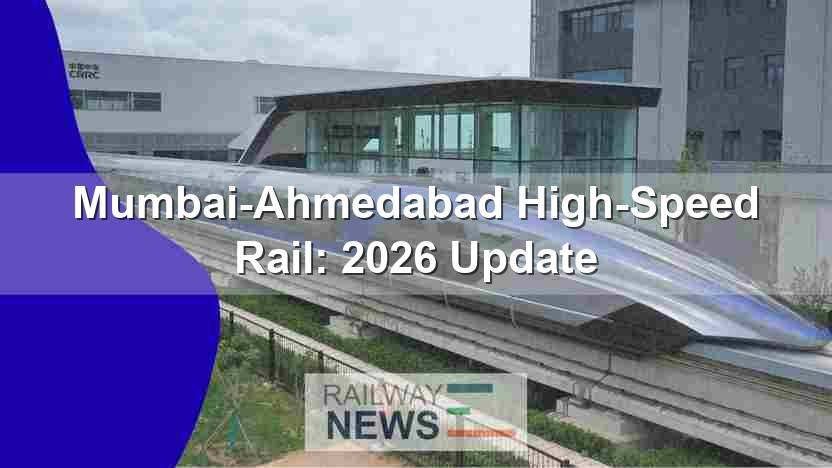
The Mumbai-Ahmedabad High-Speed Rail (MAHSR) project is India’s inaugural high-speed rail line, engineered to connect the nation’s financial capital, Mumbai, with the economic hub of Ahmedabad. This 508 km corridor leverages Japanese Shinkansen technology to establish a new benchmark in Indian transportation infrastructure. Its implementation by the National High-Speed Rail Corporation Limited (NHSRCL) represents a significant technological and logistical undertaking, set to redefine intercity travel in the region.
Project Fact Sheet
| Attribute | Details |
|---|---|
| Project Name | Mumbai-Ahmedabad High-Speed Rail (MAHSR) |
| Location | Maharashtra & Gujarat, India |
| Corridor Length | 508 km |
| Maximum Operational Speed | 320 km/h (Design Speed: 350 km/h) |
| Estimated Cost | ₹1.1 trillion (approx. US$17 billion) |
| Current Status (Q4 2025) | Under Construction |
| Key Stakeholders & Contractors | National High-Speed Rail Corporation Ltd. (NHSRCL), Japan International Cooperation Agency (JICA), Rail Vikas Nigam Limited (RVNL) |
Technical Specifications
The MAHSR corridor’s design is predominantly a 468 km elevated viaduct to minimize land acquisition and environmental impact. The alignment includes a complex 27 km section featuring a 7 km undersea tunnel in the Thane Creek, a first for India’s railway system. The project fully adopts Japan’s E5 Series Shinkansen technology, encompassing not only the rolling stock but also the advanced Continuous Automatic Train Control (CATC) signaling and power systems to ensure operational safety at high speeds. The infrastructure includes 12 stations designed for high passenger throughput and two major rolling stock depots located near Thane and Sabarmati for maintenance and operations.
Key Takeaways
- Technological Benchmark: The project introduces Shinkansen technology to India, establishing a national standard for high-speed rail safety, reliability, and operational efficiency.
- Economic Catalyst: By reducing Mumbai-Ahmedabad travel time to under two hours, the corridor is projected to significantly boost economic activity, trade, and tourism between the two major commercial hubs.
- Infrastructure Blueprint: Successful execution of the MAHSR serves as a critical pilot, providing a scalable model and invaluable expertise for the planned network of high-speed rail corridors across India.
Frequently Asked Questions (FAQ)
When will the Mumbai-Ahmedabad bullet train open?
The Mumbai-Ahmedabad High-Speed Rail project is being constructed in phases. The first section, located in Gujarat, is targeted for operational launch by 2026-2027. Full commissioning of the entire 508 km corridor is anticipated by the end of the decade, pending land acquisition and construction progress in Maharashtra.
Who is building India’s first high-speed rail?
India’s first high-speed rail project is being implemented by the National High-Speed Rail Corporation Limited (NHSRCL), a special purpose vehicle. The project is a joint venture between the Government of India and participating state governments, with significant financial and technical assistance provided by the Japan International Cooperation Agency (JICA).

Railway infrastructure, rolling stock and transport technologies specialist focused on global rail industry developments, high-speed rail systems, signaling technologies and freight transportation. Covering railway investments, public transport modernization, rail operations and international mobility projects across Europe, Asia and North America.