
Delhi-Meerut RRTS: 2026 Construction Update
Delhi-Ghaziabad-Meerut RRTS, India’s first regional rapid transit system, opens, revolutionizing NCR commutes with high-speed rail.
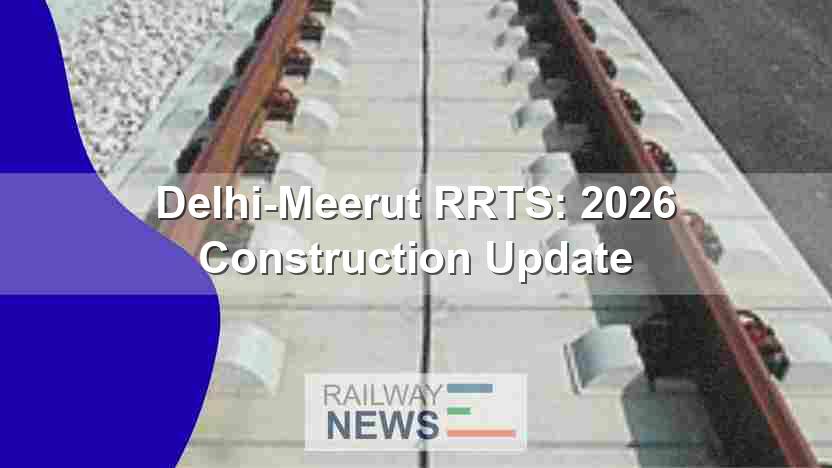
The Delhi-Ghaziabad-Meerut Regional Rapid Transit System (RRTS) is an 82.15 km semi-high-speed rail corridor connecting key urban nodes within India’s National Capital Region (NCR). Engineered for a maximum operational speed of 160 km/h, the project establishes a new benchmark for regional commuter transit by drastically reducing travel time and fostering polycentric urban development across the region.
| Attribute | Details |
|---|---|
| Project Name | Delhi-Ghaziabad-Meerut RRTS (Namo Bharat) |
| Location | National Capital Region (NCR), India |
| Total Length | 82.15 km |
| Design Speed | 180 km/h (Operational Speed: 160 km/h) |
| Estimated Cost | USD $3.94 Billion |
| Status (as of 2026) | Operational |
| Executing Agency | National Capital Region Transport Corporation (NCRTC) |
| Key Contractors | Larsen & Toubro (L&T), Alstom (formerly Bombardier Transportation), APCO-CRFG JV |
Technical Specifications
The corridor’s infrastructure is a blend of elevated and underground sections, with 68.03 km built on viaducts and 14.12 km running through tunnels, primarily in dense urban areas of Delhi and Meerut. The system operates on a standard gauge (1,435 mm) track, utilizing high-performance ballastless track on the main line to support high speeds and reduce maintenance, while ballasted track is used in depots. Power is supplied via a 25 kV AC overhead electrification system. Signalling is managed by a state-of-the-art Continuous Automatic Train Control (CATC) system, based on the European Train Control System (ETCS) Level 2, ensuring high frequency and safety of operations.
The rolling stock consists of advanced aerodynamic trainsets manufactured from lightweight aluminum, designed for energy efficiency and high acceleration. The fleet includes both six-car regional configurations and three-car local metro service configurations for Meerut. Each train offers a mix of seating, including a premium business class coach and a dedicated ladies’ coach, along with modern amenities like CCTV, mobile charging ports, and luggage racks to enhance passenger experience.
Key Takeaways
- Redefining Regional Mobility: By cutting the Delhi-Meerut travel time to under 60 minutes, the project enables polycentric development, integrating satellite towns with the economic core and significantly decongesting road networks in one of the world’s most populous urban agglomerations.
- Technological Benchmark for India: As India’s first operational RRTS, it implements modern global standards like ETCS Level 2 signalling, ballastless track for high-speed sections, and lightweight aluminum rolling stock, setting a template for future high-speed rail projects nationwide.
- Multilateral Financing Model: The project’s successful funding through a blend of government investment and substantial loans from the Asian Development Bank (ADB), New Development Bank (NDB), and Asian Infrastructure Investment Bank (AIIB) provides a robust financial template for future large-scale infrastructure in India.
Frequently Asked Questions (FAQ)
When did the full Delhi-Meerut RRTS open?
The entire 82.15 km Delhi-Ghaziabad-Meerut RRTS corridor became fully operational for the public in 2025. The project was launched in phases, with the initial priority section opening to passengers in 2023.
Who is building the Delhi-Meerut RRTS?
The project was executed by the National Capital Region Transport Corporation (NCRTC). Key construction and supply contracts were awarded to leading firms including Larsen & Toubro (L&T) for major civil works, and Alstom for supplying the advanced rolling stock and signalling systems.

Railway infrastructure, rolling stock and transport technologies specialist focused on global rail industry developments, high-speed rail systems, signaling technologies and freight transportation. Covering railway investments, public transport modernization, rail operations and international mobility projects across Europe, Asia and North America.