
Stadler Citylink: 2026 Construction Update & Route Map
Stadler Citylink bi-modal tram‑train: 100 km/h, multi‑system voltage, seamless mainline/tram integration. VDV consortium order of up to 504 units (~€4bn). UK, Germany, Spain.
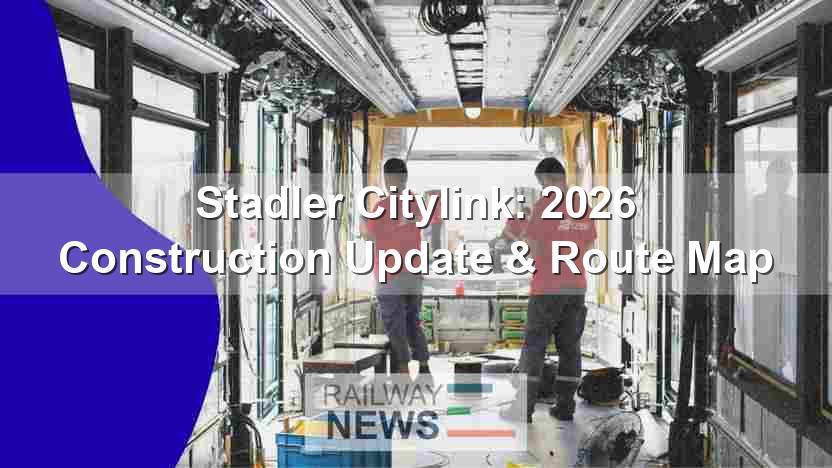
The Stadler Citylink is a bi-modal light rail vehicle (LRV) platform engineered to unify disparate urban tramway and mainline intercity railway networks. This profile analyzes the technical specifications and large-scale deployment of the Citylink, focusing on its role in creating seamless, integrated regional public transport systems across Europe. The platform’s success demonstrates a pivotal shift towards interoperable rolling stock for modernizing railway infrastructure.
| Attribute | Details |
|---|---|
| Project Name | Stadler Citylink Platform (VDV Tram-Train Consortium Example) |
| Location | Germany, Austria, UK, Spain, Hungary |
| Length | Route-dependent; integrates existing regional and urban networks |
| Speed | Up to 100 km/h (62 mph) on mainline rail |
| Estimated Cost | ~€4 billion (VDV Consortium order of up to 504 units) |
| Status | Operational in multiple locations; VDV project in phased delivery |
| Key Contractors | Stadler Rail (Manufacturer); VBK, AVG, Saarbahn Netz, SYPTE (Operators/Authorities) |
Technical Specifications
The Stadler Citylink is a bi-directional LRV designed for maximum operational flexibility. The platform can be configured for both standard (1,435 mm) and metre-gauge networks. A key engineering feature is its multi-system electrical capability, allowing operation under various catenary voltages including 600V/750V DC for urban tram lines and 25kV AC for mainline railways. A diesel-electric hybrid variant also exists for operation on non-electrified routes. The vehicle architecture features a 100% low-floor interior for barrier-free access, advanced acoustic insulation, and flexible door placement to accommodate diverse platform heights. Second-generation models incorporate a fully electric drivetrain delivering up to 900kW of power, a dynamic passenger information system (FIS), and enhanced accessibility features such as a radio-controlled blind information system (BLIS).
Key Takeaways
- Seamless Network Integration: The Citylink’s primary strategic value is its ability to operate on both street-level tram tracks and mainline railways, eliminating the need for passenger transfers and bridging the urban-regional transport gap.
- Scalable and Adaptable Platform: The vehicle’s design is highly flexible, accommodating various track gauges, multiple voltage systems, and diverse operational environments, as proven by deployments from the UK to Hungary.
- Proven Financial Viability: Large-scale procurements are supported by robust public-private financing models involving institutions like the European Investment Bank (EIB), demonstrating a strong long-term economic case for integrated transit solutions against initial capital expenditure.
Frequently Asked Questions (FAQ)
What makes the Stadler Citylink tram-train unique?
The Stadler Citylink’s unique capability is its bi-modal operation. It functions as a conventional tram in city centers and as a regional train on mainline rail networks, enabling a single, uninterrupted journey between urban and suburban areas. This versatility is achieved through its ability to handle different track gauges, platform heights, and electrical power systems.
Which countries are using the Stadler Citylink?
The Stadler Citylink is operational in several countries, demonstrating its adaptability. Key deployments are found in Germany (Karlsruhe, Chemnitz, Saarbrücken), the United Kingdom (Sheffield Supertram, South Wales Metro), Spain (Alicante), and Hungary (Szeged-Hódmezővásárhely). A major ongoing project will significantly expand its presence across Germany and Austria.

Transport and railway industry editor covering global rail infrastructure, sustainable mobility, urban transit systems and next-generation railway technologies with a focus on accessible and industry-focused reporting.
RELATED POSTS
August 11, 2026 11:13 am
Hungary confirmed the €2.5B Hungarian rail upgrade will not see...
August 7, 2026 11:14 am
České dráhy opens steam service with 101-year-old locomotive 354.195 in...
August 16, 2026 12:13 am
Hungary approved the €9.76B Baross Gábor plan for 2026–2035 covering...
August 18, 2026 6:14 am
Hungary resumes passenger rail service on the 18 km Dombóvár–Komló...