
Italy Halts Turin-Lyon High-Speed Rail: A Critical Analysis
Italy’s halt of the Turin-Lyon high-speed rail project tenders exposes critical flaws in mega-project planning. Learn how this impacts future high-speed rail development!
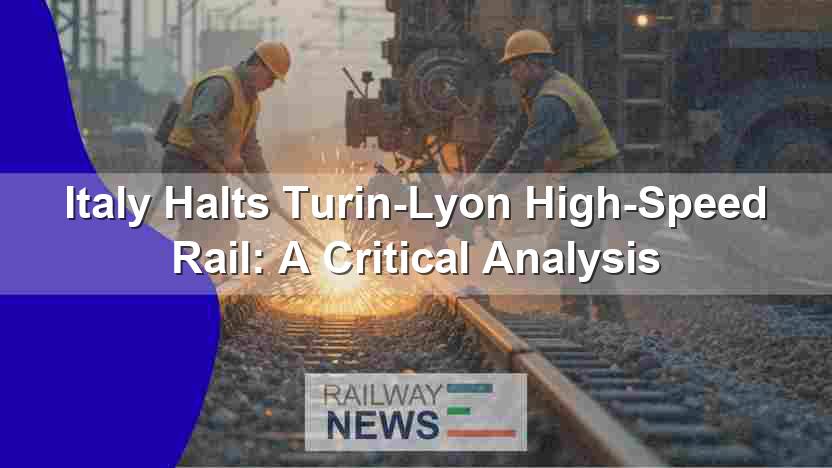
The suspension of tenders for the Turin-Lyon high-speed rail (HSR) project by the Italian government marks a significant turning point in a long-standing debate regarding the economic viability and environmental impact of large-scale infrastructure projects. This article explores the complex political, economic, and technical considerations that led to this decision, examining the project’s history, the conflicting viewpoints of stakeholders, and the potential implications for future high-speed rail development in Europe. The analysis will explore the financial projections, the environmental concerns, the political maneuvering, and the broader implications for cross-border infrastructure projects within the European Union (EU). The suspension underscores the inherent challenges in balancing national interests, international cooperation, and the long-term strategic goals of sustainable transportation infrastructure development. This seemingly simple act of halting tenders reveals a deeper struggle over budgetary priorities, differing visions of national development, and the very nature of cost-benefit analysis in the context of mega-projects. The case of the Turin-Lyon line provides valuable insights into the decision-making processes and political pressures involved in constructing large-scale infrastructure, particularly within a multi-national framework.
The Turin-Lyon High-Speed Rail Line: A Project in Limbo
The planned Turin-Lyon high-speed rail link, often referred to as the TAV (Treno Alta Velocità) link, aims to create a high-speed connection between Turin, Italy, and Lyon, France, traversing the challenging terrain of the Alps. The project has been fraught with controversy since its inception, primarily due to its substantial cost and the environmental concerns associated with its construction, particularly the impact on the Alpine ecosystem and the potential for significant land disruption. The project’s ambitious scope and complex engineering requirements have also contributed to its protracted planning and development phases. Initial cost estimates significantly underestimated the project’s true financial burden, leading to ongoing disputes and re-evaluations.
Conflicting National Interests and Political Gridlock
The Italian government’s decision to suspend the tenders reflects deep divisions within the ruling coalition. The 5-Star Movement (M5S), a key coalition partner, staunchly opposed the project, citing its exorbitant cost and questioning its projected economic benefits. The M5S argued that the funds allocated to the TAV link would be better utilized in upgrading and maintaining Italy’s existing rail infrastructure, addressing more immediate transportation needs. This internal conflict within the Italian government has resulted in political gridlock, delaying the project and hindering its progress.
Financial Viability and Cost Overruns
A crucial factor contributing to the suspension is the escalating cost of the project. Initial estimates were far below the current projected figures. This discrepancy reflects both unforeseen engineering challenges and the inherent complexities of large-scale infrastructure projects. Recent reports suggest that the project may not be financially viable, potentially resulting in significant losses for Italy, France, and the EU. The distribution of costs among the participating nations (Italy, France, and the EU), further complicated the situation, leading to heated debates on cost-sharing responsibilities.
Environmental Concerns and Sustainable Development
Beyond the financial considerations, environmental concerns also play a significant role in the controversy. The construction of a high-speed rail line through the Alps necessitates extensive tunneling and excavation, potentially impacting sensitive ecosystems and posing risks to biodiversity. Environmental impact assessments have become a focal point of the debate, with critics arguing that the environmental damage outweighs the potential benefits of the project. The lack of clear, detailed, and transparent environmental impact reports has further fueled the opposition.
Conclusions: A Crossroads for High-Speed Rail Development
The suspension of the Turin-Lyon high-speed rail project tenders highlights the complex interplay of political, economic, and environmental factors that shape large-scale infrastructure projects. The decision underscores the importance of thorough cost-benefit analyses, transparent communication with stakeholders, and robust environmental impact assessments. The project’s failure to secure consensus among key stakeholders demonstrates the challenges of coordinating cross-border infrastructure initiatives. The high cost, coupled with concerns about environmental impact and questions about its long-term economic viability, has forced a critical reassessment of the project’s feasibility. The Italian government’s decision to engage in further discussions with France and the EU represents an opportunity to re-evaluate the project’s scope, potentially incorporating adjustments to address concerns about cost and environmental impact. The outcome of these discussions will not only determine the fate of the Turin-Lyon line but will also have broader implications for future high-speed rail development across Europe, raising vital questions about sustainable infrastructure planning and the balancing of economic growth with environmental protection. The case provides a valuable lesson in the importance of careful planning, transparent cost accounting, and meaningful stakeholder engagement in the development of large-scale infrastructure projects, ensuring that such ventures are not only economically sound but also environmentally and socially responsible. The future of this project and similar ones hinges on a detailed approach that incorporates all relevant considerations, promoting both economic development and environmental sustainability.

Railway infrastructure, rolling stock and transport technologies specialist focused on global rail industry developments, high-speed rail systems, signaling technologies and freight transportation. Covering railway investments, public transport modernization, rail operations and international mobility projects across Europe, Asia and North America.
RELATED POSTS

October 1, 2026 7:09 am
United States regulators confirmed a September 30 deadline for the...

October 8, 2026 1:15 pm
Alstom secured a €1bn contract to build 13 automated trains,...

October 4, 2026 5:14 pm
Alstom secured a CA$4.7 billion order from VIA Rail Canada...

October 4, 2026 11:08 pm
Sound Transit confirmed the September 30 opening of Seattle Pinehurst...
October 1, 2026 10:14 am
HS2 installed a 55-metre steel span in Birmingham, completing phase...

October 8, 2026 12:18 pm
Siemens Mobility signed an agreement with VinSpeed to supply 350...