
Hamburg-Berlin Railway Line: Major Refurbishment Starts 2025
Germany’s Deutsche Bahn has greenlit the comprehensive refurbishment of the Hamburg-Berlin railway line, marking a significant investment in modernizing infrastructure for one of Europe’s busiest passenger routes.
Germany, 17th May 2024
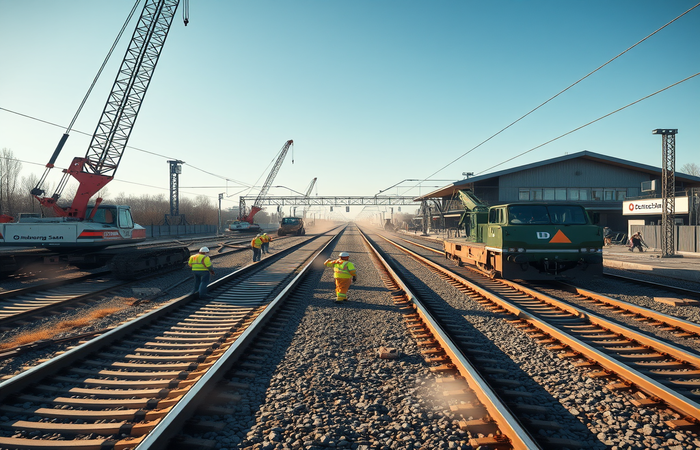
Deutsche Bahn (DB), Germany’s national railway company, has officially greenlit the detailed refurbishment of the Hamburg-Berlin railway line, a crucial artery in the nation’s rail network. With construction contracts finalized and a start date of August 1, 2025, this project marks a significant investment in modernizing and enhancing the infrastructure of one of the busiest passenger routes in the country. This extensive undertaking, spanning the Hamburg-Rothenburgsort to Büchen section, encompasses a complete overhaul of the track infrastructure, signaling systems, and stations. The project aims to not only improve operational efficiency and capacity but also to upgrade passenger amenities, ensuring a more reliable and comfortable travel experience for the millions who rely on this vital connection. The implementation of advanced technologies, such as the European Train Control System (ETCS), will further align the Hamburg-Berlin line with the latest advancements in railway technology, paving the way for increased safety and efficiency in the coming years. This ambitious project reflects DB’s commitment to delivering a world-class railway service, despite the inevitable disruptions during the renovation phase.
Project Scope and Contract Award
The refurbishment of the Hamburg-Berlin railway line is a multifaceted project involving the complete renewal of critical infrastructure components. The scope of work includes replacing over 180 kilometers of tracks, 200 switches, and upgrading signaling and control systems. This also involves the construction of new interlockings at key locations such as Aumühle, Schwarzenbek, and Büchen. The project’s complexity demanded a rigorous tendering process, leading DB to award contracts to a consortium of specialized firms. These include Rhomberg Sersa Rail Holding GmbH, Eurovia GmbH, Axians GA Netztechnik GmbH, Knapp Engineering GmbH, CRS grüntechnik GmbH, SPL Powerlines Germany GmbH, SPITZKE SE, and a joint venture comprising Schweerbau GmbH & Co. KG, Joseph Hubert GmbH & Co. KG, and Wiebe Holding GmbH & Co. KG. DB InfraGO (the infrastructure division of Deutsche Bahn) will be overseeing the coordination of these various contractors, ensuring a streamlined execution of the project. The project is scheduled to be completed by April 30, 2026. This timeline reflects the scale of the undertaking and the logistical challenges of carrying out such extensive works on a live railway line, whilst also minimizing disruption.
ETCS Implementation and System Upgrades
A key component of the Hamburg-Berlin line refurbishment is the preparation for the future implementation of the European Train Control System (ETCS). Following lessons learned from the Riedbahn pilot project, DB has revised its approach to ETCS deployment. Instead of a complete ETCS rollout during the current refurbishment, the focus will be on preparing the signal boxes and axle counting systems for future integration. The existing train protection systems (PZB and LZB) will remain operational for the time being. The full installation of ETCS is now projected for the early 2030s, when fleet conversion is more feasible. This phased approach minimizes the cost and complexity associated with operating dual systems. Other significant upgrades include the modernization and accessibility improvements at stations along the route. Platforms will be extended in Müssen and Schwarzenbek to accommodate longer regional trains. These platform extensions, funded by the state of Schleswig-Holstein, will greatly enhance the efficiency and comfort of regional services.
Traffic Management and Passenger Services
During the nine-month construction period, significant alterations to passenger services will be necessary. Long-distance trains between Hamburg and Berlin will be rerouted via Uelzen and Stendal, resulting in a 45-minute extension to journey times. Some services to Rostock and Stralsund will be diverted via Lübeck. To mitigate the impact on passengers, DB will implement a detailed traffic management plan. Capacity for regional trains between Hamburg, Lübeck, and Bad Kleinen will be increased. To ensure that local travel needs are met, over 170 buses will replace suspended regional services during peak times. The bus services will cover up to 86,000 kilometers daily. Revised timetables are readily available on bahn.de and the DB Navigator app, allowing passengers to plan their journeys effectively and stay informed about any changes to services. Additionally, DB will introduce six new crossover points that will boost operational flexibility, enabling faster trains to overtake slower freight services.
Conclusion
The Hamburg-Berlin railway line refurbishment project represents a significant investment in Germany’s railway infrastructure, with the potential to transform the passenger experience and boost the efficiency of this crucial transport link. The project’s scope includes extensive track and signaling upgrades, the modernization of stations, and the preparation for the future implementation of ETCS. While the nine-month construction period will undoubtedly cause some disruption to passenger services, DB has developed a detailed plan to minimize the impact, including rerouting long-distance trains, increasing regional train capacity, and providing extensive bus replacement services. The project’s success hinges on careful coordination between multiple contractors and DB InfraGO, the infrastructure division of Deutsche Bahn. This project is part of DB’s broader S3 infrastructure renewal strategy. In the long run, the investment in infrastructure will result in improved reliability, increased capacity, and enhanced passenger comfort. As the project progresses, the public will be updated via communication, showcasing the progress, and detailing the benefits that will be realized for the future, securing its position as one of Germany’s most vital and efficient railway corridors, providing a major boost to the rail industry. Ultimately, this refurbishment is a strategic move to ensure the long-term viability and competitiveness of the railway.
Summary of Companies Involved:
- Deutsche Bahn (DB) / DB InfraGO: German national railway company and infrastructure division, overseeing the project.
- Rhomberg Sersa Rail Holding GmbH: Specialized in railway construction and maintenance.
- Eurovia GmbH: Involved in construction and civil engineering.
- Axians GA Netztechnik GmbH: Focused on network technology solutions.
- Knapp Engineering GmbH: Offers engineering services, likely related to railway infrastructure.
- CRS grüntechnik GmbH: Possibly involved in green infrastructure elements.
- SPL Powerlines Germany GmbH: Specializes in power supply and overhead line systems.
- SPITZKE SE: Specializes in track construction and railway infrastructure.
- Schweerbau GmbH & Co. KG, Joseph Hubert GmbH & Co. KG, and Wiebe Holding GmbH & Co. KG: A joint venture of construction firms, possibly focused on track and civil works.

Railway infrastructure, rolling stock and transport technologies specialist focused on global rail industry developments, high-speed rail systems, signaling technologies and freight transportation. Covering railway investments, public transport modernization, rail operations and international mobility projects across Europe, Asia and North America.
RELATED POSTS

October 5, 2026 6:12 pm
AECOM and Jacobs secured a contract in September 2026 to...

October 4, 2026 11:08 pm
Sound Transit confirmed the September 30 opening of Seattle Pinehurst...
October 6, 2026 9:17 am
Illinois approved $1.1M in state funds to upgrade two McHenry...
October 6, 2026 12:16 am
FTA awarded $233 million in grants to eight US rail...
October 5, 2026 3:13 pm
DART launched a 90-day fare enforcement pilot across 5 light-rail...
October 1, 2026 10:14 am
HS2 installed a 55-metre steel span in Birmingham, completing phase...