
Huawei’s Rail Revolution: LTE-R, 5G, and Cloud
This article discusses Huawei’s advancements in railway communication technologies, focusing on its LTE-R solution for modernizing rail networks with increased bandwidth, reliability, and integration of 5G and IoT, while also examining the benefits of cloud computing for optimizing railway operations.
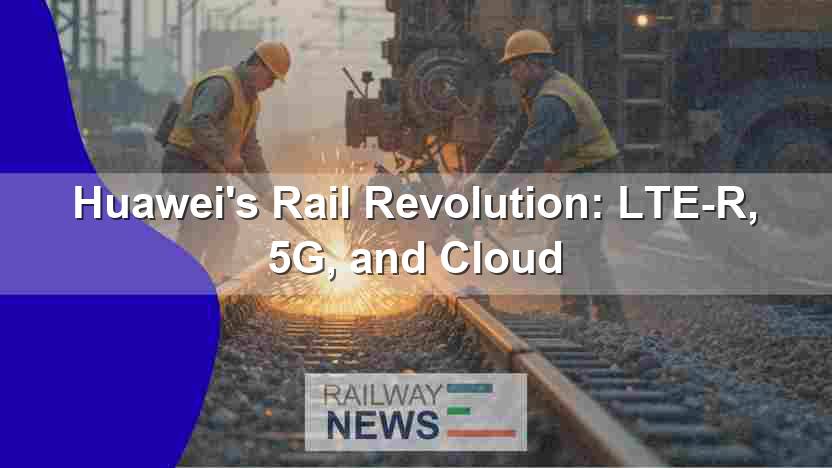
This article explores the advancements in railway communication technologies, focusing on Huawei’s contributions to the modernization of rail networks. The increasing demand for higher bandwidth, greater reliability, and seamless integration of various railway systems necessitates a shift from legacy technologies. This transition involves the implementation of advanced wireless communication systems, cloud-based solutions, and the integration of technologies like 5G and the Internet of Things (IoT). We will examine Huawei’s LTE-R (Long Term Evolution – Railway) solution, its integration with existing GSM-R (Global System for Mobile Communications – Railway) infrastructure, and the complementary roles of cloud computing and 5G in creating a more efficient and safer railway environment. The discussion will delve into the technical aspects of these solutions, their benefits, and the impact on railway operations and passenger experience. Finally, we will analyze the broader implications of these technological advancements for the future of railway systems globally.
LTE-R and GSM-R Integration: A Seamless Transition
Huawei’s LTE-R solution represents a significant step towards modernizing railway communication infrastructure. LTE-R offers substantial advantages over the older GSM-R standard, primarily in terms of increased bandwidth and data capacity. This allows for the seamless integration of various applications, including advanced train control systems, enhanced passenger information systems (PIS), high-resolution CCTV surveillance, and mission-critical push-to-talk (MCPTT) communications. The key to a smooth transition lies in Huawei’s design, which supports interoperability with existing GSM-R networks. This phased approach minimizes disruption during the upgrade process, allowing railway operators to leverage the benefits of LTE-R while maintaining compatibility with their existing infrastructure. The gradual migration ensures operational continuity and minimizes financial risks associated with a complete system overhaul.
The Role of Cloud Computing: Urban Rail Light Cloud Solution
Huawei’s Urban Rail Light Cloud solution plays a crucial role in optimizing railway operations. By virtualizing computing, storage, network, and security resources, this solution simplifies infrastructure management and reduces operational costs. The virtualization allows for dynamic resource allocation, enabling efficient scaling to meet varying demands. This flexibility is particularly beneficial for rail networks with fluctuating passenger loads, ensuring optimal performance regardless of the operational context. The integration of data center devices further streamlines operations, minimizing procurement and deployment costs, and improving overall efficiency. This cloud-based approach simplifies maintenance and upgrades, reducing downtime and improving the overall resilience of the railway system.
5G Integration: Enhancing Passenger Experience and Operational Efficiency
Huawei’s 5G Digital Indoor System (DIS) solution, marketed as 5G LampSite, integrates seamlessly with LTE-R to further enhance railway operations. This solution leverages the high bandwidth and low latency characteristics of 5G technology to enable a variety of applications aimed at improving passenger experience and operational efficiency. These include improved passenger flow management through real-time information dissemination and streamlined ticketing systems, as well as enhanced security features utilizing high-quality video surveillance and improved communication capabilities for security personnel. The combination of LTE-R and 5G creates a robust and future-proof communication network, capable of adapting to the evolving needs of modern railway systems.
Digital Transformation: A Holistic Approach to Railway Modernization
Huawei’s strategy extends beyond individual solutions; it focuses on facilitating the digital transformation of the entire railway ecosystem. Their approach emphasizes the integration of various technologies—cloud computing, IoT, big data, and AI—to create a holistic and interconnected environment. This integrated approach optimizes efficiency across various aspects of railway operations, enhancing safety, reliability, and overall passenger experience. By collaborating with global partners, Huawei aims to drive innovation and contribute to the future of rail transportation, leading to more sustainable and technologically advanced railway systems worldwide.
Conclusions
To summarize, Huawei’s suite of solutions – LTE-R, Urban Rail Light Cloud, and 5G LampSite – represents a significant advancement in railway communication technologies. The integration of LTE-R with existing GSM-R networks provides a practical path to modernization, minimizing disruption while maximizing the benefits of the new technology. The adoption of cloud computing through the Urban Rail Light Cloud solution streamlines operations, optimizes resource allocation, and reduces costs. Additionally, the incorporation of 5G technology significantly enhances both passenger experience and operational efficiency. The overall impact of Huawei’s integrated approach is a move towards a more digitally transformed, safer, and more efficient railway system. The success of these solutions hinges not only on their technical capabilities but also on effective collaboration between technology providers and railway operators, ensuring seamless integration and maximizing the potential for improved railway operations and passenger satisfaction. The future of railway communication is clearly characterized by the convergence of advanced wireless technologies, cloud computing, and data analytics, promising a more interconnected, reliable, and passenger-centric railway experience globally.

Railway infrastructure, rolling stock and transport technologies specialist focused on global rail industry developments, high-speed rail systems, signaling technologies and freight transportation. Covering railway investments, public transport modernization, rail operations and international mobility projects across Europe, Asia and North America.
RELATED POSTS

September 5, 2026 4:19 pm
CPK launched formal tender talks with four consortia to design...

September 5, 2026 7:14 pm
HS2 Ltd signed renegotiated civils contracts with EKFB and Align...

September 6, 2026 4:12 am
Alstom delivered the first of 100 new G Class trams...
September 5, 2026 6:17 pm
Universal Signalling won a deal to install its U-Cross system...
September 6, 2026 8:17 am
DB InfraGO reopened the Nuremberg-Regensburg line in Bavaria on 31...
September 6, 2026 12:20 pm
Indian Railways ordered a probe after a fire destroyed 2...