
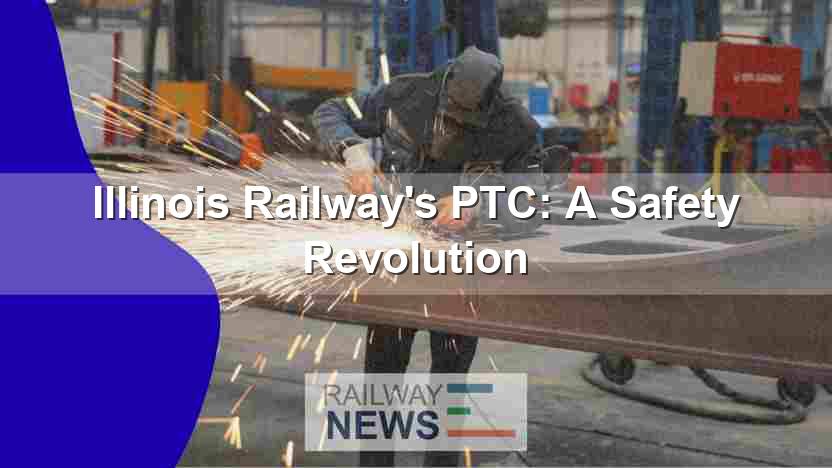
Illinois Railway’s PTC: A Safety Revolution
The successful implementation of Positive Train Control (PTC) on three trains of the Illinois Railway by OmniTRAX demonstrates significant advancements in railway safety technology through innovative interoperability with larger networks, offering a valuable case study for other short-line railroads considering similar upgrades.
Introduction
This article examines the significant advancements in railway safety technology through the lens of the Illinois Railway’s (IR) recent implementation of Positive Train Control (PTC). The deployment of PTC on three of IR’s trains marks a crucial step towards enhancing safety within the short-line railroad sector and underscores the importance of interoperability with larger railway networks. We will explore the technical aspects of PTC, the financial considerations involved in its deployment, the collaborative efforts between private entities and governmental agencies, and the broader implications for railway safety standards and future technological advancements in the field. The success of this project provides a valuable case study for other short-line railroads contemplating similar upgrades, highlighting both the challenges and benefits of adopting advanced safety systems. The integration of PTC also demonstrates a commitment to proactive risk mitigation and a dedication to maintaining the highest standards of passenger and operational safety within the rail transportation industry.
PTC Implementation on the Illinois Railway
The Illinois Railway, operated by OmniTRAX, has successfully installed fully functional PTC equipment on three of its trains. This initiative aims to bolster passenger safety and ensure interoperability with the PTC systems employed by major railroads like BNSF and Metra. The project was partially funded by a grant from the Federal Railroad Administration (FRA), covering 70% of the deployment costs. This reflects the FRA’s commitment to promoting rapid implementation of safety enhancing technologies across the national rail network. The PTC system, supplied and installed by Wabtec, includes hardware, configuration, installation, rigorous testing (both lab and field), and detailed training for railway personnel. The system monitors numerous variables including train speed, location, track conditions, and other operational parameters. When operating within PTC-enabled territories, the system facilitates communication and coordination with adjacent railways such as BNSF, mitigating risks of collisions and speed-related infractions.
Financial and Operational Considerations
The adoption of PTC represents a substantial financial investment for short-line railroads like the Illinois Railway. While the FRA grant significantly reduced the cost burden, the remaining expenditure highlights the need for efficient capital expenditure (CAPEX) strategies within the rail industry. The success of the Illinois Railway’s project underscores the importance of effective planning, procurement, and project management for successful PTC implementation. This includes careful consideration of hardware selection, software integration, personnel training, and ongoing maintenance costs. Further research into optimizing CAPEX strategies for short-line railroads adopting PTC is vital to encourage wider adoption of this life-saving technology. The careful planning demonstrated by OmniTRAX provides a valuable case study for similar undertakings.
Interoperability and Collaboration
A key feature of the Illinois Railway’s PTC implementation is its emphasis on interoperability with the systems used by BNSF and Metra. This seamless integration is vital for ensuring safety across different railway networks. Such collaboration between different railway operators, governmental agencies (such as the FRA), and technology providers (like Wabtec) is crucial for the successful implementation of nationwide PTC systems. The support received from the FRA, Senator Tammy Duckworth, the Illinois Department of Transportation, and BNSF exemplifies the vital role of collaborative partnerships in promoting advancements in railway safety.
Conclusion
The Illinois Railway’s successful installation of PTC represents a significant milestone in short-line railroad safety. The project showcases the effectiveness of collaborative efforts between private operators, government agencies, and technology providers in implementing crucial safety upgrades. The financial investment, although substantial, is justified by the significant improvement in safety levels, reducing the risk of costly accidents and enhancing public confidence in rail transportation. The emphasis on interoperability with larger railway systems underlines the importance of a cohesive national strategy for PTC deployment. The project’s success offers valuable lessons for other short-line railroads considering PTC adoption, demonstrating the feasibility and benefits of this advanced technology while highlighting the importance of strategic planning and financial management. Looking ahead, wider adoption of PTC and continued investment in railway safety technologies are crucial for ensuring the safety and efficiency of the nation’s rail network. Further research focusing on optimized CAPEX strategies, enhanced interoperability solutions, and the integration of new technologies, such as AI and predictive maintenance, will be pivotal in shaping the future of rail safety and promoting a safer, more reliable, and efficient railway system. The Illinois Railway’s initiative serves as a compelling example of proactive leadership in railway safety and sets a high standard for the industry to follow.

Railway infrastructure, rolling stock and transport technologies specialist focused on global rail industry developments, high-speed rail systems, signaling technologies and freight transportation. Covering railway investments, public transport modernization, rail operations and international mobility projects across Europe, Asia and North America.
RELATED POSTS

September 5, 2026 4:19 pm
CPK launched formal tender talks with four consortia to design...

September 5, 2026 7:14 pm
HS2 Ltd signed renegotiated civils contracts with EKFB and Align...

September 6, 2026 4:12 am
Alstom delivered the first of 100 new G Class trams...
September 5, 2026 6:17 pm
Universal Signalling won a deal to install its U-Cross system...
September 6, 2026 8:17 am
DB InfraGO reopened the Nuremberg-Regensburg line in Bavaria on 31...
September 6, 2026 12:20 pm
Indian Railways ordered a probe after a fire destroyed 2...