
5G: Automating German Railways with Nokia
The integration of 5G technology into Deutsche Bahn’s Hamburg S-Bahn network represents a pivotal step in realizing the Future Railway Mobile Communications System (FRMCS), offering real-world testing grounds for advanced communication technologies and paving the way for future global railway modernization efforts.
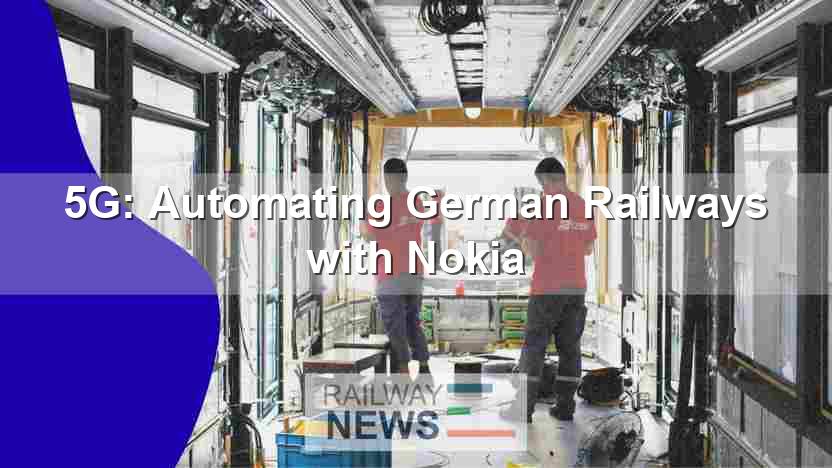
The integration of 5G technology into railway operations represents a significant advancement in the pursuit of automated and digitally enhanced rail systems. This article explores the pioneering collaboration between Deutsche Bahn (DB), Germany’s national railway company, and Nokia, a leading telecommunications provider, to trial standalone (SA) 5G technology for automated train operations. This initiative is not merely a technological experiment; it is a crucial step in realizing the vision of the Future Railway Mobile Communications System (FRMCS), a global standard for next-generation railway communication. The successful implementation of 5G in this context promises to revolutionize various aspects of railway operations, from enhanced safety and efficiency to improved passenger experience and streamlined maintenance procedures. The trial, focusing on a section of the Hamburg S-Bahn network, provides a real-world testing ground to assess the feasibility, reliability, and scalability of 5G for complex railway applications. The implications extend beyond Germany, offering valuable insights for global railway modernization efforts and setting a benchmark for future deployments of advanced communication technologies in the rail sector. We will explore the technical aspects of the 5G implementation, the anticipated benefits, and the broader implications for the future of railway infrastructure.
5G Technology: The Foundation for Automated Rail Operations
The core of DB’s initiative lies in leveraging the capabilities of standalone 5G (SA) technology. Unlike non-standalone (NSA) 5G, which relies on existing 4G infrastructure, SA 5G offers a dedicated and optimized network architecture specifically designed for high-bandwidth, low-latency communication—critical requirements for automated train control systems. This low latency is paramount for real-time data transmission, ensuring seamless communication between trains, trackside equipment, and control centers. The chosen 3GPP standards ensure interoperability and adherence to international communication protocols, crucial for seamless integration into existing and future railway infrastructure. The SA 5G network’s reliability and high bandwidth also facilitate the transmission of large amounts of data from various sensors and onboard systems, providing detailed situational awareness for optimized train control and improved safety measures.
The Hamburg S-Bahn Pilot Project: A Real-World Testbed
The trial project on the 23km stretch of S-Bahn Line 21 in Hamburg serves as a practical demonstration of 5G’s capabilities in a real railway environment. The chosen route incorporates diverse operational scenarios, including automated train operation with onboard drivers and driverless shunting of empty trains near Bergedorf station. This range of applications allows for detailed testing of the 5G network’s performance under varying conditions, providing valuable data on its resilience and adaptability. The data collected from the trial will be instrumental in fine-tuning the FRMCS standard, ensuring its compatibility with the diverse needs of various railway systems globally.
Benefits and Implications of 5G in Railway Systems
The successful integration of 5G promises several key advantages for railway operations. Improved safety is a primary benefit, with real-time data transmission enabling advanced collision avoidance systems and enhanced train monitoring. Increased efficiency is another key advantage, allowing for optimized train scheduling, reduced delays, and improved overall network performance. Additionally, the high bandwidth of 5G supports the development of advanced passenger information systems, providing real-time updates and enhancing the overall passenger experience. Lastly, remote diagnostics and predictive maintenance become feasible, enabling proactive maintenance schedules and reducing downtime.
Global Perspectives and Future Trends
The DB-Nokia collaboration is not an isolated incident; it exemplifies a broader global trend toward the adoption of advanced communication technologies in the railway industry. Numerous other initiatives worldwide are exploring the use of 5G for similar purposes, underscoring the widespread recognition of its transformative potential. The lessons learned from the Hamburg trial will be invaluable for future projects, paving the way for widespread adoption of 5G in railway systems globally. As technology continues to evolve, future developments may include the seamless integration of artificial intelligence (AI) and machine learning (ML) for even more sophisticated train control and predictive maintenance capabilities.
Conclusions
The Deutsche Bahn and Nokia partnership represents a significant leap forward in the evolution of railway technology. Their trial of standalone 5G technology for automated train operations on the Hamburg S-Bahn network serves as a crucial proof-of-concept, demonstrating the feasibility and benefits of integrating 5G into complex railway systems. The project’s focus on the Future Railway Mobile Communications System (FRMCS) standard underscores the importance of developing interoperable and globally applicable solutions. The successful implementation of 5G in this context promises to transform various aspects of railway operations, leading to improved safety, efficiency, and passenger experience. The low-latency, high-bandwidth characteristics of 5G are crucial for real-time data transmission, enabling advanced control systems and predictive maintenance capabilities. The insights gained from this trial will inform future deployments of 5G in railway systems worldwide, setting a precedent for a global shift towards safer, more efficient, and digitally enhanced rail networks. The potential for integrating AI and ML further enhances the long-term prospects of 5G’s transformative impact on the railway industry, promising a future of enhanced automation and optimized operations across the globe. The Hamburg S-Bahn trial is not just a technological achievement; it signifies a paradigm shift in the way we approach railway infrastructure and operations.

Railway infrastructure, rolling stock and transport technologies specialist focused on global rail industry developments, high-speed rail systems, signaling technologies and freight transportation. Covering railway investments, public transport modernization, rail operations and international mobility projects across Europe, Asia and North America.
RELATED POSTS

September 5, 2026 4:19 pm
CPK launched formal tender talks with four consortia to design...
September 5, 2026 7:14 pm
HS2 Ltd signed renegotiated civils contracts with EKFB and Align...
September 6, 2026 4:12 am
Alstom delivered the first of 100 new G Class trams...
September 5, 2026 6:17 pm
Universal Signalling won a deal to install its U-Cross system...
September 6, 2026 8:17 am
DB InfraGO reopened the Nuremberg-Regensburg line in Bavaria on 31...
September 6, 2026 12:20 pm
Indian Railways ordered a probe after a fire destroyed 2...