
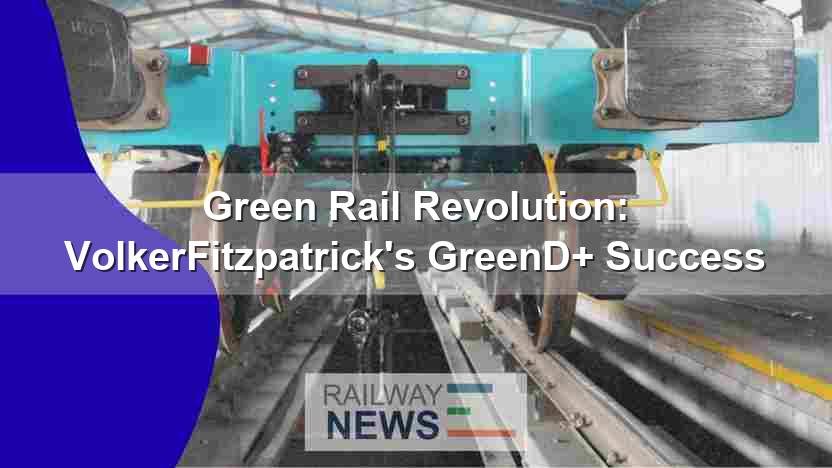
Green Rail Revolution: VolkerFitzpatrick’s GreenD+ Success
VolkerFitzpatrick’s partnership with Green Biofuels has significantly reduced its carbon footprint by implementing GreenD+, a sustainable alternative fuel that reduces railway operations’ environmental impact through notable emission reductions and improved air quality.
Introduction
The railway industry, a cornerstone of global transportation, faces increasing pressure to mitigate its environmental impact. This article explores the innovative approach adopted by VolkerFitzpatrick, a prominent UK construction company, in significantly reducing its carbon footprint within its rail operations. Their partnership with Green Biofuels and the subsequent implementation of GreenD+ (Hydrotreated Vegetable Oil), a sustainable alternative fuel, represents a significant step towards a greener railway sector. We will examine the technical aspects of GreenD+, its environmental benefits as demonstrated through independent testing, the logistical advantages of its direct substitution for conventional diesel, and the broader implications of this initiative for the industry’s pursuit of sustainability. The analysis will highlight the potential for wider adoption of this technology and its contribution to achieving ambitious emission reduction targets within the railway industry.
GreenD+ Fuel: A Technical Overview
GreenD+, a hydrotreated vegetable oil (HVO) based fuel, presents a compelling alternative to traditional diesel fuels within the railway sector. Its chemical composition closely resembles that of conventional diesel, ensuring seamless compatibility with existing railway engines and infrastructure. This eliminates the need for costly equipment retrofits or modifications to fuel storage and handling systems, a significant advantage for cost-conscious operators. The key to GreenD+’s reduced emissions lies in its unique formulation, incorporating a proprietary additive not found in other HVO fuels. This additive is instrumental in achieving the substantial emission reductions observed during independent testing.
Environmental Performance and Testing
Independent testing conducted at the Millbrook specialist vehicle testing facility provided concrete evidence of GreenD+’s superior environmental performance. Results demonstrated a remarkable 77% reduction in particulate matter (PM) emissions and a 29% reduction in nitrogen oxides (NOx) compared to standard diesel fuel. The significant reduction in PM, a major contributor to air pollution and respiratory illnesses, is particularly noteworthy. The decrease in NOx emissions is also vital, contributing to improved air quality and a lessened impact on the environment. These reductions directly translate to a substantial decrease in greenhouse gas emissions, specifically an estimated 4,000 metric tons of CO2 annually for VolkerFitzpatrick’s rail operations.
Logistical Advantages and Operational Implementation
The ease of implementation is a key factor contributing to the appeal of GreenD+. Its drop-in replacement nature eliminates the need for extensive infrastructure upgrades, significantly reducing the financial and logistical hurdles often associated with adopting new fuels. This characteristic makes it particularly attractive to railway operators seeking to reduce their carbon footprint without disrupting their existing operational workflows. VolkerFitzpatrick’s adoption of GreenD+ across its diverse network, encompassing sites in East London, Northwest London, Scotland, and Norfolk, underscores the fuel’s adaptability and practicality in varied operational settings.
Industry Implications and Future Outlook
VolkerFitzpatrick’s pioneering adoption of GreenD+ sets a powerful precedent for the railway industry. The company’s success in seamlessly integrating this sustainable fuel demonstrates its viability and effectiveness in real-world applications. The significant emission reductions achieved highlight the potential for substantial environmental improvements across the broader railway sector. This initiative encourages other railway operators to explore similar solutions, accelerating the transition toward cleaner, more sustainable transportation systems. The success of GreenD+ lies not only in its environmental benefits but also in its cost-effectiveness and ease of implementation, making it a viable and attractive option for operators of all sizes. The potential for wider adoption is significant, paving the way for a substantial reduction in the railway industry’s carbon emissions, contributing towards a more environmentally responsible and sustainable future. The reduction in particulate matter (PM) and nitrogen oxides (NOx) directly translates to improved air quality in the vicinity of railway lines, benefiting local communities and the environment as a whole. The readily available nature of HVO fuels, which are derived from sustainably sourced feedstocks, further enhances the long-term sustainability of this approach. This case study serves as a compelling example of how the railway sector can actively contribute to climate change mitigation goals while maintaining operational efficiency.

Railway infrastructure, rolling stock and transport technologies specialist focused on global rail industry developments, high-speed rail systems, signaling technologies and freight transportation. Covering railway investments, public transport modernization, rail operations and international mobility projects across Europe, Asia and North America.
RELATED POSTS

September 5, 2026 4:19 pm
CPK launched formal tender talks with four consortia to design...

September 5, 2026 7:14 pm
HS2 Ltd signed renegotiated civils contracts with EKFB and Align...

September 6, 2026 4:12 am
Alstom delivered the first of 100 new G Class trams...
September 5, 2026 6:17 pm
Universal Signalling won a deal to install its U-Cross system...
September 6, 2026 8:17 am
DB InfraGO reopened the Nuremberg-Regensburg line in Bavaria on 31...
September 6, 2026 12:20 pm
Indian Railways ordered a probe after a fire destroyed 2...