
HS2’s 4D Safety Revolution: VR & Risk Mitigation
The innovative application of 4D technology in High-Speed 2 (HS2) project construction sites revolutionizes safety by providing immersive, interactive hazard identification and risk mitigation training through realistic virtual environments.
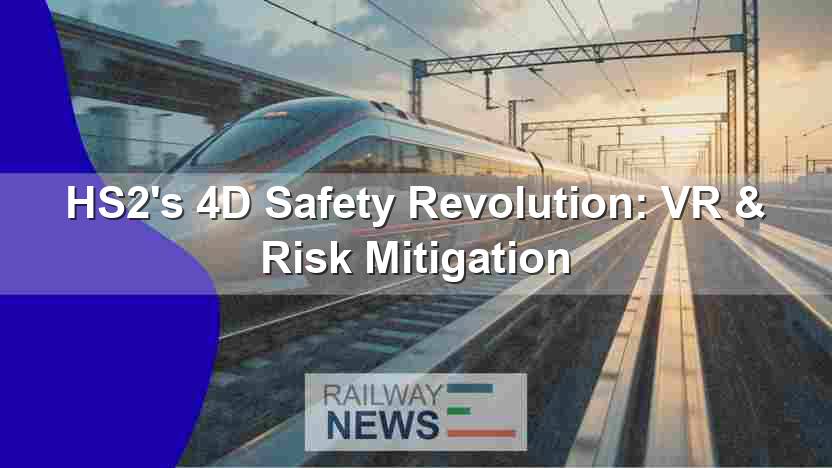
The construction of large-scale infrastructure projects, such as the High-Speed 2 (HS2) railway in the UK, presents significant challenges in ensuring worker safety. Traditional safety training methods often lack the immersive and interactive elements necessary for effective hazard identification and risk mitigation. This article explores the innovative application of 4D technology – integrating three-dimensional spatial data with the fourth dimension of time – within the HS2 project to revolutionize construction site safety. We will examine the implementation of this technology, its impact on hazard identification and risk management, and the overall contribution to improved worker safety and project efficiency. The use of immersive virtual environments promises a paradigm shift in construction safety, moving away from reactive measures towards proactive hazard prevention. This proactive approach, enabled by technology, offers the potential for substantial improvements in safety performance and a significant reduction in workplace accidents.
Implementing 4D Technology for Enhanced Safety
High Speed 2 (HS2) is leveraging 4D modeling technology, specifically the SafetiBase system developed by Balfour Beatty VINCI (BBV) and 3D Repo, to create realistic virtual representations of its construction sites. This cloud-based platform allows workers to experience a four-dimensional (4D), 360-degree virtual environment mirroring actual construction sites within the Area North route. Workers, participating in training sessions within designated “Mission Rooms,” can navigate the virtual site, identify potential hazards, and collaboratively develop mitigation strategies before any physical work commences. This preemptive approach contrasts sharply with traditional methods that typically respond to hazards after they have been identified on the live site.
Interactive Hazard Identification and Risk Mitigation
The 4D model allows for interactive identification and tagging of hazards within a specific spatial context and timeframe. By simulating the entire construction sequence virtually, teams can visualize the temporal evolution of risks, including those that may emerge only at certain stages of the project. This allows for a more detailed risk assessment than traditional methods, which often rely on static snapshots or limited simulations. Additionally, the virtual environment allows for collaborative problem-solving, with teams working together to identify and propose solutions before any potential accidents occur. This capability greatly enhances the efficacy of risk mitigation strategies.
The Role of Virtual Reality in Construction Safety Training
The use of virtual reality (VR) within the SafetiBase system significantly enhances the effectiveness of safety training. Instead of relying solely on theoretical instruction and static diagrams, workers can actively participate in simulated construction scenarios, encountering and responding to a range of potential hazards in a risk-free environment. This immersive learning experience fosters better hazard recognition and reinforces safe working practices. The ability to repeatedly practice responses to different scenarios further improves competency and reduces the likelihood of errors on the actual construction site. The feedback mechanisms built into the system allow for continuous improvement and personalized training.
Boosting Productivity Through Proactive Safety Management
By proactively identifying and mitigating hazards before they materialize on-site, the 4D technology contributes to increased productivity. The time and resources lost due to accidents, delays, and rework are significantly reduced. Additionally, the improved safety culture fostered by this technology enhances worker morale and job satisfaction. This ultimately translates into improved efficiency and cost savings for the project. The system also facilitates better communication and collaboration among different teams involved in the project, leading to streamlined workflows and enhanced overall project management.
Conclusions
The implementation of 4D technology on the HS2 project represents a significant advancement in construction site safety. By utilizing immersive virtual environments, the SafetiBase system allows for proactive hazard identification, effective risk mitigation, and enhanced safety training. The technology goes beyond reactive measures, fostering a proactive safety culture that prioritizes the prevention of accidents. The virtual environment offers a realistic and interactive platform for workers to learn and practice safe work procedures, improving competence and reducing the likelihood of on-site incidents. The ability to simulate the entire construction sequence and tag hazards within a specific spatiotemporal context allows for a far more detailed risk assessment than traditional methods. This leads to significant cost savings through the reduction of accidents, delays, and rework. Additionally, the improved safety culture fosters enhanced worker morale and contributes to a more efficient and productive work environment. The successful integration of 4D technology into major infrastructure projects such as HS2 points towards a future where proactive safety management, driven by technological innovation, becomes the industry standard.
To summarize, the application of 4D technology on the HS2 project demonstrates a significant shift towards a proactive safety approach in the construction industry. The use of immersive virtual environments enables a paradigm change from reactive to proactive hazard management, leading to enhanced worker safety, improved efficiency, and cost savings. This forward-thinking strategy sets a new benchmark for large-scale infrastructure projects, emphasizing the vital role of technology in creating safer and more productive workplaces. The success of this initiative underscores the value of investing in innovative technologies to improve safety performance and contribute to a culture of continuous improvement within the construction sector.

Railway infrastructure, rolling stock and transport technologies specialist focused on global rail industry developments, high-speed rail systems, signaling technologies and freight transportation. Covering railway investments, public transport modernization, rail operations and international mobility projects across Europe, Asia and North America.
RELATED POSTS

September 5, 2026 4:19 pm
CPK launched formal tender talks with four consortia to design...

September 5, 2026 7:14 pm
HS2 Ltd signed renegotiated civils contracts with EKFB and Align...

September 6, 2026 4:12 am
Alstom delivered the first of 100 new G Class trams...
September 5, 2026 6:17 pm
Universal Signalling won a deal to install its U-Cross system...
September 6, 2026 8:17 am
DB InfraGO reopened the Nuremberg-Regensburg line in Bavaria on 31...
September 6, 2026 12:20 pm
Indian Railways ordered a probe after a fire destroyed 2...