
Bavaria’s New Trains: Siemens Wins Major DB Regio Order
This article discusses DB Regio Bayern’s significant order with Siemens Mobility for 31 new regional trains, including Desiro HC and Mireo models, to enhance Bavaria’s rail services, reflecting a broader trend towards improving passenger experience and capacity in the region.
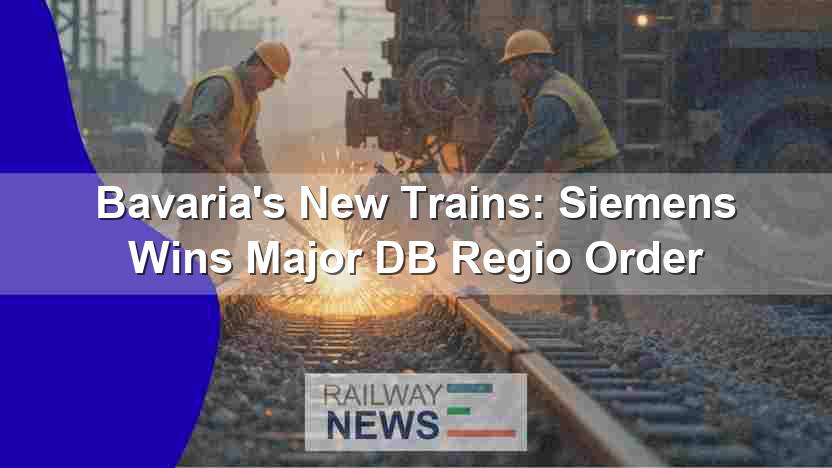
This article explores the significant order placed by DB Regio Bayern (DB Regio Bavaria) with Siemens Mobility for the procurement of 31 new regional trains to enhance passenger rail services in Bavaria, Germany. The order highlights the increasing demand for modern, efficient, and accessible rolling stock in regional rail networks. It exemplifies a broader trend towards investment in improving passenger experience and expanding rail transport’s capacity to compete with other modes of transportation. This analysis will delve into the specifics of the order, examining the train types involved – the Desiro HC (High Capacity) and Mireo – their specifications, planned routes, and the broader implications for regional rail transport in Bavaria. We will also consider the importance of accessibility and technological advancements incorporated into the new fleet and the strategic planning behind the procurement process by the Bayerischen Eisenbahngesellschaft (BEG) (Bavarian Railway Company).
Siemens Mobility Secures Major Order from DB Regio Bayern
DB Regio Bayern, a subsidiary of Deutsche Bahn (DB), has awarded Siemens Mobility a contract for the supply of approximately 31 regional trains. This substantial order consists of 25 double-decker Desiro HC trainsets and six single-decker Mireo trainsets. These trains represent a significant investment in upgrading Bavaria’s regional rail infrastructure and are intended to improve passenger experience and increase overall capacity. The selection process involved a Europe-wide tender, demonstrating the competitiveness of Siemens Mobility’s offerings. The emphasis placed by DB Regio Bayern on modern features highlights the importance of attracting and retaining passengers in the face of competition from alternative transportation modes.
Train Specifications and Route Allocation
The Desiro HC trains, known for their high passenger capacity, are earmarked for routes RE 3 (Munich Hbf – Landshut Hbf – Plattling – Passau Hbf) and RB 33 (Munich Hbf – Freising – Moosburg – Landshut Hbf), the latter initially, until the completion of Munich’s second S-Bahn main line. The Mireo trains will primarily serve the airport express RE 22 (Munich Airport Terminal – Landshut Hbf – Regensburg Hbf). The adaptability of the rolling stock is evident in the plans to utilize RB 33 trains for peak-hour services between Munich and Regensburg or Plattling once the second S-Bahn line becomes operational. The four-car Desiro HC configuration offers 20 first-class and 350 second-class seats, while the four-car Mireo configuration offers 14 first-class and 250 second-class seats. This demonstrates a strategic approach to matching rolling stock capacity to specific route demands.
Accessibility and Technological Enhancements
A key requirement specified by the BEG was the provision of barrier-free vehicles. The new trains are designed to meet accessibility standards, enabling wheelchair users to board and alight without assistance on standard-height platforms (76cm). On-board power lifts cater to low-platform stations. Multi-purpose areas at each car entrance further enhance accessibility for passengers with reduced mobility. Beyond accessibility, the trains incorporate modern passenger amenities, including real-time passenger information systems, Wi-Fi (WLAN), and air conditioning. A noteworthy technological feature is the use of special high-frequency windowpanes developed by Siemens Mobility to significantly improve mobile phone reception within the trains.
Strategic Significance and Future Implications
The DB Regio Bayern order represents a significant investment in the modernization of Bavaria’s regional rail network. The BEG’s role in planning, financing, and controlling the project underscores the importance of coordinated regional transport strategies. The emphasis on passenger comfort, accessibility, and technological integration reflects a proactive approach to attract passengers and enhance the overall appeal of rail travel. The implementation of these modern trains signals a commitment to sustainability and efficiency within Bavaria’s rail system. The successful deployment of the Desiro HC and Mireo trains on these key routes will serve as a benchmark for future upgrades and expansion within the regional rail network, setting a new standard for passenger experience and operational efficiency. The project also has wider implications, demonstrating the importance of public-private partnerships in driving innovation and improving the quality of public transport. The success of this project will likely influence future procurement strategies in other regions of Germany and beyond.
Conclusions
In summary, the DB Regio Bayern’s order of 31 new regional trains from Siemens Mobility signifies a substantial investment in upgrading Bavaria’s regional rail infrastructure. This procurement, encompassing both Desiro HC and Mireo trainsets, is not merely about replacing older rolling stock; it represents a strategic initiative to enhance the passenger experience and increase capacity on critical routes connecting major cities like Munich, Passau, and Regensburg. The focus on accessibility features, advanced passenger information systems, and improved mobile phone reception underscores a commitment to modernizing rail travel to compete effectively with other transportation modes. The selection of the Desiro HC and Mireo trains reflects a considered approach to matching train specifications to specific route requirements and anticipated passenger volumes. The role of the BEG in overseeing the project highlights the importance of well-defined regional transport strategies and the commitment of Bavarian authorities to improving public transportation. The successful implementation of this project sets a precedent for future developments in regional rail transport, emphasizing the importance of collaboration between public authorities and private sector companies in driving innovation and improving the quality of public transport services. The overall success of this project will depend on seamless integration, timely delivery, and effective management of the new fleet, factors crucial to ensuring a positive return on investment and fulfilling the projected benefits for both passengers and the Bavarian railway system.

Railway infrastructure, rolling stock and transport technologies specialist focused on global rail industry developments, high-speed rail systems, signaling technologies and freight transportation. Covering railway investments, public transport modernization, rail operations and international mobility projects across Europe, Asia and North America.
RELATED POSTS

September 5, 2026 4:19 pm
CPK launched formal tender talks with four consortia to design...

September 5, 2026 7:14 pm
HS2 Ltd signed renegotiated civils contracts with EKFB and Align...

September 6, 2026 4:12 am
Alstom delivered the first of 100 new G Class trams...
September 5, 2026 6:17 pm
Universal Signalling won a deal to install its U-Cross system...
September 6, 2026 8:17 am
DB InfraGO reopened the Nuremberg-Regensburg line in Bavaria on 31...
September 6, 2026 12:20 pm
Indian Railways ordered a probe after a fire destroyed 2...