
Chenab Bridge: World’s Highest Railway Marvel
The Chenab River Bridge, a world-renowned feat of engineering in the Himalayas, stands as a testament to human ingenuity overcoming extreme challenges in construction, showcasing the project’s strategic importance for India’s rail network expansion.
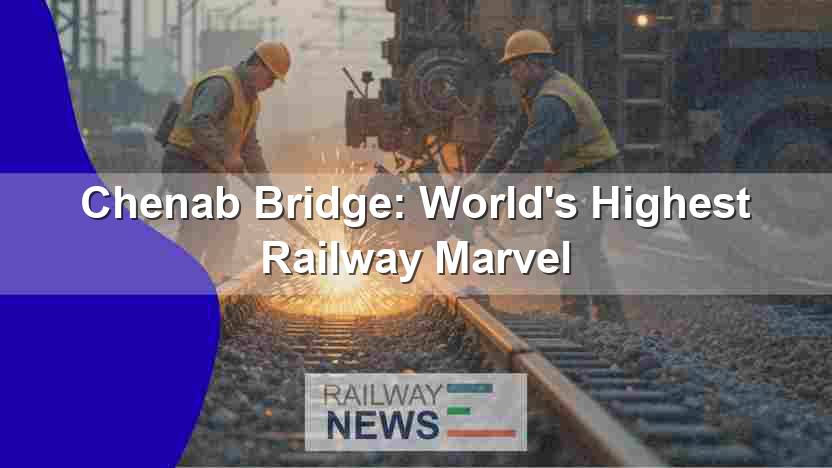
This article explores the remarkable feat of engineering represented by the Chenab River Bridge, currently under construction as part of the Udhampur-Srinagar-Baramulla Rail Link (USBRL) project in Jammu and Kashmir, India. This project, aiming to connect the Kashmir Valley to the broader Indian railway network, presents significant logistical and engineering challenges due to the region’s rugged terrain and extreme weather conditions. The construction of the Chenab Bridge, the world’s highest railway bridge, stands as a testament to human ingenuity and the unwavering commitment to overcome these obstacles. This analysis will delve into the project’s complexities, highlighting the bridge’s design, construction methods, and the overall impact on the region’s infrastructure and economic development. We will also consider the project’s strategic importance and the logistical challenges inherent in building a structure of this scale in such a demanding environment. Finally, a detailed overview of the project’s completion and future implications will be presented.
Design and Construction Challenges
The Chenab Bridge’s design is a marvel of modern engineering. Suspended 359 meters above the Chenab River, it significantly surpasses the height of the Eiffel Tower. Its arch design, chosen to withstand the region’s seismic activity and high winds, necessitated the use of sophisticated computational modeling and advanced materials. Construction in such a remote and challenging environment presented considerable logistical hurdles. The transportation of materials, the deployment of specialized equipment, and the management of a large workforce at high altitudes required meticulous planning and execution. The project also faced challenges related to extreme weather conditions, including heavy snowfall and monsoons, demanding robust safety protocols and adaptable construction strategies. The use of innovative techniques and materials, such as high-strength steel and advanced concrete mixes, was crucial in mitigating these risks.
Strategic Importance and Connectivity
The USBRL project, of which the Chenab Bridge is a centerpiece, holds immense strategic importance for India. It aims to provide all-weather rail connectivity to the Kashmir Valley, previously heavily reliant on road transportation, which is frequently disrupted by inclement weather and geopolitical factors. This improved connectivity will not only enhance the region’s accessibility but also stimulate economic growth through increased trade, tourism, and improved access to essential goods and services. The project contributes to national integration, strengthens regional connectivity and opens up numerous development opportunities for the region. The completed rail link will significantly reduce travel time and transportation costs, benefiting both residents and businesses.
Project Phases and Progress
The USBRL project has been strategically divided into three sections for efficient implementation. The Udhampur-Katra and Banihal-Baramulla sections are operational, while the Katra-Banihal section, the most challenging part of the project, which includes the Chenab Bridge, is nearing completion. The completion of the arch bottom of the Chenab Bridge marks a significant milestone. The project involves extensive tunneling, with a substantial portion already completed. The project’s adherence to its schedule, despite encountering numerous logistical and environmental challenges, speaks to the efficient project management and engineering expertise involved.
Economic and Social Impact
The completion of the USBRL project, including the Chenab Bridge, promises a transformative impact on the Jammu and Kashmir region. Improved connectivity will stimulate economic activities, fostering growth in tourism, trade, and industry. It will provide better access to education, healthcare, and employment opportunities for the local population. The project’s positive social impact is expected to improve the overall quality of life for residents of the region. Moreover, the construction itself has generated significant employment opportunities, benefiting local communities. The long-term economic benefits are expected to outweigh the considerable initial investment.
Conclusion
The completion of the arch bottom of the Chenab Bridge represents a monumental achievement in engineering and infrastructure development. This remarkable structure, standing as the world’s highest railway bridge, overcomes significant geographical and logistical challenges. The bridge is a critical component of the USBRL project, aiming to revolutionize connectivity to the Kashmir Valley. The project’s strategic importance extends beyond infrastructure development, encompassing national integration, economic growth, and social progress. The meticulous planning, innovative engineering solutions, and robust project management demonstrated throughout this undertaking serve as a model for future large-scale infrastructure projects. The project’s successful completion will not only transform the lives of the people of Kashmir but also serve as a testament to the power of human ingenuity and the transformative potential of ambitious infrastructure development. The long-term socio-economic benefits, combined with improved regional connectivity and national integration, solidify the Chenab Bridge as a symbol of progress and a landmark achievement in modern railway engineering. The successful execution of this complex project demonstrates the capacity of Indian Railways to tackle even the most formidable engineering challenges, setting a new benchmark for ambitious infrastructure development worldwide. The project highlights the synergy between technological innovation, strategic planning, and efficient project management in realizing a vision of national development and connectivity.

Railway infrastructure, rolling stock and transport technologies specialist focused on global rail industry developments, high-speed rail systems, signaling technologies and freight transportation. Covering railway investments, public transport modernization, rail operations and international mobility projects across Europe, Asia and North America.
RELATED POSTS

September 5, 2026 4:19 pm
CPK launched formal tender talks with four consortia to design...

September 5, 2026 7:14 pm
HS2 Ltd signed renegotiated civils contracts with EKFB and Align...

September 6, 2026 4:12 am
Alstom delivered the first of 100 new G Class trams...
September 5, 2026 6:17 pm
Universal Signalling won a deal to install its U-Cross system...
September 6, 2026 8:17 am
DB InfraGO reopened the Nuremberg-Regensburg line in Bavaria on 31...
September 6, 2026 12:20 pm
Indian Railways ordered a probe after a fire destroyed 2...